

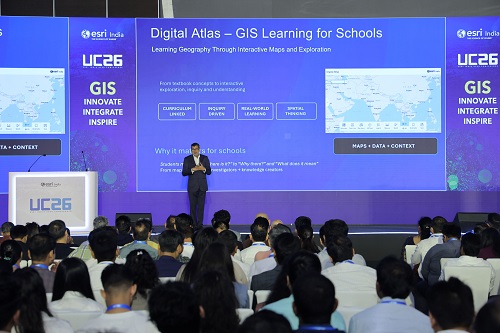
Esri India, the market leader in Geographic Information System (GIS) software, location intelligence, and mapping solutions in India, has launched its Digital Atlas Program, an initiative designed to make geography education more engaging and impactful for school studentsSupported through ArcGIS Online, the Digital Atlas Program is available free of cost to schools across India.
 |
Esri India Launches Digital Atlas Program for Schools
With curriculum-relevant content and ready-to-use resources, the program is aimed to help teachers create learning experiences that spark curiosity, encourage exploration, and connect classroom concepts to real-world situationsIt will enable students to ask questions and find answers, discover the world beyond the textbook, and turn their discoveries into creative projectsBy exploring relationships between people, places, and the environment, students will develop a deeper and more connected understanding of geographyThe aspiration is to move students from being map users to map investigators, and eventually, knowledge creators.
Agendra Kumar, Managing Director, Esri India, said, “Through the Digital Atlas Program, we want to make geography learning more engaging for school studentsThe vision is to have students see geography differentlyInstead of simply asking, ‘Where is it?’, students can start asking, ‘Why is it there?’, ‘What is connected to it?’, ‘What does this pattern tell me?’, and even, ‘What could happen next?’ For example, while learning about urban flooding, their questions can become more inquiry-driven, such as, ‘Where did the flooding take place?’, ‘Why did it happen?’, ‘How many people were impacted?’, ‘What could cause flooding to happen again?’, ‘What can be done to prevent it?’, and so onThe Digital Atlas Program brings together maps, data, and context to drive this kind of inquisitivenessImportantly, since the program is curriculum-linked, it makes learning geography exciting right in the classroom.”
GIS is becoming increasingly integral to how we understand and address the challenges of a rapidly changing worldToday’s students are the future of our country, and nurturing spatial thinking through school education can enable them to view real-world challenges from a geographic perspective from an early ageThe Digital Atlas Program is not just about teaching students to use mapsIt is about developing spatial thinkingIt builds on Esri India’s experience of working with schools, colleges, and universities to introduce students to GIS and geospatial technologies.