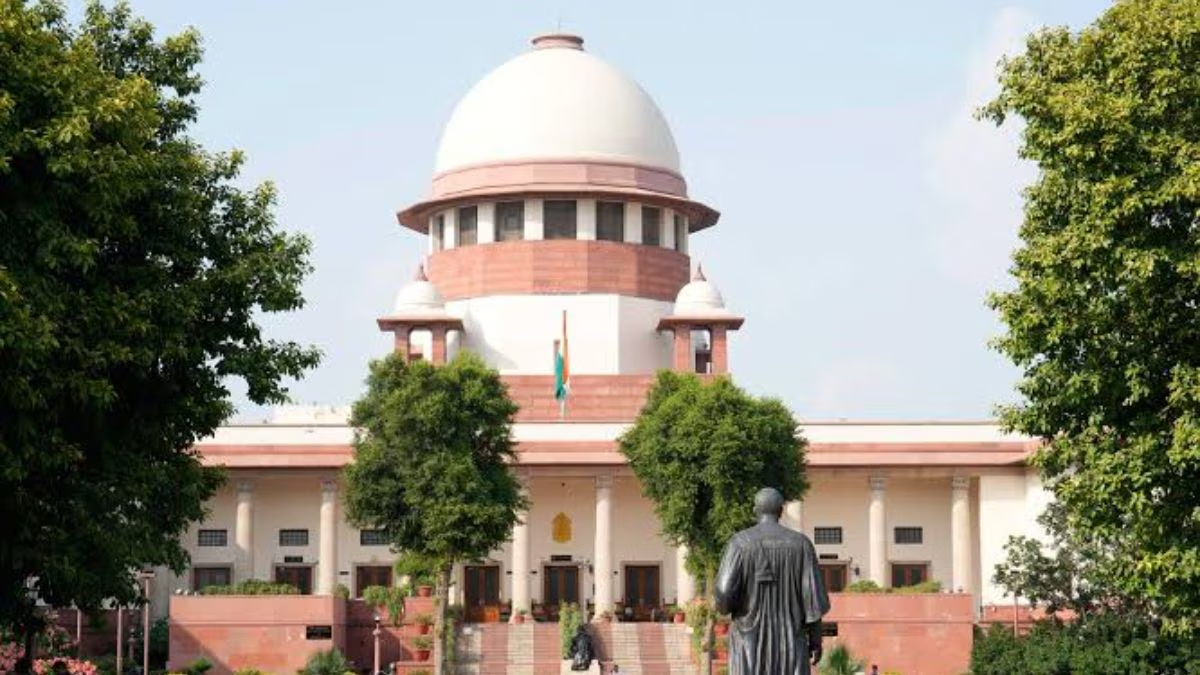
The Supreme Court will start hearing a batch of petitions seeking to criminalise marital rapeAppearing on behalf of the Centre, Solicitor General Tushar Mehta said that criminalising marital rape is the job of Parliament, not the Supreme Court.
Published: September 9, 2026, 5:52 PM IST
Share Article
https://www.india.com/news/india/criminalising-marital-rape-falls-under-parliaments-domain-centre-tells-supreme-court-8520582/
The petitions challenge Exception 2 to Section 63 of the Bharatiya Nyaya Sanhita, which retains the exception for marital rape that was earlier part of Section 375 of the Indian Penal CodeFile image/PTI
The Centre argued before the Supreme Court on Wednesday that criminalising marital rape falls within the powers of the legislature and executive, not the judiciary.
The Supreme Court will start hearing a batch of petitions seeking to criminalise marital rape after three weeksThe bench of CJI Surya Kant and Justices Joymalya Bagchi and V Mohana directed that the case be listed for final hearing on Wednesdays and Thursdays.
Appearing on behalf of the Centre, Solicitor General Tushar Mehta said that criminalising marital rape is the job of Parliament, not the Supreme Court.
The petitions challenge Exception 2 to Section 63 of the Bharatiya Nyaya Sanhita, which retains the exception for marital rape that was earlier part of Section 375 of the Indian Penal Code.
The provision says sexual intercourse or sexual acts by a man with his own wife, provided she is not under 18, do not constitute rapeObserving that the safety and physical security of women are indeed crucial issues, Justice Bagchi asked whether the State defines this as rape or not.
Also Read | Supreme Court forms panel to probe police use of force on July 20 at CJP protest
“A woman subjected to involuntary sexual intercourse [in marriage] is undoubtedly a victimWe will protect victimsOnly question is whether State defines it as rape,” Justice Bagchi askedJustice Bagchi also observed that marriage cannot mean the ‘extinction of a woman’s autonomy’.
The Court said that it will examine two questions: one, whether a prosecution can be sustained even if the marital rape exception survives, and two, whether the exception itself is constitutionally valid.
Senior Advocate Karuna Nundy, appearing for one of the petitioners, argued that if a husband inflicts grievous injury on his wife, he cannot claim legal immunity simply on the grounds of the marital relationship.
Also Read | Relief for Imran Khan’s family: Pakistan ex-PM meets Bushra Bibi, sister following Supreme Court order
Nundy contended that the marital relationship does not grant a person the licence to engage in sexual acts against the wife’s will or to inflict severe physical harm upon herThe central government had earlier stated in its affidavit that it is not in favour of making marital rape a distinct criminal offence.
The Centre has raised concerns that criminalising marital rape could undermine the institution of marriage and impact relationships between spousesIt has argued that cases involving sexual relations within marriage should be handled under existing laws, rather than being treated on the same footing as conventional rape.