E20 offers a higher octane rating, cleaner combustion, improved acceleration, and lower emissions, which can offset some of the trade-offs.
Published: July 28, 2026, 9:32 AM IST
Share Article
https://www.india.com/news/india/e20-petrol-modi-government-nitin-gadkari-parliament-monsoon-session-hardeep-singh-puri-petroleum-natural-gas-suresh-gopi-ethanol-niti-aayog-oil-corporation-iocl-8485994/
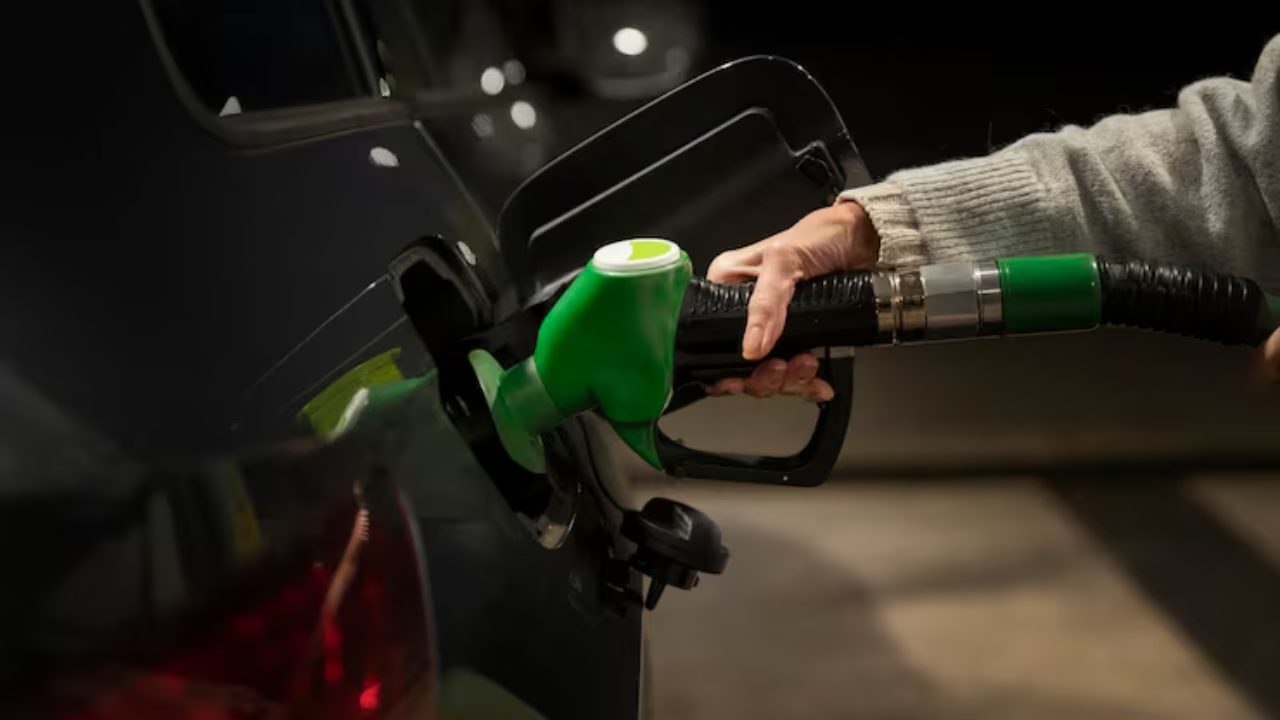
Image for representational purposes
New Delhi: In a significant development, the Modi government on Monday shared an important update in Parliament, stating that it has not conducted any assessment to determine how many vehicles in India are fully compatible with E20 fuel. Minister of State of Petroleum and Natural Gas Suresh Gopi, while responding to a question, said that no study has been carried out to estimate the number of vehicles that are fully compatible with E20 petrol.
However, he added that the ethanol blending program is backed by scientific studies as well as consultations with automobile manufacturers and technical institutions. The minister further said that available studies and industry data indicate that ethanol-blended fuel is safe for use. The minister replied, “The Ministry of Heavy Industries (MHI) has informed that no such assessment has been carried out by it.”
EBP Programme Backed by Scientific Validation
It is important to note there is no estimate is available on the number of E20-compatible vehicles in the country. The government said that the Ethanol Blended Petrol (EBP) Programme was introduced through a phased, scientifically validated, and consultative process.
The process involved consultations with key stakeholders, including the NITI Aayog, automobile manufacturers, Oil Marketing Companies (OMCs), the Automotive Research Association of India (ARAI), the Society of Indian Automobile Manufacturers (SIAM), the Indian Institute of Petroleum (IIP), and other technical institutions.
As per the government’s reply, the laboratory studies and field trials conducted by ARAI, SIAM, Indian Oil Corporation (IOCL), the Indian Institute of Petroleum (IIP), and automobile manufacturers evaluated several aspects, including engine durability, drivability, startability, corrosion resistance, material compatibility, emissions, and fuel efficiency.
The Modi government said that the studies found no significant change in vehicle performance or any abnormal wear and tear in older vehicles running on E20 fuel. As per the reply, the E15+ petrol has been in widespread use for more than three and a half years, while E19–E20 fuel has been used for over two and a half years.
During this period, more than 200 million two-wheelers and over 30 million petrol cars have operated on these fuel blends. The government said there is no verified evidence of widespread engine failures or vehicle damage caused by ethanol blending.
It also cited manufacturers’ service data, which showed no unusual corrosion, excessive wear and tear, or reduction in vehicle lifespan linked to E20 fuel.
Here are some of the key details:
- The Modi government said that vehicle manufacturers continue to honor warranty commitments for vehicles using E20 fuel.
- On fuel economy, it noted that vehicles originally designed for E10 petrol may experience a mileage reduction of around 3-5 percent when running on E20 fuel.
- E20 offers a higher octane rating, cleaner combustion, improved acceleration, and lower emissions, which can offset some of the trade-offs.
- According to data presented in Parliament, one major automobile manufacturer serviced 28.4 million vehicles during FY 2025–26.
- Of these, around 15 million vehicles were not originally certified as E20-compatible.
The company reported no cases of corrosion, abnormal wear and tear, or reduced component life attributable to the use of E20 fuel. Another manufacturer monitored 14 million vehicles that had been using E20 fuel over an extended period and similarly found no evidence of ethanol-related corrosion or damage.