

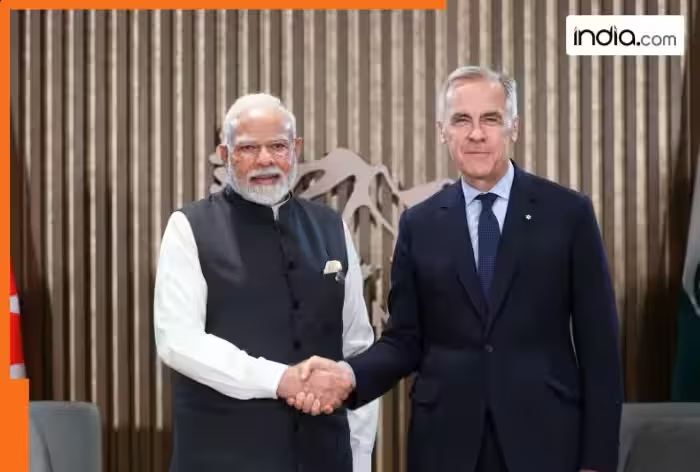
Carney’s India visit aims to rebuild trust, boost trade, secure energy and minerals, and strengthen long-term people-to-people ties.

Published: February 27, 2026 7:15 PM IST
Add India.com as a Preferred Source
Many families in India will feel happy if this visit helps forget the years of mistrust and harsh exchanges between the Modi government and Mr Carney’s predecessor Justin Trudeau. Trudeau’s last trip to India for the G-20 Summit in 2023 was especially awkward because of disagreements over the Khalistan issue. That matter had made talks very tense.
After leaving India on Monday evening, Mr Carney will fly straight to Australia. There he will discuss defence, security of the seas, critical minerals, trade and advanced technologies like artificial intelligence with Australian Prime Minister Anthony Albanese. He will also speak inside the Australian Parliament. From Australia he goes to Tokyo to meet Japan’s newly re-elected Prime Minister Sanae Takaichi.
This India visit comes only one month after Mr Carney’s trip to Beijing. In China he met President Xi Jinping and Premier Li Qiang and fixed many old problems. Canada and China restarted normal trade, opened visa services again so people can travel easily, and made rules softer for Chinese electric vehicles.
At the same time Canada’s relations with the United States have hit a rough patch. US President Donald Trump put tariffs and Canada replied with its own. Last year Mr Trump even called Canada the “51st state” of America, which upset many Canadians.
Now the big question: will relations between India and Canada really improve? Signs look good. Mr Carney, a man who understands business, is keeping politics aside and focusing on practical gains. India too wants strong partners to grow faster. In today’s changing world both countries need new friends. Signing real deals on energy and minerals can create lasting links that go beyond words.
How much does India depend on Canada? Not a lot overall, but in a few important things it matters. Canada sends us pulses like lentils and peas that become dal on millions of Indian plates every day. If supply dips, prices in your local market can jump and pinch family budgets. Canada also has uranium for our nuclear power plants that give clean electricity to homes and factories. A new ten-year uranium deal worth nearly 2.8 billion dollars is likely soon. Canada’s critical minerals help India make batteries and tech without depending only on one country. We also get some oil, wood pulp and fertilisers from there that support our farms.
How much does Canada depend on India? Again not huge, but growing nicely. India sends affordable medicines that help Canadian families pay less when someone falls ill. Our machines, auto parts, clothes and jewellery fill Canadian shops. Indian IT experts quietly keep Canadian banks and offices running smoothly. Total goods trade was about 13 billion dollars in 2024. Add services and it touches 30 billion dollars. Canada wants to double this to 70 billion dollars because it sells almost all its energy to America and now needs other big markets like India.
One very important link is education. For many Indian families, sending their children to study in Canada is a cherished dream. Indian students make up nearly 40 per cent of all international students admitted to Canadian universities and colleges. At their peak, these bright young Indians brought around 22 billion Canadian dollars every year into Canada’s economy through college fees, house rent, food, shopping and travel. This money supports thousands of jobs in education, housing, restaurants and transport sectors. Many Indian graduates also work there and help fill labour shortages in tech and healthcare. However, numbers have dropped sharply in 2025 due to new rules, causing billions in losses for Canada. Better ties can help bring back this important flow of talent and money.
Analyst’s Note
Looking at it like a seasoned watcher of world affairs, the choice of Bharat Mandapam for the India-Canada CEO Forum on Monday carries deep meaning. This is the same grand hall where the relationship hit its lowest point during the 2023 G20 Summit. Using that very place now to sign fresh deals sends a powerful and hopeful message – both nations have truly moved on from past mistrust and are ready to build a warmer future together. For ordinary homes this means steadier prices for dal and power, more factories giving jobs to young people, cheaper good medicines across the ocean, and companies from both sides growing together. It feels like two neighbours who had arguments now choosing to help each other when the world outside is uncertain. Mr Carney’s four-day visit is like turning a fresh page. Both sides are ready to move forward. People in India and Canada will watch what comes out of these meetings. If the MoUs turn into real work, the benefits will reach kitchens, farms, factories and offices in both countries. Let us hope this trip brings the warmth and growth that everyone wants. (Girish Linganna is an award-winning science communicator and a Defence, Aerospace & Geopolitical Analyst. He is the Managing Director of ADD Engineering Components India Pvt. Ltd., a subsidiary of ADD Engineering GmbH, Germany.)Source link














Leave a Reply