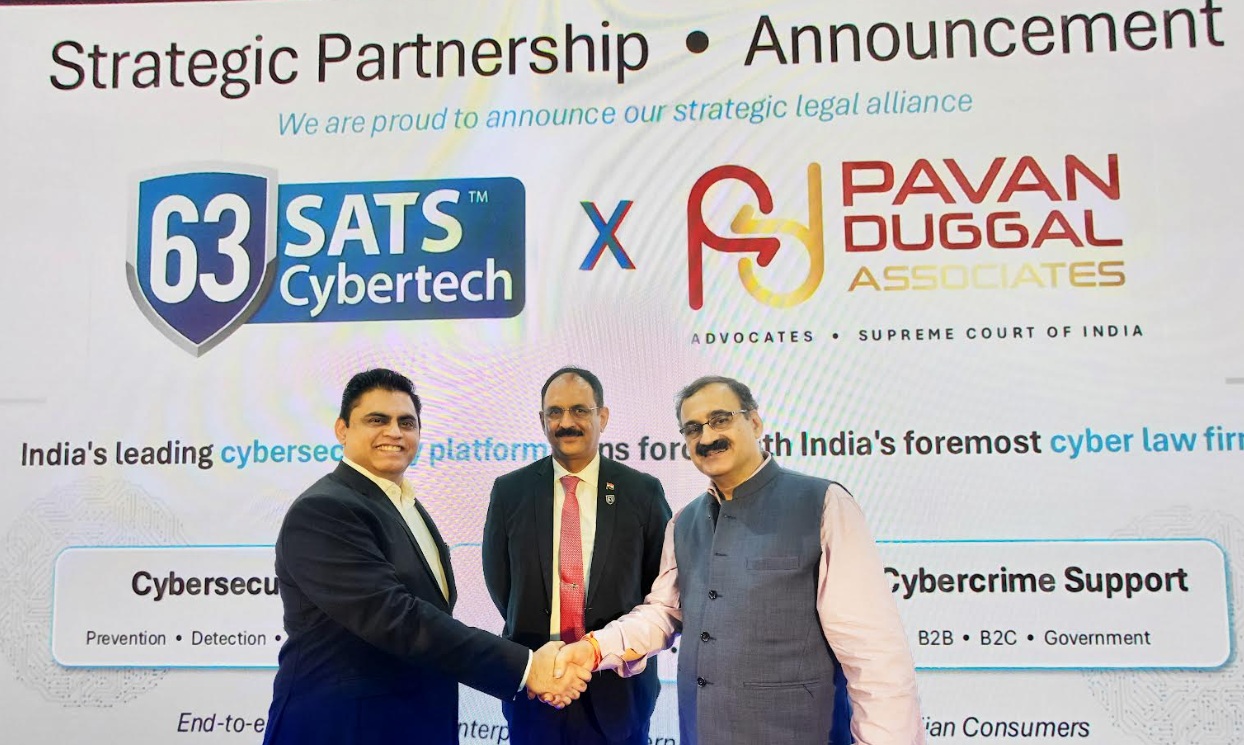
63SATS Cybertech Limited, a subsidiary of 63 moons technologies, one of India’s fastest-growing cybersecurity companies, announced a strategic legal partnership with Pavan Duggal Associates (PDA), India’s most prominent cyber law firm, to build a comprehensive cyber defence platform for consumers, enterprises, and critical infrastructures.
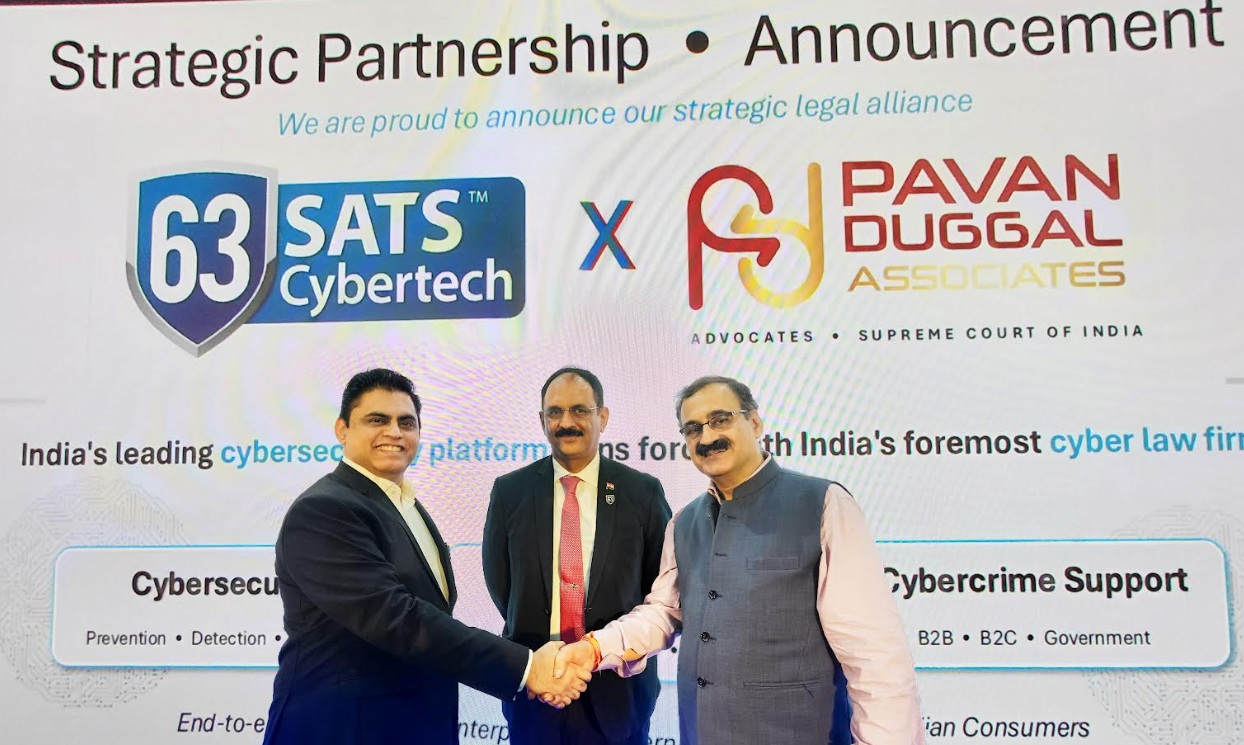 |
63SATS Cybertech MD & CEO Neehar Pathare joins hands with Dr. Pawan Duggal for a strategic alliance in front of 63SATS Chairman Lt. Gen M U Nair during CyberSec Expo in Mumbai
Under this alliance, PDA under renowned cyber law expert Dr. Pavan Duggal, Advocate, Supreme Court of India, will serve as the exclusive legal partner to 63SATS across its full spectrum of offerings, powering legal readiness, Digital Personal Data Protection (DPDP) Act compliance, cybercrime prosecution, and cybersecurity advisory for both its B2B and B2C clients.
The Mumbai-based cybersecurity major said the industry-first capability alliance will bring together India’s leading full-stack cybersecurity company and the country’s foremost cyber law firm, delivering end-to-end DPDP compliance, cybercrime response and legal protection for enterprises, governments, and over 1.4 billion Indian consumers.
Both 63SATS Cybertech and PDA will provide clients with complete protection across the entire risk lifecycle – prevention, detection, response, regulatory compliance, legal defence, and recovery.
“Cybersecurity without legal readiness is an incomplete defence. When a breach happens, when a regulator comes knocking, when a consumer is defrauded — our clients need more than technology. They need a partner who stands with them in the courtroom, in front of the regulator, and in the public domain. Dr. Pavan Duggal and his team are, without question, the finest cyber law practice in India. Together, we are building something India has never had before — a single, unified shield that protects enterprises, governments and consumers across the entire risk spectrum,” said Neehar Pathare, Managing Director, CEO & CIO, 63SATS Cybertech.
This alliance will address a long-standing gap in the Indian market. Organisations hit by a cyber incident have historically been forced to navigate fragmented responses — one partner for incident response, another for compliance, a third for legal action. 63SATS and PDA will deliver all through one integrated and accountable engagement.
“The DPDP Act, the rise of AI-driven cyber threats, and an increasingly aggressive cybercrime landscape have made it clear — the line between cybersecurity and cyber law has collapsed. Indian businesses and citizens need a partner who can operate on both sides of that line with equal authority. 63SATS has built exceptional technology depth across enterprise, government, and consumer markets. Our partnership creates a benchmark for the industry, one that the country has long needed,” said Dr. Pavan Duggal, Founder & Chairman, Pavan Duggal Associates.
The company said the collaboration spans all three 63SATS business lines. The alliance will provide enterprises with legal advisory on managed security services, VAPT, Red Team engagements, incident response, contractual risk, and liability limitation for Indian and global enterprise clients.
The collaboration will support governments through their specialised legal counsel on cyber policy, national security frameworks, law enforcement coordination, and public-sector cyber defence mandates.
The partnership will focus on B2C and B2B2C through end-to-end cybercrime reporting and prosecution support for consumers of the CYBX Super App, India’s first cybersecurity super app with integrated cyber insurance, which recently crossed 1 million downloads on the Google Play Store.
The pact will address the Digital Personal Data Protection Act, 2023, and associated rules, offering integrated legal interpretation, compliance strategies, and technology implementation for organisations across fintech, healthcare, e-commerce, BFSI, and critical infrastructure.
63SATS Cybertech, along with PDA, will also provide legal frameworks for AI-driven cybersecurity, blockchain, digital assets, and intellectual property arising from its proprietary IP portfolio.