

- Of US consumers surveyed, 58% say they are paying attention to ingredients.
- Forty-five percent of Brazilians have used AI to recommend beverages in the past year compared with 27% in the US.
- Fifty-two percent of US consumers are willing to pay more for beverages that support their health and wellness goals.
Wellness plays a crucial role in beverage selection, with consumers increasingly treating beverages as “tools” for wellbeing. Ingredients, sugar content and functional benefits now sit at the center of both choice and premiumization.According to the survey, 58% of US consumers say they are paying attention to ingredients in the drinks they purchase, and 52% are willing to pay more for drinks that support health and wellness goals. Sugar is still a key ingredient in the conversation, with 66% choosing lower sugar, lower calorie drinks.In Brazil, health benefits extend beyond hydration, with three out of four consumers citing immune support as a top benefit influencing functional beverage purchase intent.“Consumers are rewriting the rules of the beverage aisle. Wellness isn’t a niche segment but a baseline expectation shaping formulation, claims and pricing strategy. For beverage companies, the winners will be those that deliver clear benefits, build trust through transparency and meet consumers where decisions are increasingly made across apps, social channels and personalized, data-led experiences,” said Rob Holston, EY Global and Americas Consumer Products Sector Leader. “Brands must design for multiple definitions of wellness.”Digital discovery and artificial intelligence (AI) influence trial and loyalty
Digital ecosystems have become primary gateways for beverage discovery, influencing both awareness and repeat purchase. Consumers increasingly rely on digital tools to explore functional beverages, including online grocery recommendations (19%), fitness and health apps (17%), and loyalty apps (16%), with Gen Z reporting higher digital usage (26%) compared with other generations.Brazil shows even faster adoption: 45% of consumers used AI‑based beverage recommendations in the past year (compared with 27% in the US), and 70% say they are very likely to use them next year, with the highest enthusiasm among millennials.Generational shifts are redefining beverage culture
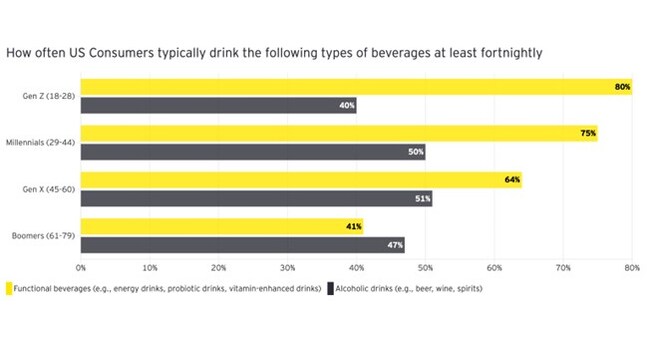
The survey finds that consumption patterns diverge across generations, reshaping both alcohol and nonalcoholic categories. In the US, social pressure to drink alcohol persists (20%), yet functional beverage consumption is surging, with 80% of Gen Z and 75% of millennials drinking alcoholic beverages at least every two weeks compared with 65% overall. The survey shows alcohol consumption in Brazil remains high (57% drink at least every two weeks), but Gen Z consumes significantly less (47%) than older cohorts, reflecting a cultural shift toward moderation and alternative beverage choices.The energy drink category also highlights the generational divide in the US, with more than half of Gen Z (53%) and almost half of millennials (47%) consuming energy drinks at least every two weeks compared with 34% overall.Harapko notes, “As beverage choices are so uniquely personal, so should be the experience of discovery and purchasing. In order for brands to succeed, they must embrace an innovation ecosystem and insights engine that allows them to proactively identify and define market trends and determine opportunities for both engagement and growth with their core consumers.”More information from the EY Consumer Beverage survey is available at https://www.ey.com/en_us/industries/consumer-products/wellness-trends-shaping-the-future-of-beveragesSurvey methodology
Online survey of 2,512 adults (18+) in the US (1,511) and Brazil (1,001), fielded November 20 through December 11, 2025; weighted to census representation; margin of error approximately ±2.5% US and ±3.1% Brazil.Notes to editorsAbout EYEY is building a better working world by creating new value for clients, people, society and the planet, while building trust in capital markets.Enabled by data, AI and advanced technology, EY teams help clients shape the future with confidence and develop answers for the most pressing issues of today and tomorrow.EY teams work across a full spectrum of services in assurance, consulting, tax, strategy and transactions. Fueled by sector insights, a globally connected, multidisciplinary network and diverse ecosystem partners, EY teams can provide services in more than 150 countries and territories.All in to shape the future with confidence.EY refers to the global organization, and may refer to one or more, of the member firms of Ernst & Young Global Limited, each of which is a separate legal entity. Ernst & Young Global Limited, a UK company limited by guarantee, does not provide services to clients. Information about how EY collects and uses personal data and a description of the rights individuals have under data protection legislation are available via ey.com/privacy. EY member firms do not practice law where prohibited by local laws. For more information about our organization, please visit ey.com.This news release has been issued by EYGM Limited, a member of the global EY organization that also does not provide any services to clients.Julia Menefee
EY US Media Relations
+1 850 228 2182
[email protected]SOURCE EY

Source link









Leave a Reply