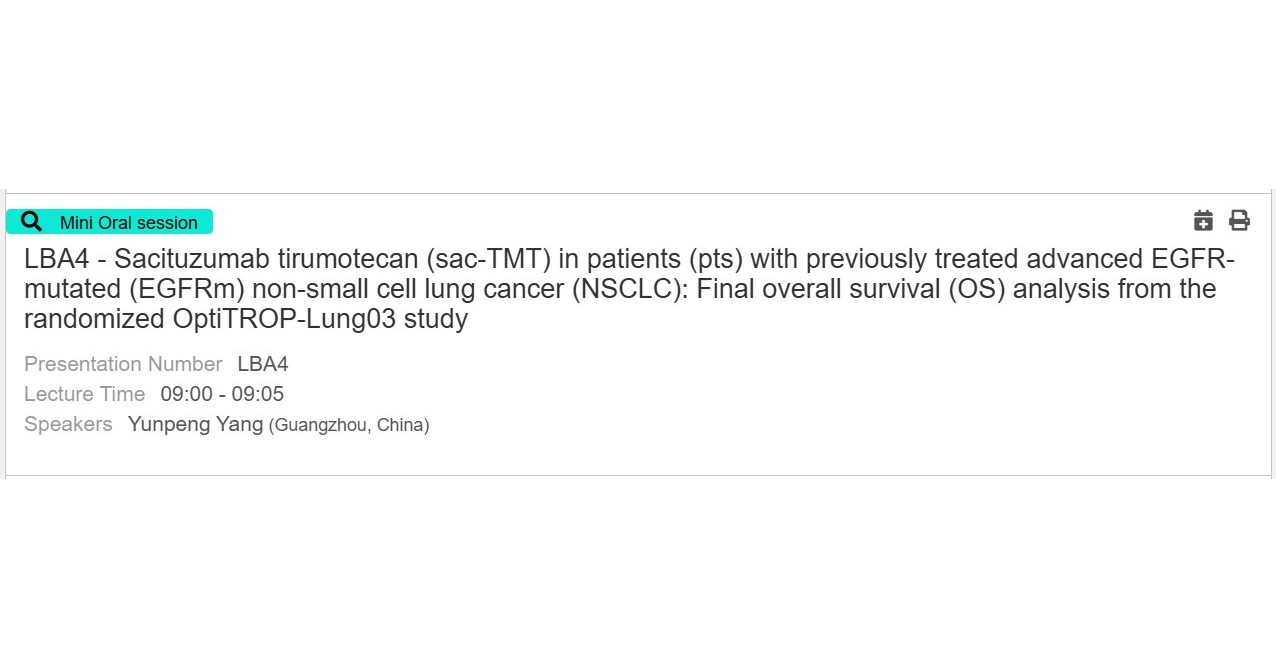
CHENGDU, China, March 18, 2026 /PRNewswire/ — The 2026 European Lung Cancer Congress (ELCC) will be held in Copenhagen, Denmark, from March 25 to 28, 2026 (local time). At this congress, the final OS analysis from the pivotal study (OptiTROP-Lung03) of sacituzumab tirumotecan (sac-TMT, also known as SKB264/MK-2870) (佳泰莱®), a TROP2 ADC developed by Sichuan Kelun-Biotech Biopharmaceutical Co., Ltd. (“Kelun-Biotech” or the “Company”, 6990.HK), has been selected as a Late-Breaking Abstract (LBA) (Presentation Number: LBA4). Professor Yunpeng Yang from the Sun Yat-sen University Cancer Center will present the findings to the global research community during a Mini Oral Session. The abstract was published on the ESMO Open.
The OptiTROP-Lung03 study was designed to evaluate the efficacy and safety profile of sac-TMT monotherapy (5 mg/kg every other week) versus docetaxel for the treatment of patients with locally advanced or metastatic EGFR-mutant NSCLC who have previously treated with an EGFR-TKI and platinum-based chemotherapy. Previously reported results presented at the ASCO 2025 meeting in 137 randomized participants demonstrated that sac-TMT achieved statistically significant and clinically meaningful improvements in progression-free survival (PFS) and overall survival (OS) compared to docetaxel——the hazard ratio (HR) for BICR-assessed PFS was 0.30 (95% CI: 0.20–0.46, one-sided p<0.001) and HR for OS was 0.49 (95% CI: 0.27–0.88, one-sided p=0.007)[1]. Based on these positive results, sac-TMT received approval from the National Medical Products Administration (NMPA) for this indication, which has also been included in China’s National Reimbursement Drug List (NRDL).
At the 2026 ELCC, the final OS analysis, along with updated PFS and additional data from the OptiTROP-Lung03 study will be presented. As of December 11, 2025, the median follow-up was 23.8 months. Key highlights are as follows:
In the docetaxel control group, 41.3% of patients crossed over to receive sac-TMT after disease progression.
Considering the impact of OS from crossover treatment in the control group, adjusted and analysed by the pre-specified rank-preserving structural failure time (RPSFT) model, the median OS was 20.0 months in the sac-TMT group vs 11.2 months in the docetaxel group (HR 0.45, 95% CI: 0.28–0.73), with 18-month OS rate of 54.7% vs 9.1%. Without adjustment for subsequent sac-TMT treatment in the control group, median OS was 20.0 months vs 13.5 months (HR 0.63, 95% CI: 0.40–0.98).
Median PFS assessed by investigators (INV) was 7.9 months vs 2.8 months (HR 0.23, 95% CI: 0.15-0.35).
Notably, based on another study, the OptiTROP-Lung04 study, sac-TMT has been approved by the NMPA for the treatment of advanced or metastatic EGFR-mutant NSCLC after progression on EGFR-TKI therapy, with the findings concurrently published in The New England Journal of Medicine[2]. In this study among the EGFR-mutant NSCLC population who have progressed after prior EGFR-TKI and platinum-based chemotherapy, sac-TMT demonstrated a statistically significant and clinically meaningful increase in overall survival,with a median OS of 20 months. The consistent positive findings from two pivotal registrational studies further reinforce sac-TMT’s leading position in the treatment landscape for pre-treated EGFR-mutant NSCLC, offering a more definitive and long-term survival benefit option for patients with advanced lung cancer.
About Sac-TMT
Sac-TMT, a core product of the Company, is a novel human TROP2 ADC in which the Company has proprietary intellectual property rights, targeting advanced solid tumors such as NSCLC, breast cancer (BC), gastric cancer (GC), gynecological tumors, among others. Sac-TMT is developed with a novel linker to conjugate the payload, a belotecan-derivative topoisomerase I inhibitor with a drug-to-antibody-ratio (DAR) of 7.4. Sac-TMT specifically recognizes TROP2 on the surface of tumor cells by recombinant anti-TROP2 humanized monoclonal antibodies, which is then endocytosed by tumor cells and releases the payload KL610023 intracellularly. KL610023, as a topoisomerase I inhibitor, induces DNA damage to tumor cells, which in turn leads to cell-cycle arrest and apoptosis. In addition, it also releases KL610023 in the tumor microenvironment. Given that KL610023 is membrane permeable, it can enable a bystander effect, or in other words kill adjacent tumor cells.
In May 2022, the Company licensed the exclusive rights to MSD (the tradename of Merck & Co., Inc, Rahway, NJ, USA) to develop, use, manufacture and commercialize sac-TMT in all territories outside of Greater China (which includes Mainland China, Hong Kong, Macao and Taiwan).
To date, four indications for sac-TMT have been approved and marketed in China for: EGFR mutant-positive locally advanced or metastatic non-squamous NSCLC following progression on EGFR-TKI therapy and platinum-based chemotherapy; unresectable locally advanced or metastatic TNBC who have received at least two prior systemic therapies (at least one of them for advanced or metastatic setting); EGFR mutant-positive locally advanced or metastatic non-squamous NSCLC who progressed after treatment with EGFR-TKI therapy; unresectable or metastatic HR+/HER2- (IHC 0, IHC 1+ or IHC 2+/ISH-) BC who have received prior ET and at least one line of chemotherapy in advanced setting. The first two indications listed above have been included in China’s National Reimbursement Drug List (NRDL). This inclusion is expected to bring clinical benefits to a greater number of patients with BC and NSCLC. Additionally, sac-TMT has been granted six Breakthrough Therapy Designations (BTDs) by the NMPA.
Sac-TMT is the world’s first TROP2 ADC drug approved for marketing in lung cancer. As of today, Kelun-Biotech has initiated 9 registrational clinical studies in China. MSD is evaluating 17 ongoing Phase III global clinical studies of sac-TMT as a monotherapy or with pembrolizumab or other anti-cancer agents for several types of cancer. These studies are sponsored and led by MSD.
About Kelun-Biotech
Kelun-Biotech (6990.HK) is a holding subsidiary of Kelun Pharmaceutical, which focuses on the R&D, manufacturing, commercialization and global collaboration of innovative biological drugs and small molecule drugs. Kelun-Biotech focuses on major disease areas such as solid tumors, autoimmune, and metabolic diseases, and in establishing a globalized drug development and industrialization platform to address the unmet medical needs in China and the rest of world. Kelun-Biotech is committed to becoming a leading global enterprise in the field of innovative drugs. At present, Kelun-Biotech has more than 30 ongoing key innovative drug projects, of which 4 projects with 8 indications have been approved for marketing, more than 10 projects are in the clinical stage. Kelun-Biotech has established one of the world’s leading proprietary ADC and novel DC platforms, OptiDC™, and has 2 ADC projects with 5 indications approved for marketing, and multiple ADC and novel DC assets in clinical or preclinical research stage. For more information, please visit https://en.kelun-biotech.com/.
Reference:
[1] Fang W, Li X, Wang Q, et al. Sacituzumab tirumotecan versus docetaxel for previously treated EGFR-mutant advanced non-small-cell lung cancer: open label, randomised, multicentre trial[J]. BMJ. 2025 Jun 5:389:e085680. doi: 10.1136/bmj-2025-085680.
[2] Fang W, Wu L, Meng X, et al. Sacituzumab Tirumotecan in EGFR-TKI-Resistant, EGFR-Mutated Advanced NSCLC[J]. NEJM. 2026 Jan 1;394(1):13-26. doi: 10.1056/NEJMoa2512071. Epub 2025 Oct 19.















Leave a Reply