The claims and objections process, initially scheduled to close on September 30, has been extended under the revised SIR scheduleClaims and objections can now be filed till October 30, their disposal will be completed by November 30, and the final electoral roll will be published on December 4.
Share Article
https://www.india.com/news/india/delhi-sir-minority-heavy-south-east-district-sees-most-form-7-applications-seeking-deletion-of-names-8531733/
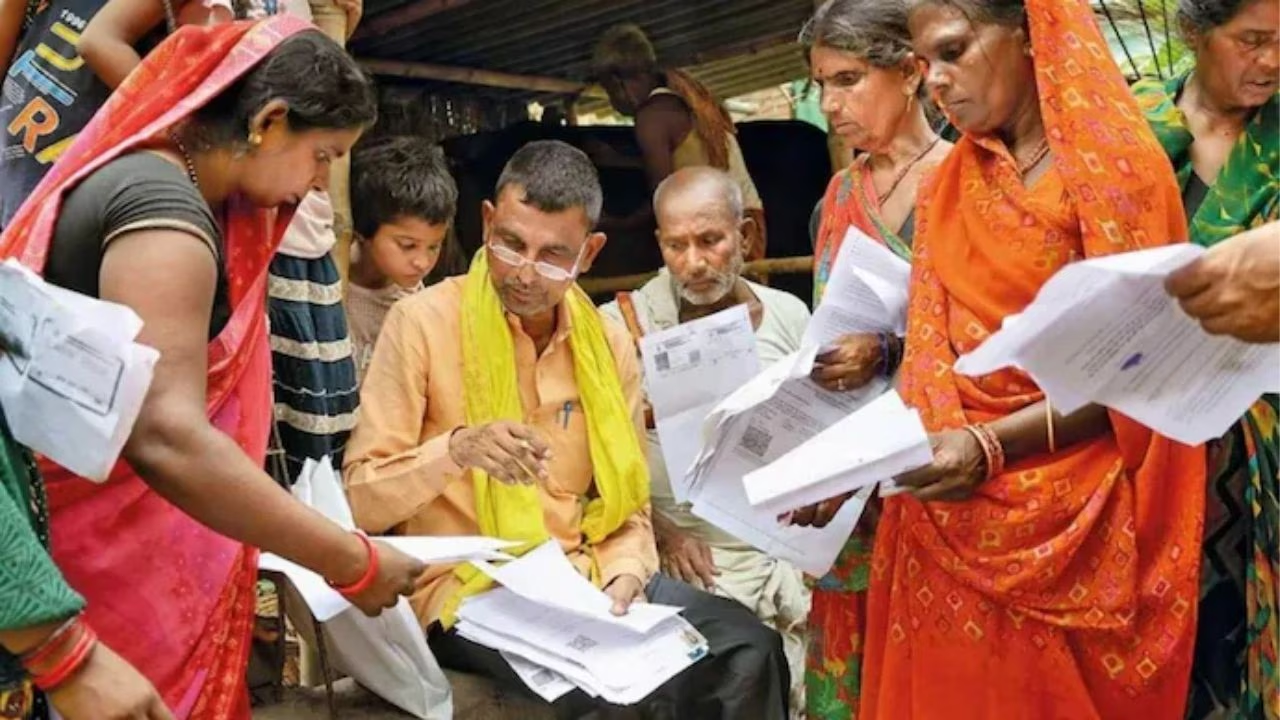
Image for represenatational purposes
New Delhi: South East Delhi, home to several constituencies with sizeable minority voters, recorded the highest number of Form 7 applications seeking deletion of names or objecting to electoral entries during the ongoing SIR, according to official data.
The district recorded 15,409 Form 7 applications, including 14,659 filed up to August 30 and 750 between August 31 and September 29North Delhi followed with 11,719 such applications, while West recorded 9,331, South West 2,994 and North East 2,878, the data showed.
The Form 7 filings come against the backdrop of substantial exclusions from the draft electoral roll published on August 31 under the SIR exerciseOf the previous electorate of 1.45 crore in the national capital, 47.56 lakh names were left out after the house-to-house enumeration exercise, leaving about 97.5 lakh electors in the draft roll.
The constituency-level data also showed significant exclusions in several seats with sizeable minority population.
Okhla, which is part of South East Delhi, recorded 45 per cent exclusion at the draft stage, the highest among the top seven such constituenciesChandni Chowk recorded 38 per cent exclusion, followed by Ballimaran at 32 per cent, Mustafabad at 28 per cent, Babarpur at 26 per cent, Matia Mahal at 24 per cent and Seelampur at 23 per cent.
An electoral registration officer (ERO) in South East district said his constituency had received 151 Form 7 applications in about a month since publication of the draft electoral roll, with most filed by individuals.
He said Form 7 applications were mainly filed in cases involving voters who had died or permanently shifted, while shifting the residence of an existing voter was generally dealt with through Form 8.
In areas affected by demolition and relocation, however, voters who moved elsewhere could subsequently have their names deleted from the old location and enrolled at their new address, he added.
The ERO cited the demolition of camps in Govindpuri as an example, saying some residents were allotted flats while others moved elsewhere, resulting in deletions from the earlier location and enrolment at their new addresses.
“First the BLO goes for physical verification and attaches a reportAfter that, the application comes to us and a notice is issued,” he said.
The data has come amid reports of political party-appointed booth-level agents (BLAs) submitting more than the prescribed 10 Form 7 applications a day, raising questions about the process through which such objections are filed and verified by election officials.
Poll officials said that BLA-2s submit their claims separately in hard copy on party letterheads and that such applications are processed separately from those submitted by individuals.
“BLA-2s don’t submit applications directly on the websiteThey give claims in hard copy on their party letterhead, and those are processed separately,” an ERO claimed.
The clarification comes as Form 7 applications cannot by themselves be treated as confirmed deletions from the electoral rollOfficials said each application is subject to physical verification, notice to the concerned elector and a hearing before a deletion is processed.
The Election Commission’s Form 7, however, does not have a separate field requiring an applicant to identify themselves as a BLA or specify their political partyThe form asks for the applicant’s name, EPIC number and contact details, besides the details of the elector against whom the objection is being raised and the reason for seeking deletion or objecting to an inclusion.
At the same time, South East Delhi recorded 40,901 Form 6 applications seeking inclusion in the electoral roll, the second-highest among Delhi’s districts after West Delhi’s 48,572.
North East district recorded 39,298 Form 6 applications, followed by North West with 38,370 and East with 36,860Of the Form 6 applications in South East Delhi, 24,923 were filed up to August 30 and another 15,978 between August 31 and September 29.
Across Delhi, Form 6 applications totalled 3,72,729, while Form 7 applications stood at 55,095.
The Election Commission’s guidelines state that a Form 7 objection can be made on grounds including death, the elector being underage, absent or permanently shifted, already enrolled elsewhere, or not being an Indian citizenThe applicant is required to make a declaration that the information furnished is true to the best of their knowledge and that a false declaration is punishable under Section 31 of the Representation of the People Act.
Officials said Delhi recorded around 33 per cent exclusion at the draft stage, the highest percentage among states and Union Territories where the SIR exercise has been undertaken.