

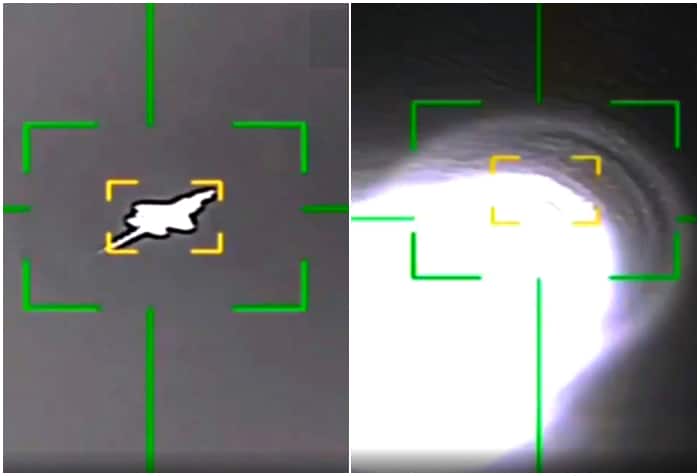
US-Iran War: In a major development amid the escalating conflict between the United States and Iran, Tehran on Friday claimed that F-35, US’s most advanced stealth fighter jet – was hit by Iranian

Published: March 20, 2026 1:55 PM IST
Add India.com as a Preferred Source
Factor this – the F-35 is the acme of US aerospace capabilities. It is the product of a trillion-dollar program. But now, a “decimated” Iran has shown that the state-of-the-art jet has certain vulnerabilities.HOW DID IRAN HIT US F-35 FIGHTER JET? But how did a stealth aircraft, specifically designed to evade radar, get hit? Defence expert Sandeep Unnithan said the so-called stealth technology was a “misnomer”.“Company brochures may claim it is totally invisible to radar. But there are other ways to get detected. One of them is through heat. It is exactly what happened on Thursday,” Unnithan told IndiaToday.in.While it is not known what missiles the Iranians used, it was a loitering munition, specifically the 358 anti-aircraft missile, or a short-range surface-to-air missile.The 358 missile, also known as the SA-67, is a kind of loitering drone equipped with an infrared sensor that can target slow-moving aircraft. But the F-35 is not a slow-moving jet. Previously, Iran has used the 358 missile to target American MQ-9 Reaper drones. Iran has also supplied these missiles to the Houthis in Yemen.In fact, since the war began on February 28, the US has reportedly lost over 12 MQ-9 Reaper drones.HOW THE EVENT MAY HAVE UNFOLDED?
So what happened on March 19? Unnithan hypothesised that the missile homed in on the F-35 using an infrared search and track (IRST) system after detecting the jet’s heat signature.This is itself very significant. It points to the fact that while the F-35 is radar invisible, it is vulnerable to the infrared spectrum.Engines of such advanced aircraft produce a lot of heat. After all, the F-35 is a single-engine aircraft that generates an enormous amount of heat. Systems like the IRST can pick up this heat and track the aircraft without using radar.This is what likely happened on Thursday, Unnithan said.“One of the most sanctioned countries on Earth was able to detect, lock on to, and hit an F-35. I don’t think most people understand that the world has just changed,” tweeted a geopolitical expert who goes by the name Adam on X.
WHEN US NIGHTHAWK WAS SHOT DOWN IN 1999?
Parallels of Thursday’s incident can be drawn to the 1999 shooting down of the US’s stealth F-117 Nighthawk. The attack aircraft, then the most-advanced in the world, was introduced in the early 1990s, and it also participated in the first Gulf War in 1991.Like the F-35, the Nighthawk was a state-of-the-art stealth aircraft and literally invisible to radar. In March 1999, it was deployed over Serbia during NATO’s bombing campaign in Yugoslavia. That is when a Soviet-era surface-to-air missile, developed in the 1960s, shot down the aircraft. How it was done is a story in itself. We will leave that for later.WHAT F-35 JET INCIDENT MEANS FOR IRAN WAR?
However, the broader picture is the implication the F-35 jet incident will have on the Iran war. The US and Israel have been suggesting that they have decimated Iranian air defences after 20 days of fighting.Based on that assessment, the US deployed its B-1 and B-2 bombers, which do not have stealth capabilities. These are only deployed when the US is assured of air superiority over enemy airspace.The likely take-down of an F-35 jet indicates Iran’s defences might still be effective. It is likely to force the US and Israel to reassess their operations over Iran. Its jets may have to fly higher and deploy more effective air-to-ground weapons.The military planners have to spend a lot more money and resources in identifying Iranian ground-based air defence systems.“It is a very big moment. It may be just one aircraft, but it will have a significant bearing on the Iran war,” Unnithan asserted.
Source link

Leave a Reply