

PWD officials said traffic movement from Mayur Vihar towards AIIMS has now been opened for commutersThe carriageway from AIIMS towards Mayur Vihar will be opened by Thursday afternoon, further facilitating smooth movement of traffic on the corridor.
Share Article
https://www.india.com/news/india/barapullah-phase-3-traffic-jam-mayur-vihar-aiims-ashram-sarai-kale-khan-dnd-loop-delhi-mumbai-expressway-ashram-extension-maharani-bagh-road-8532912/
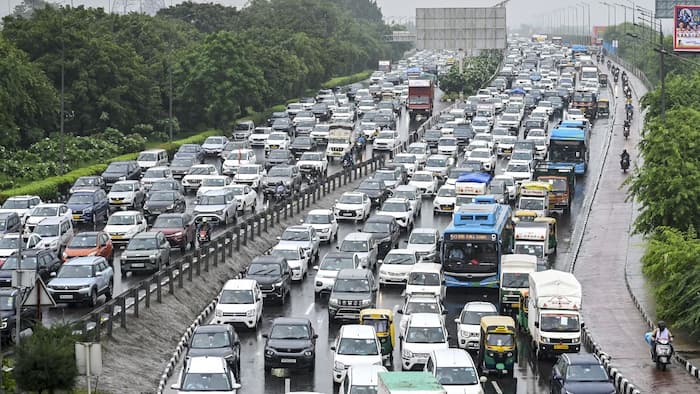
After the IMD forecast heavy rain and strong winds, several parts of Delhi-NCR have been witnessing intermittent showers since Saturday morningRepresentational Image
New Delhi: Commuters once again witnessed severe traffic congestion on the Mayur Vihar-to-AIIMS carriageway of Barapulla Phase-3 in South Delhi on Monday morning after three days of reliefTo ease congestion along this 3.5-kilometre stretch, the authorities have deployed traffic police personnel at all major pointsHowever, the problem on the Mayur Vihar-to-AIIMS carriageway remains unchanged.
It is important to note that the traffic on roads across Delhi remained relatively light during the three-day period as government and private offices and establishments remained closed on Gandhi Jayanti, the first Saturday, and SundayAfter the three-day holiday, traffic pressure on Delhi’s roads has once again increased.
Here are some of the key details:
- The stretch from Ashram to Sarai Kale Khan, as well as the lane from Mayur Vihar towards AIIMS, is witnessing severe traffic congestion.
- According to the traffic police, the three-lane road coming from the Mayur Vihar side extends up to Sarai Kale Khan.
- Beyond that, the road from Sarai Kale Khan to AIIMS narrows down to just two lanes.
- Traffic from Sarai Kale Khan via the loop, as well as traffic from the DND Loop, Delhi-Mumbai Expressway, Ashram Extension and Maharani Bagh Road via the slip road, merges onto this stretch while heading towards AIIMS.
- As a result, severe traffic congestion is being witnessed.
- According to the traffic police, motorists will start receiving real-time traffic updates on Google within the next two days.
- Installing signals and fixing the merging points could take more than a week.
- Additional staff are being deployed to regulate and manage traffic.
Commuters report 3-km-long traffic jam on Barapullah Phase-III stretch day after opening
To recall, motorists faced heavy traffic congestion on the newly-opened Barapullah Phase-III elevated corridor, a day after it was inaugurated to cut travel-time between east and south DelhiSeveral commuters said traffic from Mayur Vihar Phase-1 towards the Sarai Kale Khan was crawling, with a tailback nearly 3 km long.
A commuter said he was stuck for about 40 minutes while travelling from Mayur Vihar Phase-1 towards central Delhi during the afternoonAnother said it took 55 minutes to reach the first intersection point of the flyover.
Others said the promised travel-time reduction from Mayur Vihar Phase-1 to AIIMS, was far from visible on the first day of operationalisation of the elevated corridor.
Responding to complaints on social media platform X, Delhi Traffic Police said the congestion on the corridor from Mayur Vihar had been “noted on priority”Officers have been directed to step up regulation at critical merging and exit points, strengthen deployment and clear the build-up quickly.
Police said the traffic pattern on the new corridor was being assessed and corrective measures would be taken to improve flow.
“The congestion reported on the newly-opened Barapullah Phase-III corridor, including the tailback from the Mayur Vihar side, has been noted on priorityTraffic officers have been directed to intensify regulation and strengthen deployment at critical merging and exit points,” a traffic officer said.
Experts had cautioned before the opening that the flyover — meant to offer an alternative to the Delhi-Noida Direct (DND) flyway — could add to congestion near Sarai Kale Khan.
The corridor links Mayur Vihar Phase-1 on Noida Link Road to Sarai Kale Khan on Ring RoadIt merges with the existing Barapullah network to form a continuous, signal-free stretch of about 9 km up to the AIIMS roundaboutIt was expected to ease traffic on the DND and Akshardham stretches.