
MSMEs must move faster in adopting quality processes and build quality into every stage of their operations, from design and manufacturing to delivery, to become stronger contributors to India’s global competitiveness, emerged as a key message on Day 2 of the third edition of the IFQM Symposium 2026 in New Delhi.
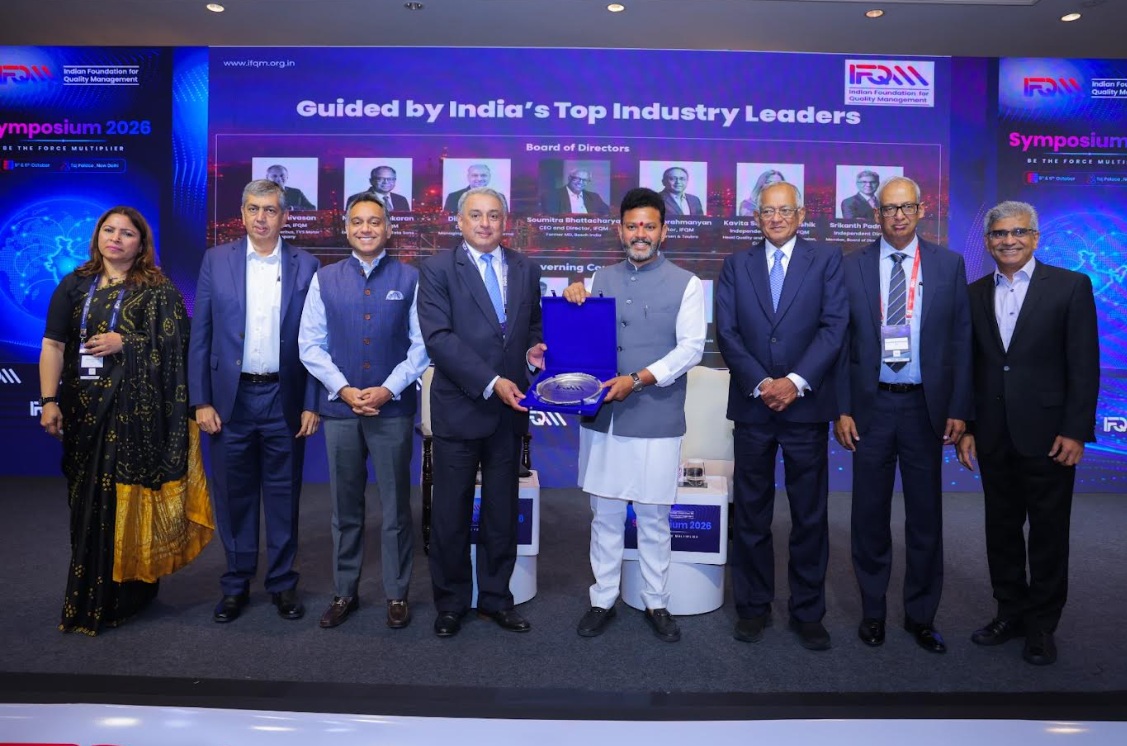 |
Shri Kinjarapu Rammohan Naidu, Hon’ble Minister of Civil Aviation, Government of India with GC members of IFQM
The second day of the symposium focused on translating the quality and innovation agenda into action, with discussions around strengthening MSME capabilities, building industry–academia partnerships, developing talent and leveraging technology to improve productivity and competitivenessAs part of this effort, IFQM announced plans to roll out a leadership programme for MSMEs and subsequently extend a similar programme to large industries, with a focus on sharing best practices, reducing waste, improving quality and driving innovation through education and continuous learning.
Delivering the keynote address on “Wings of Viksit Bharat: Transforming India into a Global Aviation Hub,” Shri Kinjarapu Rammohan Naidu, Hon’ble Minister of Civil Aviation, Government of India, emphasised the need to strengthen India’s aviation manufacturing ecosystem and develop capabilities across the supply chain.
He said, “The ultimate goal is to make aircraft in IndiaThe government is committed to providing policy support for the aviation sector, especially for MROPrime Minister Shri Narendra Modi has set a target of 350 airports by 2047; we are working to achieve itBut we need to strengthen aviation manufacturing in IndiaThe industry needs to understand the importance of material quality; we need more people and more clusters; we also need skilling, from design to the factory floorIt has to be reflected in the Indian aviation sector.”
The Minister also called upon global OEMs to bring together their supply-chain partners and MSMEs through collective industry forumsHe urged companies such as Boeing and Airbus, etc to lead discussions with Indian MSMEs on the requirements of the aviation industry, noting that clarity on product and quality specifications would enable MSMEs to better plan, innovate, design and manufacture to global standardsHe also highlighted the role that institutions such as IFQM can play in facilitating this collaboration.
IFQM, established by a consortium of India’s leading enterprises, is an industry-led movement committed to catalysing Indian organisations to become globally competitive and export-capable through Quality, Innovation and ExcellenceThe Foundation is focused on strengthening the capabilities of Indian industry, including MSMEs, through initiatives that promote quality, innovation and sustainable development in line with the nation-first objectives of Viksit Bharat.
From Quality Intent To Measurable Action
The two-day symposium brought together senior industry leaders, policymakers, global quality experts, CEOs, CXOs, academia and MSMEs to explore how India can leverage its scale, technology and human capital to build globally competitive enterprises.
In his concluding remarks, MrVenu Srinivasan, Chairman, IFQM, emphasised that quality must become a personal commitment across leadership and organisationsHe said, “Our shared responsibility is to build India’s reputation and make it synonymous with QualityQuality must be a personal commitment from the leadersChange begins at the topTo build a world-class company, innovation has to be continuous; follow the standardsBe willing to make mistakes and learn to correct them quicklyDaily discipline has to be part of the work.”
Highlighting the critical role of MSMEs in India’s growth, he added, “MSMEs are the foundation of any country, and vibrant MSMEs are key to the country’s successIFQM’s single-minded purpose is to make 5,000 MSMEs part of quality and innovation and to become part of a nationwide movementCaring and sharing is a critical journeyOur commitment is to make quality a habit; it should start at home.”
MrSoumitra Bhattacharya, CEO and Director, IFQM, highlighted the organisation’s ambition to scale its MSME engagement and turn collective industry participation into measurable actionHe said, “We create USPs and turn plans into actionWe had 200-plus MSMEs; we are looking at 500-plus, and the next target is 1,000-plus MSMEsHow can we use our members and non-members as force multipliers? We need to create a burning platform and work together, contribute, cooperate and participate.”
MrT.VNarendran, CEO & Managing Director, Tata Steel, emphasised the need to build momentum and a critical mass around qualityHe said, “We need to create momentum, create a critical mass, and the mindsetIndustry-academia tango has to happen for real success and quality in the MSME ecosystemTo build a quality culture, we need to go beyond CEOs; there are many ways to influence it.”
MrK.NRadhakrishnan, Director & CEO, TVS Motor Company, stressed the need to accelerate the transformation of MSMEs into process-driven organisationsHe said, “I believe there is a lot to doAs an example, how to transform the 132 MSMEs that TVS Motors has released, in the next 90 daysTransforming Indian companies to be process-drivenIntensify the CEO connect sessions; the more we share, the more we achieve.”
Building Quality and Governance Across Sectors
Day 2 featured four keynote addresses that explored how organisations can strengthen their understanding of customers, challenge existing systems and processes, and use both successes and failures as opportunities to improve quality.
The discussions brought together industry leaders around themes including “Creating Force Multipliers for the Industry-led Movement,” “Quality to Credibility: Building Trust at Global Scale,” “Instilling a Culture of Quality Excellence: Boardroom to Shopfloor,” “From Incremental to Breakthrough: Reimagining Kaizen at Scale,” “Deploying AI for Manufacturing and Services,” and “Strengthening Partnerships Globally.”
DrMasahiko Mori, President & Group CEO, DMG MORI, highlighted the importance of understanding customer needs and using real-world data to improve products and solutionsHe said, “Customers’ culture is also important, and understanding it is key to acquiring and retaining customersGathering data from the customer site is very criticalUsing the data, the company can customise the software for customers’ requirements.”
Speaking on the importance of leadership commitment to continuous improvement, MrYugo Miyamoto, Managing Director, Kaizen Saudi Arabia, Abdul Latif Jameel, said, “Kaizen must become a necessity for the CEONot something the CEO supports, not something the CEO sponsors and leads with personal commitment and not something they occasionally visitA necessity.”
MrStefan Grosch, Member of the Board of Management and Director of Industrial Relations, Robert Bosch GmbH, highlighted the importance of quality governance and shared his perspective on the alignment between IFQM and global quality movementsHe said, “My experience with EFQM (European Foundation for Quality Management) has helped me understand the IFQM visionWe understand the quality governance process to help customers achieve their set goals.”
AI: A Challenge And Opportunity For Msmes
The growing role of artificial intelligence in manufacturing and services was another key area of discussion, with the symposium examining how organisations can move from experimentation to meaningful adoption.
The panel, moderated by MrGirish Krishnamurthy, MD & CEO, Tata Technologies, and featuring DrGopichand Katragadda, Founder & CEO, Myelin Foundry, and DrLucas Bretz, General Manager, KIT/GAMI, explored whether industry’s understanding of AI is evolving from experimentation into a more mature discipline.
The discussion highlighted the distinction between Core AI—the intelligence layer—and Operational AI, where AI is embedded into workflows and decision-makingWith Large Language Models increasingly changing how organisations learn, operate and use technology, the panel emphasised that AI adoption must be viewed as an operating-model opportunity rather than only a technology upgrade.
For MSMEs, however, barriers to adoption remain significantThe discussion highlighted the opportunity for an IFQM-led platform that can curate, validate and simplify AI solutions for MSMEs, enabling them to use AI as a practical force multiplier rather than viewing it as a distant or complex technology.
Strengthening Global Partnerships
The symposium also reinforced IFQM’s focus on building global partnerships to accelerate India’s quality and innovation journey.
Delivering a special address on “Strengthening Partnerships Globally: IFQM and JUSE Collaboration,” MrMasato Onodera, Managing Director, JUSE, emphasised the importance of a two-way exchange of knowledge and experience between India and JapanHe said, “We want to keep this timeline going from Japan to India and from India to JapanIt will be a two-way relationship where we learn from each other and build value together.”
Building Momentum For India’s Quality Movement
Over two days, the IFQM Symposium 2026 brought together around 50 CEOs, 200 CXOs, and a total participation of more than 400 including academicians and students representatives from government, industry, academia, global quality institutions and MSMEs to advance a common agenda for India’s competitiveness.
The discussions reinforced the need for India to move from scale to excellence, from intent to adoption, and from individual organisational initiatives to a broader industry-led movement for Quality and InnovationWith MSMEs at the heart of India’s economic growth and global supply chains, the symposium highlighted the need to equip them with the right capabilities, partnerships, talent and technology to build quality into the way they design, manufacture and deliver.
The symposium also underscored that India’s journey towards Viksit Bharat will require quality to become more than a process or metric—it must become a culture, a leadership commitment and a way of working across the country’s enterprises and supply chains.
About IFQM
Instituted in the year 2023, IFQM is the Indian Foundation for Quality Management ( IFQM) that is committed to the promotion of transformative changes across Indian industriesIt seeks to institutionalize a culture of quality that meets and exceeds global standardsIt is about bringing in continuous improvements of both products and services, thereby elevating the perception about Brand IndiaCommitted to the prosperity and quality of life of all, IFQM functions as a catalyst in making Indian businesses globally respected with cooperative trust, respect, empathy, and mutual sharingThrough its initiatives, IFQM supports India’s journey towards becoming a developed nation by 2047, with an emphasis on innovation, excellence, and stakeholder engagement across sectors.
The IFQM Governing Council, MrNChandrasekaran, Chairman, Tata Sons, MrDilip Sanghvi, MD, Sun Pharmaceuticals, MsKiran Mazumdar Shaw, Executive Chairperson, Biocon Biologics, MrTV Narendran, CEO & MD, Tata Steel Limited, MrK.NRadhakrishnan, Director & CEO, TVS Motor Co, DrRandhir Thakur, CEO & MD, Tata Electronics PvtLtd., MrSalil Gupte, President, Boeing India & South Asia, MrSN Subrahmanyan, Chairman & MD, Larsen & Toubro, MrVenu Srinivasan, Chairman Emeritus, TVS Motor Co & Chairman, IFQM
IFQM on Web: ifqm.org.in
IFQM Events: events.ifqm.org.in
IFQM on social media: www.linkedin.com/company/ifqm