To insulate its economy from geopolitical shocks in the Strait of Hormuz, India is executing a multi-pronged overhaul, boosting domestic LPG production to 63,810 tonnes a day, diversifying global contracts and enforcing strict digital distribution rules to guarantee household energy security.
Published: August 17, 2026, 11:28 PM IST
Share Article
https://www.india.com/news/india/strait-of-hormuz-how-india-lpg-png-reshaping-long-term-energy-security-strategy-explained-reliance-ongc-oil-india-gail-8503853/
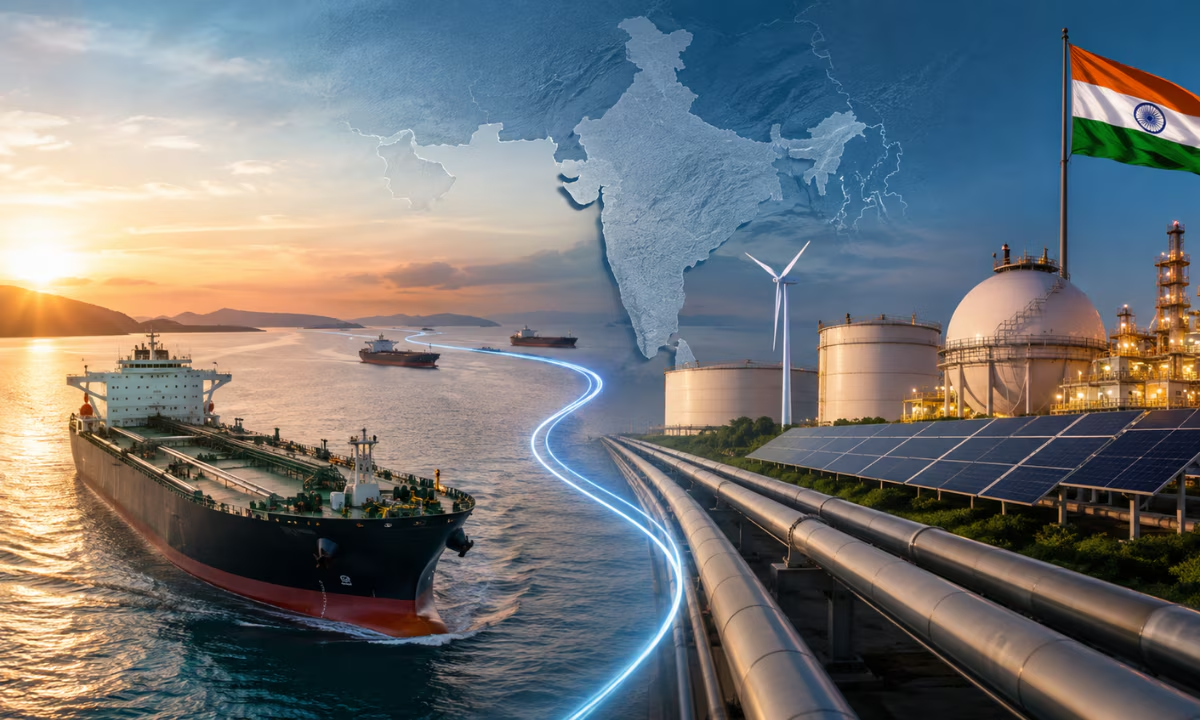
India LPG supplies- Representational AI image
New Delhi: The Indian government has initiated a structural overhaul of its domestic Liquefied Petroleum Gas (LPG) framework to secure energy supplies against geopolitical volatilityHistorically dependent on imports routed through the vulnerable Strait of Hormuz, India is ramping up domestic refining targets, enforcing technical facility upgrades, and diversifying global supply channelsBy establishing higher production floors alongside demand-side digital management, the country aims to transition from reactive crisis management to a resilient, long-term energy security standing.
What is the new order of Petroleum and Natural Gas Ministry?
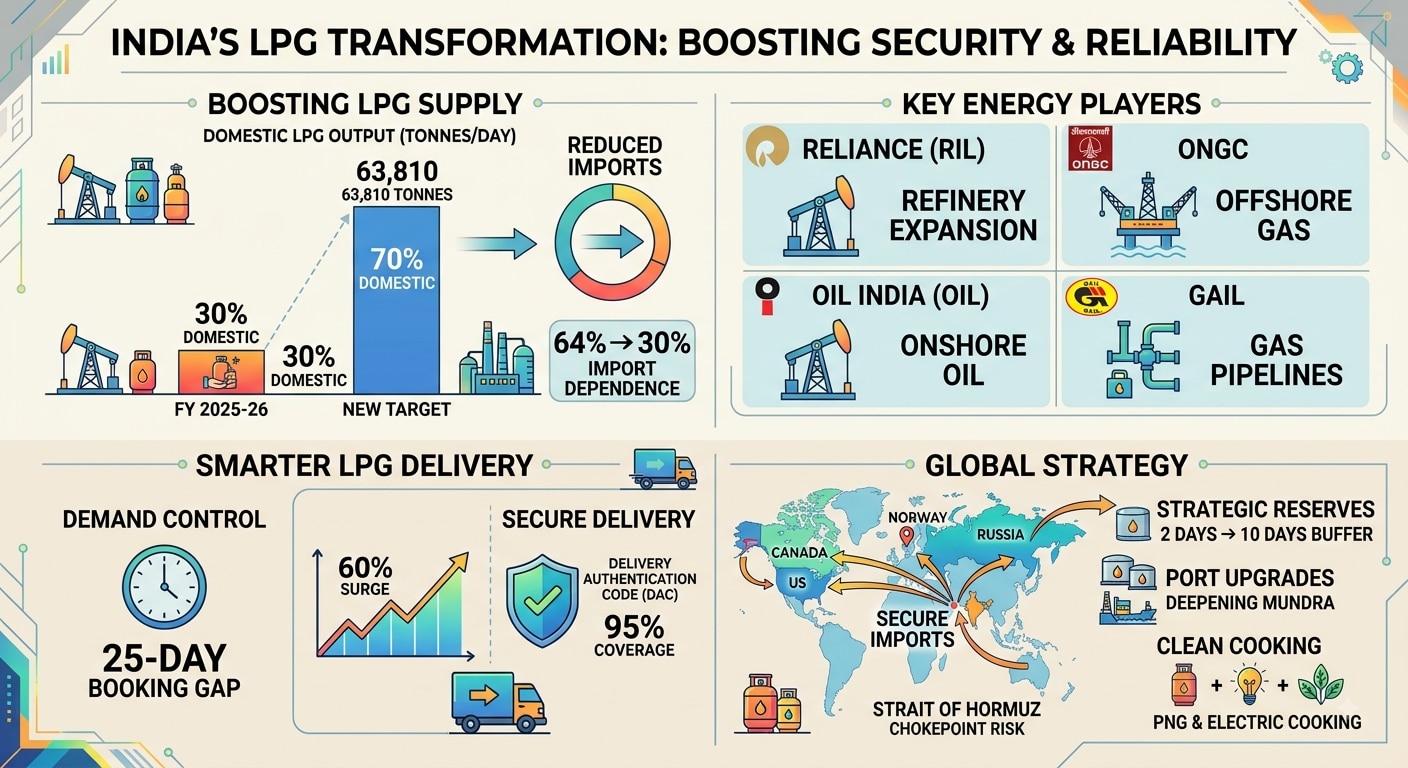
In the recent development from earlier this month, the Petroleum and Natural Gas Ministry, in an order issued on August 13, has specified maximum LPG production levels for 21 refineries and upstream companies, with combined production potential set at 63,810 tonnes a day — more than double the domestic LPG output in the fiscal year ended March 31, 2026 and about 70 per cent of the country’s daily consumption.
India LPG supplies- Gemini Generated Image
The production limits will kick in whenever there is a supply constraintThe lion’s share of the planned output has been set from Reliance Industries Ltd’s older refinery, which would have to produce up to 18,000 tonnes a day of LPG, according to the order.
India consumed 33.2 million tonnes of LPG in the 2025-26 fiscal year (about 91,000 tonnes per day)Of this, 13.1 million tonnes a year was produced locally (about 35,900 tonnes a day) while the remaining 21.3 million tonnes per annum (about 58,400 tonnes a day) was imported.
Impact of raised production targets on LPG supplies
The target of 63,810 tonnes per day is designed to cover ~70% of India’s daily LPG demand (~91,000 tonnes)This more than doubles domestic production from FY 2025–26 (13.1 million tonnes locally vs21.3 million tonnes imported)By raising local coverage to 70%, India slashes its 64% import dependence and curbs exposure to the Strait of Hormuz, which previously handled 90% of importsRefineries are mandated to maintain infrastructure floors, supported by specific quotas like Reliance Jamnagar’s 18,000 tonnes/day and 31,470 tonnes/day across 18 public-sector refineries.
Effect on delivery shortages and lags
Higher volume addresses physical availability, but production alone cannot fix last-mile delivery delays caused by artificial demand spikes (e.g., panic bookings surging 60% in March 2026)Maintaining the standard 2.5-day booking-to-delivery cycle requires combining higher output with demand-side controls:
What is the role of Reliance, ONGC, Oil India and GAIL?
Thes entities like Reliance, ONGC, Oil India and GAIL drive upstream hydrocarbon production needed for LPG extraction:
-
Reliance & ONGC: Extracting gas from unconventional blocks (Sohagpur CBM for RIL; Bokaro CBM and East Coast deep-water fields for ONGC) under market pricing policies like HELP.
-
Oil India (OIL): Developing small discovered fields, exploring shale and acquiring overseas assets like Russia’s Vankor cluster.
-
GAIL: Managing midstream pipeline logistics to transport gas to LPG extraction plants and building City Gas Distribution networks.
What is India’s Long-Term Structural Strategy?
In its long-term strategy, India is bypassing Middle Eastern chokepoints by sourcing non-Middle East cargoes (US, Russia, Norway, Canada), building strategic LPG reserves from 2 to 10 days, upgrading west coast ports like Mundra and accelerating transitions to Piped Natural Gas (PNG) and electric cooking.
To move beyond emergency interventions, India is implementing broader structural reforms to diversify supply and curb baseline demand:
-
Geographic Diversification: Bypassing Middle Eastern chokepoints by contracting spot and term cargoes from the United States, Russia, Norway and Canada.
-
Fuel Transition: Promoting Piped Natural Gas (PNG), induction cooktops, and biofuels to reduce aggregate LPG demand.
-
Strategic Reserves & Port Capacity: Expanding LPG strategic storage from 2 days to 10 days of supply and upgrading deep-water port facilities on the west coast (such as Mundra) to receive Very Large Gas Carriers (VLGCs).