


Some meaningful investment opportunities begin with changes whose impact extends across sectors and company sizesThese long-duration structural shifts, called megatrends, can reshape how India consumes, saves, builds and does business, creating possibilities across established leaders, emerging challengers and specialised companies.
 |
Since inception, the fund has outperformed its benchmark, BSE 500 TRI, by 3.85 percentage points under the Regular Plan and 5.47 percentage points under the Direct Plan
Bajaj Finserv Flexi Cap Fund follows a megatrend investing strategy, pairing this long-term lens with the freedom to invest across large cap, mid cap and small cap companies subject to minimum 65% investment in equity and equity-related instrumentsThe flagship fund of Bajaj Asset Management Limited (formerly known as Bajaj Finserv Asset Management Limited) completed three years since inception on 14 August 2026.
In its journey, the fund has regularly outperformed the benchmarkSince inception, the Regular Growth plan delivered 16.59% annualised returns and the Direct Growth plan delivered 18.21%, compared with 12.74% for its benchmark, BSE 500 TRIOver the last year, the respective returns were 9.85% and 11.26%, against the benchmark’s 4.93%*.
The milestone marks three years of following structural change across sectors and company sizes.
*Source: Internal Analysis, MFI360 and BloombergData as of August 13, 2026Past performance may or may not be sustained in future.
What is a megatrend?
A megatrend is a deep and lasting change in how an economy or society worksIt usually unfolds over many years, cuts across industries and can alter how businesses compete and how people live, work and consumeA trend may dominate headlines for a few quarters; a megatrend can reshape an economy for years.
For instance, digitisation has changed banking, shopping, entertainment, logistics and healthcareRising incomes and urbanisation can influence financial services, housing, travel and discretionary consumptionManufacturing policies, cleaner energy and infrastructure development can open opportunities across industrial businesses and their supply chains.
These forces often reinforce one anotherElectric mobility, for example, sits at the meeting point of technology, regulation, environmental priorities and consumer behaviourIts effects can extend from vehicle makers to component suppliers and charging networksDigital payments offer another example: smartphone adoption, affordable data, payment infrastructure and changing consumer habits have together altered how transactions are made.
Megatrend investing is therefore not one narrow sector callIt can cut across industries, markets and even geographies.
Six lenses for a changing economy
Bajaj Finserv Flexi Cap Fund studies megatrends through its T.R.E.N.D.Sframework: Technological, Regulatory, Economic, Nature, Demographic and Social.
Each lens captures a different source of long-term change:
-
Technological: Advances such as digitisation, automation and artificial intelligence can change how industries operate and deliver products or services. -
Regulatory: Policy and regulatory shifts, including manufacturing and infrastructure initiatives, can reshape industries or create new markets. -
Economic: Structural changes such as financialisation, rising consumption and infrastructure expansion can influence long-term business growth. -
Nature: Environmental priorities such as sustainability, clean energy and cleaner mobility are gaining momentum, and businesses responding to them may be aligned for future growth. -
Demographic: A large working-age population, rising incomes and urbanisation are supporting consumption and economic growth. -
Social: Evolving lifestyles and consumer behaviour, including urbanisation and the growing focus on health and wellness, are creating new patterns of demand across industries.
The portfolio process
Identifying a megatrend is the starting pointThe next step is to determine whether that long-term change can translate into a viable opportunity at the company levelFor fund managers, a company needs to meet the following parameters to be considered for the portfolio:
-
It should be a beneficiary of the trend -
It should offer a monetizable opportunity -
It should have strong fundamentals -
It should be trading at favourable valuations
The investment process begins with a universe of roughly 1,100 stocksApplying the megatrends lens narrows this to around 340 to 380 companies whose businesses may be positioned to participate in one or more of the structural shifts identified through the T.R.E.N.D.Sframework.
Top-down research examines how these shifts may affect economies, industries and value chainsBottom-up analysis then assesses individual companiesThe process also incorporates the AMC’s INQUBE philosophy, combining informational, quantitative and behavioural insights in investment decisionsFrom the screened universe, a portfolio of approximately 40 to 60* holdings may be constructed.
*The number of stocks mentioned is tentative and for understanding purposes only; the final portfolio may hold more or fewer names depending on prevailing market conditionsSource: Internal AnalysisThe data provided in the communication is based on latest available information and is subject to change in futureThe AMC is not responsible for any decision taken based on the data disclosed in the communication.
Flexible approach
A megatrend does not arrive labelled large cap, mid cap or small capA large company may have the resources to scale a new marketA mid-sized business may gain share as an industry expandsA smaller company may own a specialised capability within a developing value chain.
A flexi cap mandate lets the fund manager follow opportunities without maintaining a fixed allocation across market-cap segments subject to minimum 65% investment in equity and equity related instrumentsAs of July 31, 2026, Bajaj Finserv Flexi Cap Fund held 44.17% in large cap companies, 23.02% in mid cap companies and 29.33% in small cap companiesThe allocation reflects the opportunities identified through the investment process rather than a pre-set balance among the three market-cap segments.
The portfolio’s strategic choices extend beyond market cap allocationIts active share against the BSE 500 TRI stood at 70% as of July 31, 2026Active share measures how far a portfolio’s holdings and weights differ from its benchmark, offering an indication of how distinctly it is positioned.
Source: Internal Analysis | Active share is calculated vis-a-vis scheme benchmark i.eBSE 500 TRI | Data as on July 31, 2026.
Conclusion
At three, Bajaj Finserv Flexi Cap Fund has established a distinct investment identity: megatrends provide the direction, while flexi cap investing provides the freedom to pursue their beneficiaries across company sizes and sectors.
For investors with a long horizon and the ability to accept equity market fluctuations, the fund brings several engines of structural change into one portfolioStructural changes can advance unevenly, and the companies positioned to benefit from them can change over timeThe fund’s flexi cap mandate allows the portfolio to adjust as those opportunity sets evolve.
Investors can invest in Bajaj Finserv Flexi Cap Fund through a lump-sum investment or a Systematic Investment Plan (SIP)After completing the applicable KYC requirements and carefully reviewing the scheme-related documents, investors may invest through the official website of Bajaj Asset Management Limited, an authorised mutual fund distributor or an eligible third-party investment platform or appInvestors should consider their investment objectives, time horizon and risk appetite before investing.
Past performance may or may not be sustained in future.
Mutual Fund investments are subject to market risks, read all scheme related documents carefully
|
|
|
|
|
|
|
|
|
|
|
|
|
|
|
|
|
|
|
|
|
|
|
|
|
|
|
|
|
|
|
|
|
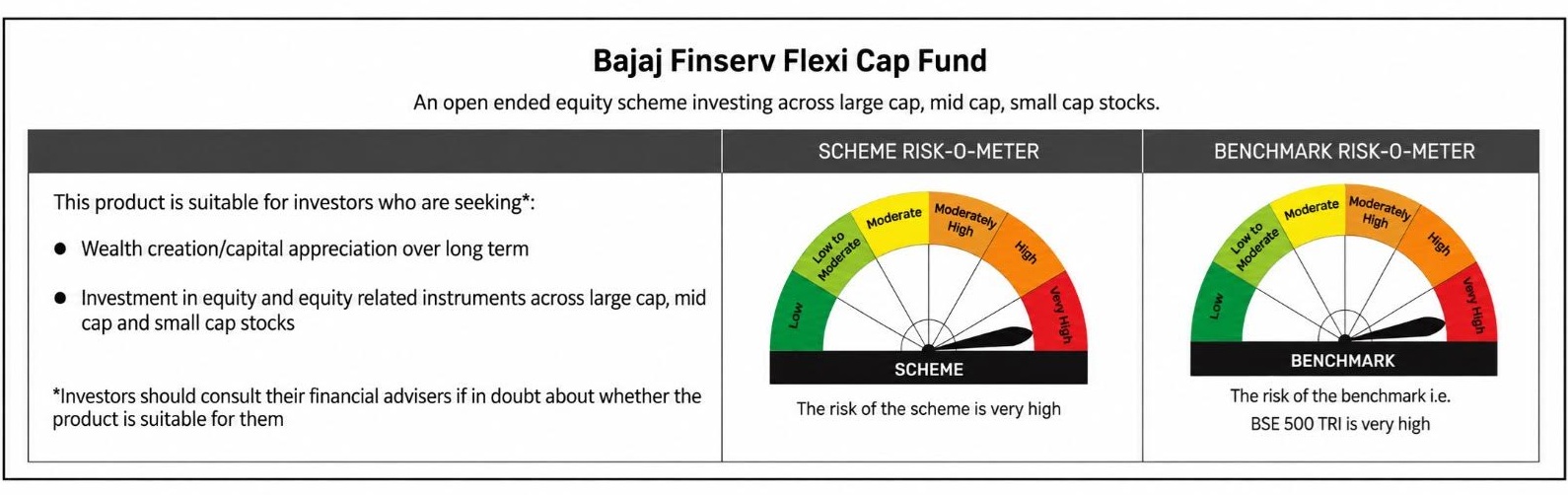 |
Bajaj Finserv Flexi Cap Fund
|
|
|
|||||
|
|
|
|
|
|
|
|
|
|
||||||
|
|
|
|
|
|
|
|
|
|
|
|
|
|
|
|
|
|
||||||
|
|
|
|
|
|
|
|
|
|
|
|
|
|
|
|
For the performance of other schemes managed by the Fund Managers which have completed 1 year or more than 1 year since inception, please visit https://www.bajajamc.com/downloads?factsheet and download the latest Factsheet or click here.