Jointly developed by China Medical University Hospital and Ever Supreme Bio Technology, the platform demonstrates compelling preclinical tumor clearance across multiple modelsTAICHUNG, Feb. 13, 2026 /PRNewswire/ — Cancer has long ranked among the leading causes of death in Taiwan, and solid tumors account for more than 90% of cancer cases worldwide—making them the most challenging frontier for CAR-T cell therapy. China Medical University Hospital (CMUH) announced today that, in collaboration with Ever Supreme Bio Technology, it has successfully developed the world’s first EXO 001 targeted exosome platform, a breakthrough technology that enables direct in vivo programming of T cells to generate multi-target nanobody-based CAR-T cells.
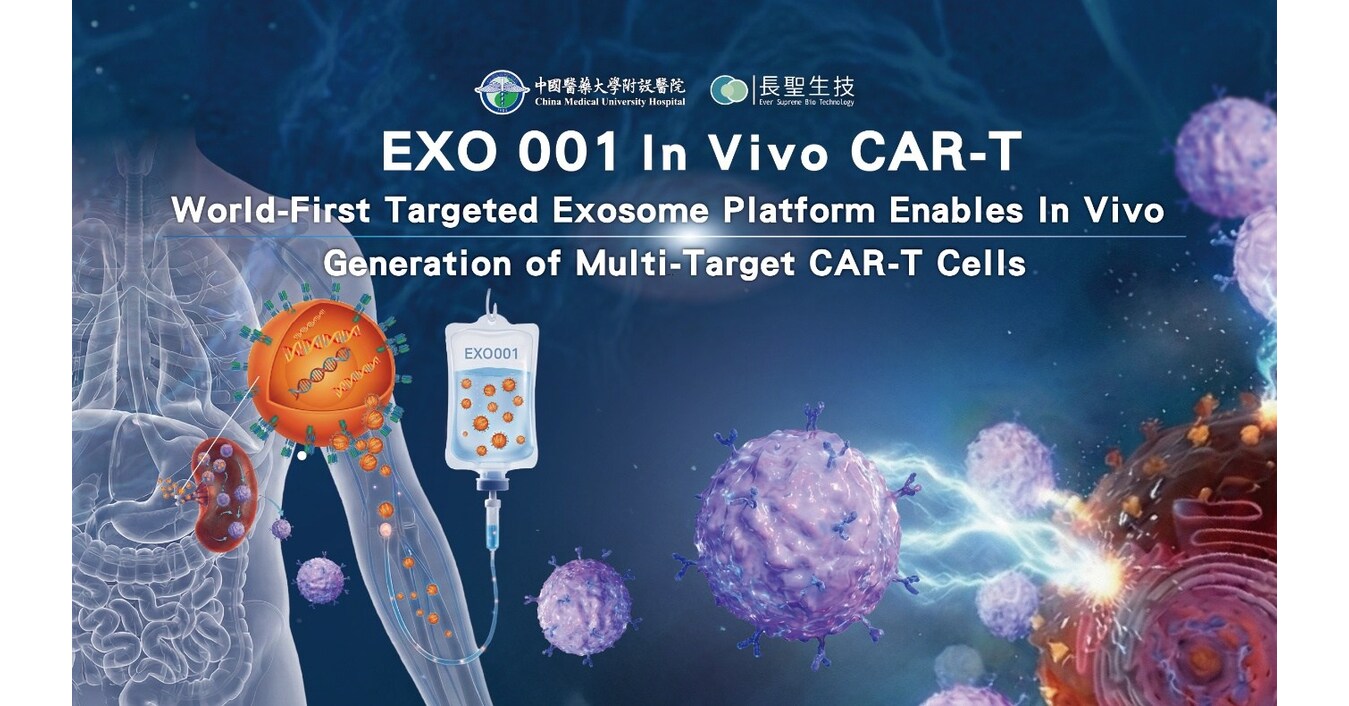
EXO 001 In Vivo CAR-T: World-First Targeted Exosome Platform Enables In Vivo Generation of Multi-Target CAR-T Cells. China Medical University Hospital and Ever Supreme Bio Technology Report Complete Tumor Elimination in Select Animal Models. Patients with Solid Tumors—including Lung, Pancreatic, Colorectal, and Malignant Brain Cancers—May Benefit.
In multiple solid tumor animal models, EXO 001 demonstrated significant therapeutic efficacy, including complete tumor eradication in select cases, offering a fundamentally new treatment strategy for patients with advanced solid malignancies.
In Vivo Immune Programming Overcomes the Limitations of Conventional CAR-T Therapy
According to CMUH Superintendent Dr. Der-Yang Cho, both autologous and allogeneic CAR-T therapies currently rely on complex and time-consuming ex vivo cell manufacturing processes. For patients with rapidly progressing solid tumors, these approaches are often too slow to meet clinical needs and remain constrained by immune rejection, manufacturing failure, and high costs.
The core innovation of EXO 001 lies in repositioning exosomes as carriers for in vivo immune programming, representing an advanced evolution of the CAR001 platform currently under clinical evaluation.
Following intravenous administration, EXO 001 circulates through key immune organs such as the spleen, where it precisely delivers Nb-CAR.BiTE genes to CD3-positive T cells. This enables direct genetic programming within the patient’s body, converting native T cells into multi-target CAR-T cells capable of infiltrating solid tumors, killing cancer cells, and dismantling the immunosuppressive tumor microenvironment.
This design enables immune cells to be “trained in vivo and deployed immediately,” combining the immune compatibility of autologous CAR-T therapy with the off-the-shelf availability and scalability typically associated with allogeneic approaches—an essential factor in EXO 001’s effectiveness against solid tumors.
Compelling Animal Data
Compelling Preclinical Results: Tumor Clearance and Extended Survival
Dr. Cho noted that in mouse models of colorectal cancer, pancreatic cancer, malignant brain tumors, and ovarian cancer, intravenous administration of EXO 001 successfully generated CAR-T cells in vivo. These cells effectively penetrated the tumor microenvironment, significantly inhibited tumor growth, and extended survival by two- to three-fold. In some animals, tumors were completely eliminated with long-term, recurrence-free outcomes.
By using exosomes as a gene and drug delivery vehicle, EXO 001 achieves higher biocompatibility and safety compared with viral vectors or synthetic lipid materials. This approach reduces immunogenicity, minimizes the risk of cytokine storm and anti-drug antibody formation, and lowers overall immune-related risks.
A Platform with Clear Clinical and Industrial Advantages
Wen-Liang Huang, General Manager of Ever Supreme Bio Technology, emphasized that EXO 001 offers not only academic innovation but also strong translational and commercialization potential, including:
Single-cell-line sourcing with stable quality Exosomes derived from a single engineered cell line minimize donor variability and support standardized production and quality control.
Scalable manufacturing aligned with international standards Production can be carried out in fully closed, automated systems compliant with U.S. FDA regulations for cell-based therapies.
Off-the-shelf readiness Eliminates the need for patient- or donor-specific ex vivo cell cultivation, enabling timely intervention for rapidly progressing solid tumors.
Cost advantages and improved accessibility Significantly reduces overall production costs compared with traditional autologous CAR-T manufacturing.
Platform extensibility Beyond solid tumors, the platform can be adapted to carry different CAR genes, nucleic acids, or small-molecule drugs, supporting multiple therapeutic indications.
Potential for long-term anti-tumor immunity Animal studies indicate the induction of CAR-T cells with immune memory characteristics, suggesting more durable anti-cancer effects.
Global Momentum in In Vivo CAR-T Development
In recent years, in vivo CAR-T has emerged as a key focus for global pharmaceutical leaders. Companies such as Gilead Sciences (Kite), AstraZeneca, Bristol Myers Squibb, and AbbVie have actively invested in viral vectors, lipid nanoparticles, and nanocarrier-based immune programming technologies to overcome the limitations of conventional CAR-T therapy in solid tumors.
Within this global landscape, the EXO 001 targeted exosome platform—developed jointly by CMUH and Ever Supreme Bio Technology—stands out for its use of high-biocompatibility, naturally derived exosomes, offering a differentiated and internationally competitive approach.
Next Steps Toward Clinical Translation
This research has been accepted for publication in the internationally recognized journal Advanced Science (January 2026), has secured patents in the United States and other countries, and has completed technology transfer. Manufacturing development and clinical trial preparation are currently underway, with first-in-human trials anticipated as early as next year, targeting patients with colorectal cancer, pancreatic cancer, malignant brain tumors, and ovarian cancer.
The EXO 001 platform represents a new horizon for solid tumor immunotherapy and a promising step forward for patients with advanced cancer.
SOURCE China Medical University Hospital


















Leave a Reply