

India’s 114-Rafale deal has sparked alarm in Pakistan. Islamabad takes big move.

Published: March 29, 2026 7:04 AM IST
Why is Pakistan alarmed by India’s Rafale deal?
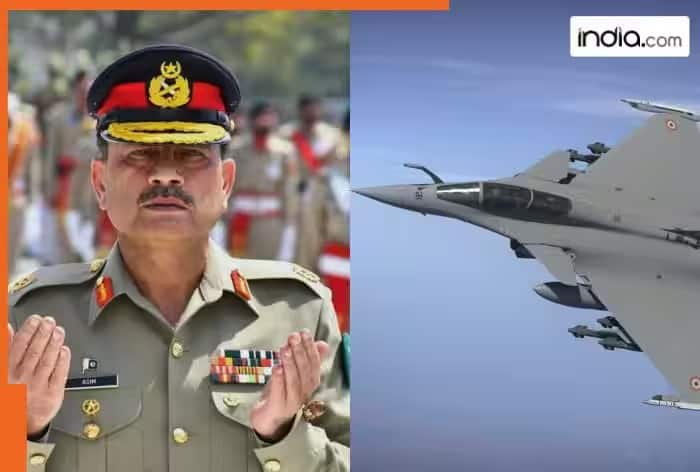
Pakistan’s expansion plans for its fighter jet fleet are designed to allow it to keep pace with India’s increasing number of Rafales, as well as to continue improving its military power following Operation Sindoor. Earlier in February, the Defence Acquisition Council (DAC) cleared proposals worth nearly Rs 3.60 lakh crore, including the decision to procure 114 Rafale fighter jets for the Indian Air Force (IAF). Chaired by Union Defence Minister Rajnath Singh, the DAC approves acquisitions for the Air Force, Army, Navy, and Coast Guard. However, the proposed induction of 114 Rafale Multi-Role Fighter Aircraft (MRFA) has emerged as the centrepiece of the modernisation drive, as per the news agency ANI report.How will 70 J-10CE jets change Pakistan’s air power?
Pakistan’s increase in the number of J-10CE fighter jets will mark a fundamental transition of its military architecture, according to IDRW. Modern fighter aircraft with beyond-visual-range (BVR) capability and modern doctrines for use in a high-technology environment will be given priority; therefore, the J-10CE fighter would play a central role in Pakistan’s shift towards modernisation by incorporating state-of-the-art AESA radar systems and PL-15 long-range air-to-air missiles.Pakistan is looking to offset existing gaps in its aviation capabilities by increasing the total number of aircraft it has and improving its ability to conduct missile strikes. Conversely, the Dassault Rafale aircraft used by India has been used in combat situations and has proven to be a versatile platform. The Dassault Rafale aircraft has a cutting-edge electronic warfare system called Spectra, a deep-strike capability, and a contemporary sensor fusion system. Chengdu’s J10CE Fighter offers a more economical solution for inducting a larger number of modern fighter jets into the fleet.Add India.com as a Preferred Source
Having a fleet of about 100 Chengdu J-10CE jet fighters in the Pakistan Air Force (PAF) will allow for the generation of higher sortie rates, increased capability to perform large-scale combined Air Patrols, and execution of the coordinated beyond-visual-range (BVR), using a network-centric approach. This will support Pakistan’s overall “stand-off warfare” strategy, which employs striking targets at a distance using long-range sensors and weapons, as opposed to using traditional dogfighting tactics. What is the top speed and other features of Chengdu J-10CE?
The Chengdu J-10CE, famously known as Vigorous Dragon, is a Chinese-made, single-engine, multi-role fighter aircraft which features a delta wing and a canard design. Top speeds for the aircraft are approximately Mach 1.8. The Chengdu Aircraft Corporation (CAC) has produced the J-10CE as its most advanced fighter aircraft to date.Currently, there are about 20 J-10CE fighter jets in service with the Pakistan Air Force, making up a major portion of their overall air combat capability. The J-10CE is classified as a premier 4.5+ generation of fighter aircraft and was added to the PAF in 2022. Due to state-of-the-art avionics, an AESA radar system, and beyond-visual-range (BVR) missile capability, the J-10CE offers considerable tactical and technical advantages. Furthermore, the aircraft’s speed and overall performance indicate that it is designed to compete with fighter jets like the Dassault Rafale.Source link

Leave a Reply