

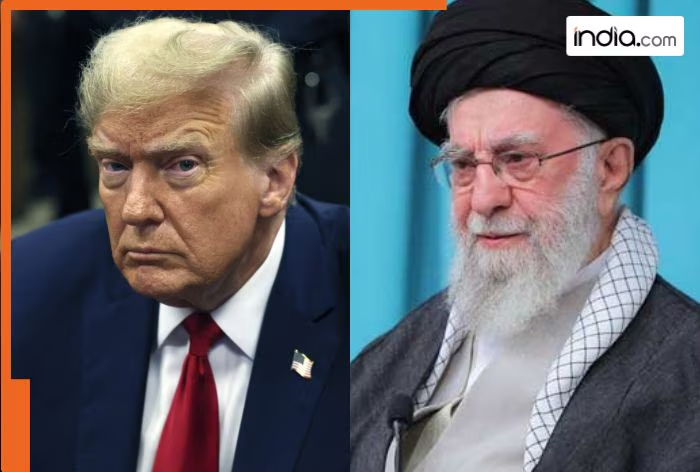
Big political win for Trump as US Senate rejected a War Powers Resolution aimed at limiting President Donald Trump’s military action, ‘Operation Epic Fury’, against Iran.

Published: March 5, 2026 7:01 AM IST
What does the 47–53 vote signal about Congress’s role in war decisions?
The War Powers Resolution would require Congressional approval before any military action could be taken. This was the first congressional vote regarding this topic since the attacks in Iran on February 28. The bill that would have prohibited Donald Trump from conducting military operations against Iran without Congressional consent experienced a partisan divide among Senators, Most Democratic senators supported the resolution, while Republicans largely backed the president’s military campaign.Why did the Senate block a bid to curb Trump’s Iran war powers?
Notable exceptions were also evident with respect to political affiliation. For example, Only Senator Rand Paul voted in favour of the resolution, while Jon Fetterman was the lone Democrat to cross the aisle in support of a move that helped the GOP defeat the measure. Democrats argued that Trump’s actions were another instance of him disregarding Congress’ authority to use military force, that they lacked a clear strategy going forward and, further, that they were yet another campaign promise he had broken, Fox News reported.”It’s time for the president to keep promises, not break them,” Kaine said ahead of the vote.Read More: ’15 Out of 10′: Amid six US soldiers killed, Trump rates war against Iran, calls pre-emptive action necessaryAdd India.com as a Preferred Source
What will this mean for U.S. troops and regional stability?
Fox News reported Democrats also seized on the administration’s refusal to rule out sending US troops into Iran.”They refuse to take off the table the insertion of ground troops,” said Senator Chris Murphy, warning the conflict could expand beyond air and naval operations. Sen. Josh Hawley, who previously supported a resolution to rein in Trump’s war powers in Venezuela, said he would oppose the latest effort.”I’ve always said that committing ground troops would be something I think would require immediate congressional authorisation, but that doesn’t appear to be on the immediate horizon,” Hawley said. The military escalation has raised numerous questions regarding the Decision to enter into this conflict. Till now, six American soldiers have been killed.Read More: Baba Vanga 2026 chilling prediction: Could US-Israel-Iran conflict trigger a Nuclear war and World War 3?
The US and Israel in coordinated airstrikes across multiple Iranian cities on February 28, targeted military command centres, air-defence systems, missile sites, and key regime infrastructure. These strikes resulted in the death of Iranian Supreme Leader Ayatollah Khamenei and four senior military and security officials, with large explosions reported in Tehran and other major cities. In response, Iran also retaliated by launching ballistic missiles and drones at US assets and allies across the region, including Israel, Bahrain, Kuwait, Qatar, Saudi Arabia, the United Arab Emirates, and Jordan, further widening the conflict in the Middle East and heightening risks for civilians and expatriates alike.Read More: Mojtaba Khamenei family, net worth: Know about wife Zahra Haddad Adel and kids as Iran gets new supreme leader after Khamenei’s death
On Wednesday, U.S. Defence Secretary Pete Hegseth announced the current military action in Iran, indicating that the conflict may last as long as eight weeks. This is a significant change from the previous estimate given by the Trump administration, which suggested that the conflict could potentially end in approximately four weeks. The U.S. government has not provided clarification regarding whether there will be a ground invasion of Iran, while most Democrats in Congress believe that President Trump is dragging the U.S. into an unnecessary war. Reports indicate that over 1,000 Iranian people were killed, including top Iranian leaders such as Supreme Leader Ali Khamenei.Source link









Leave a Reply