

Business Wire India
Reckitt is advancing a nationwide movement to strengthen India’s sanitation economy by building sanitation entrepreneurs, modernising school sanitation systems, and generating the evidence required to bridge the life expectancy gap faced by millions of sanitation workers across the country.
While India’s sanitation landscape has transformed significantly with over 100 million toilets constructed under Swachh Bharat Mission, the people who maintain sanitation systems continue to face some of the highest occupational risks. Shorter life spans among sanitation workers reflect hazardous exposure, lack of mechanisation, informal labour structures and generational disadvantages.
Building a modern sanitation workforce through enterprise
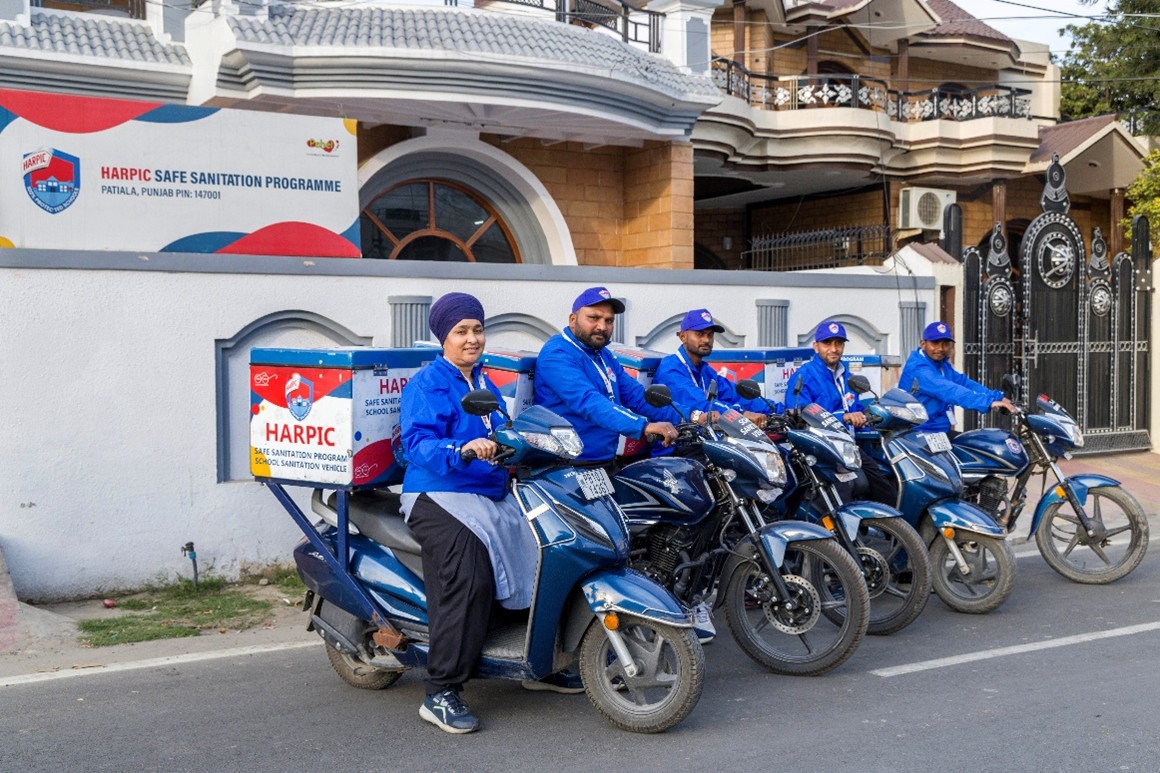
Reckitt’s Harpic World Toilet College, launched in partnership with the World Toilet Organisation and Jagran Pehel, has trained over 1.25 lakh sanitation workers, with women constituting over 45% of all trainees. Since its inception, the programme focuses on creating a skilled cadre of sanitation professionals who operate as micro‑entrepreneurs, managing mechanised cleaning units, managing school sanitation services, drain maintenance and overseeing facility‑care operations in urban and rural areas.
An independent social return assessment revealed that each rupee invested in the programme generates Rs. 23.20 of social value, supported by improvements in dignity, safer working conditions, and stronger financial and health resilience for workers and their families. These outcomes lay the foundation for a sanitation workforce that is equipped, respected and empowered.
Power of 8 — a scalable, service‑assured sanitation model
Reckitt’s Harpic Safe Sanitation Programme enables systemic school sanitation reform through its Power of 8 model, a robust, eight‑element framework, that ensures hygiene quality, operational accountability and enterprise participation at scale.
The Power of 8 framework includes assured funding for sanitation needs, scheduled cleaning cycles, trained HWTC manpower, equipped with professional tools, supervisory mechanisms for quality assurance, essential supplies including soaps, dustbins and cleaning agents, drain de‑clogging and structural maintenance, live digital tracking for transparency, and school data systems to guide decision‑making and improvements.
This model transforms sanitation into an enterprise‑driven service ecosystem, enabling HWTC‑trained workers to operate as service providers, contractors and entrepreneurs delivering safe sanitation at scale.
The programme uses interactive hygiene learning tools, including muppet-led sessions, storybooks, pop-ups and wall art, co-created with Sesame Workshop India, to embed early‑age hygiene and sanitation behaviours among children.
Dignity at the centre: National recognition for an invisible workforce
To mark the 25th anniversary of World Toilet Day, Reckitt celebrated sanitation workers through the release of commemorative postage stamps, a powerful national affirmation of their contributions.
Need for life‑expectancy modelling for sanitation workers
Sanitation workers face chronic and acute hazards, toxic gases, infections, musculoskeletal strain and socio-economic vulnerabilities. However, India still lacks nationally representative, occupation-linked life expectancy data. Critical gaps include no national linkage between occupation and mortality, poor visibility on long-term health impacts, absence of cause-specific mortality insights, and inadequate evidence to guide mechanisation, PPE policies or compensation systems.
Reckitt’s support for India’s first comprehensive life‑expectancy assessment for sanitation workers aims to build a scientific understanding of the survival risks they face, ultimately helping the country bridge the nearly 30‑year life‑expectancy gap between an average Indian and a sanitation worker.
Gaurav Jain, Executive Vice President, South Asia, Reckitt, said, “India has made extraordinary progress in building toilets, but true sanitation progress must also mean longer and safer lives for the people who maintain them. At Reckitt, through Harpic World Toilet College, we are strengthening the sanitation economy by empowering workers as entrepreneurs and with the Harpic Safe Sanitation Programme ‘Power of 8’ model, we are building new benchmarks for safety, quality and accountability across schools and communities. As we build scientific evidence on the life‑expectancy gap, our commitment is clear — to enable a future where every sanitation worker lives a longer, healthier and dignified life.”
Towards an evidence-led, enterprise-driven sanitation economy
Reckitt is working towards expanding the Power of 8 framework across states, deepening enterprise development through HWTC, reaching 70% cohort of sanitation workers across India and integrating life‑expectancy modelling into national sanitation economy planning.
By combining entrepreneurship, systemic school sanitation reform, national recognition and evidence-led policymaking, Reckitt is working to create a sanitation economy where every worker can live a longer, healthier and dignified life.
Source link











Leave a Reply