Discovery from experts at Cincinnati Children’s opens doors to improved stem cell transplant outcomes and potentially healthier agingCINCINNATI, Jan. 13, 2026 /PRNewswire/ — In a groundbreaking proof-of-concept study, researchers at Cincinnati Children’s report success at restoring healthy function to blood-making stem cells that have worn out with advancing age or became overstressed after chemotherapy and stem cell transplantation.
The study, published Jan. 13, 2026, in Cell Stem Cell, was led by co-first authors James Bartram, PhD and Sydney Treichel, PhD candidate, and corresponding author Marie-Dominique Filippi, PhD, both with the Division of Experimental Hematology at Cincinnati Children’s.
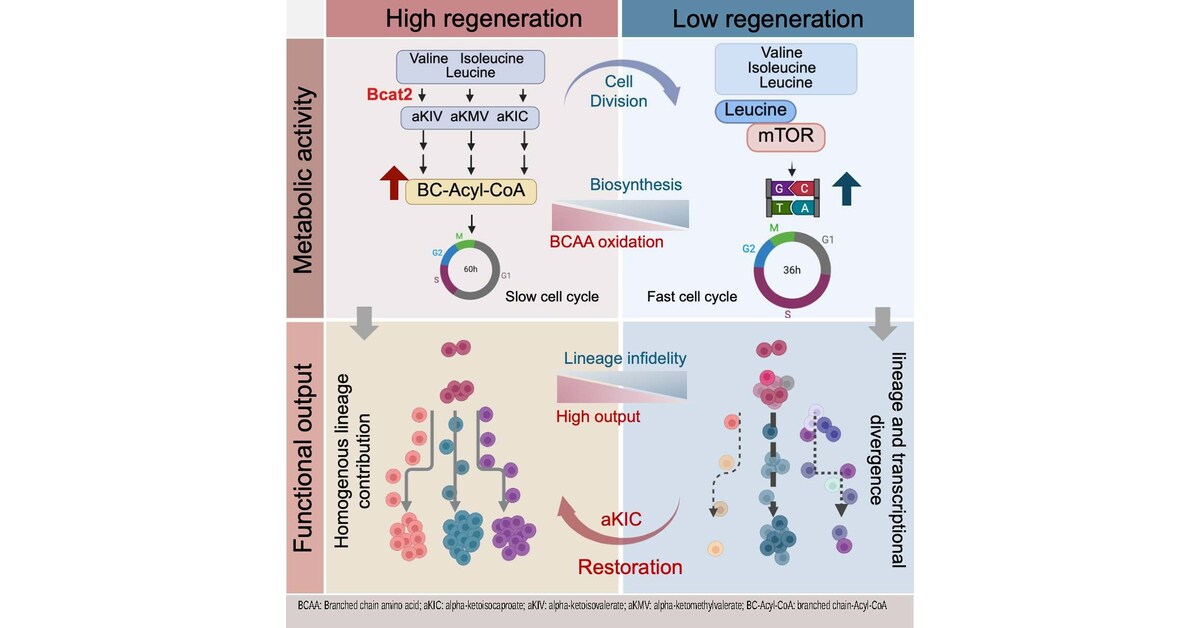
Graphical abstract depicts how blood stem cell metabolism changes with successive generations, making the cells less capable of producing healthy T lymphocytes (a key part of the immune system). However, in mice, adding a metabolite supplement restored healthy blood stem cell function. Source: Cell Stem Cell.
“Clinically, these findings have significant implications, both for understanding why some patients can develop bone marrow failure after receiving stem cell transplants and why some older people have impaired immunity and do not respond as well as others to vaccines,” Filippi says. “Most importantly, we also demonstrate that the health of overstressed blood stem cells can be restored.”
The Problem: Stem Cell Stress and Long-Term Risks
Blood stem cells, known as hematopoietic stem cells (HSCs), are the body’s source for all blood and immune cells. For people with leukemia and other immune diseases, stem cell transplants have served as powerful, often curative treatments. But in some cases, patients later develop bone marrow failure or secondary cancers, suggesting that the new blood stem cells can lose their effectiveness over time.
Meanwhile, as people age, their blood stem cells appear to become less functional, making them less likely to respond robustly to vaccines and more likely to develop anemias, myelodysplastic syndrome, or leukemia.
The new study provides evidence that the process of regenerating the blood system—whether due to disease treatment, or aging—places enormous stress on these stem cells. As the body forms successive generations of blood stem cells, they become less capable of producing the full range of blood cell types the body needs, especially T lymphocytes, an important type of immune cell.
The Breakthrough: Understanding and Correcting Stem Cell Defects
Using mouse models and a series of advanced techniques to analyze changes in activity down to the single-cell level, the scientists isolated different generations of stem cells that were exposed to different levels of stress and compared their function and molecular makeup.
“This was done in mice, but in a way, we were able to compare how HSC metabolic functions changed between a 20-year-old, a 40-year-old, and an 80-year-old,” Filippi says.
They report three key findings:
The team reports fundamental new details about how stem cells become defective after successive generations. Not only do these stem cells lose the ability to produce the correct number of other blood cell types, the blood cells they do produce are themselves abnormal.
The researchers traced the key driver of these defects to changes in the cells’ metabolic activity—specifically, how the cells process branched-chain amino acids (BCAAs). The team observed a shift from energy-producing (catabolic) activity to a building-block (anabolic) metabolism that accelerates cell division and leads to stem cell exhaustion.
In finding a metabolic cause for the stem cell dysfunction, the team also found a potential solution. In mice, injecting a metabolite called alpha-ketoisocaproate corrected the stem cells’ ability to produce healthy T lymphocytes. The treatment worked in mice that had been exposed to chemotherapy and in models of natural aging.
Clinical Relevance: Toward Safer Transplants and Healthier Aging
The implications of this research are profound. By identifying a metabolic “checkpoint” that can be reversed, the study suggests that patients undergoing bone marrow transplants or chemotherapy could receive metabolite supplementation to protect their stem cells from long-term damage. This could reduce the risk of secondary cancers and improve immune recovery.
The findings also have relevance for healthy aging. As people age, their blood stem cells naturally accumulate defects, contributing to increased susceptibility to infections and blood cancers. If the mouse-based results can be duplicated in humans, the metabolite supplement approach might one day serve as a preventive therapy to maintain stem cell health in older adults.
Cautious Next Steps
Years of research will be needed to verify if the metabolite used in the study will be safe and effective to use in humans, or whether other metabolite treatments would need to be developed instead.
The research team emphasized that, despite the potential excitement, the science is still evolving. Clinical trials will be necessary before any recommendations can be made for patients or the general public. Individuals should not attempt to self-administer such compounds without medical guidance.
About the Study
Cincinnati Children’s co-authors on this study include Nathan Salomonis, PhD, Division of Biomedical Informatics; H. Leighton Grimes, PhD, and Baobao Annie Song, both with the Division of Immunobiology; and Juying Xu, Devyani Sharma, Waseem Nasr, Madeline Frangiosa, and Andrew Harley, all with the Division of Experimental Hematology and Cancer Biology. Co-authors also included two collaborators from the University of Colorado.
Funding sources included several awards from the National Institutes of Health (R01DK121062, R01HL151654, R01HL122661, RC2DK122376, U2C‑DK119886, and OT2OD030544)
SOURCE Cincinnati Children’s Hospital Medical Center















Leave a Reply