Peer-reviewed evidence published in the International Journal of Spine Surgery strengthens the scientific foundation for NanoFuse as a next-generation synthetic biologic for bone regeneration, with strong implications for its potential role in spinal fusion
FORT LAUDERDALE, Fla., Jan. 26, 2026 /PRNewswire/ — A landmark peer-reviewed scientific study published in the International Journal of Spine Surgery reports that a NanoFuse® bioactive glass–demineralized bone matrix (DBM) composite demonstrated significantly greater osteoinductive activity than DBM alone or bioactive glass alone in a validated in vitro alkaline phosphatase assay.
Peer-reviewed clinical data published in the International Journal of Spine Surgery confirms that NanoFuse® is the first bioactive glass–DBM composite shown to achieve superior osteoinductive synergy—marking a major milestone in the development of safer, materials-based bone regeneration for spinal fusion
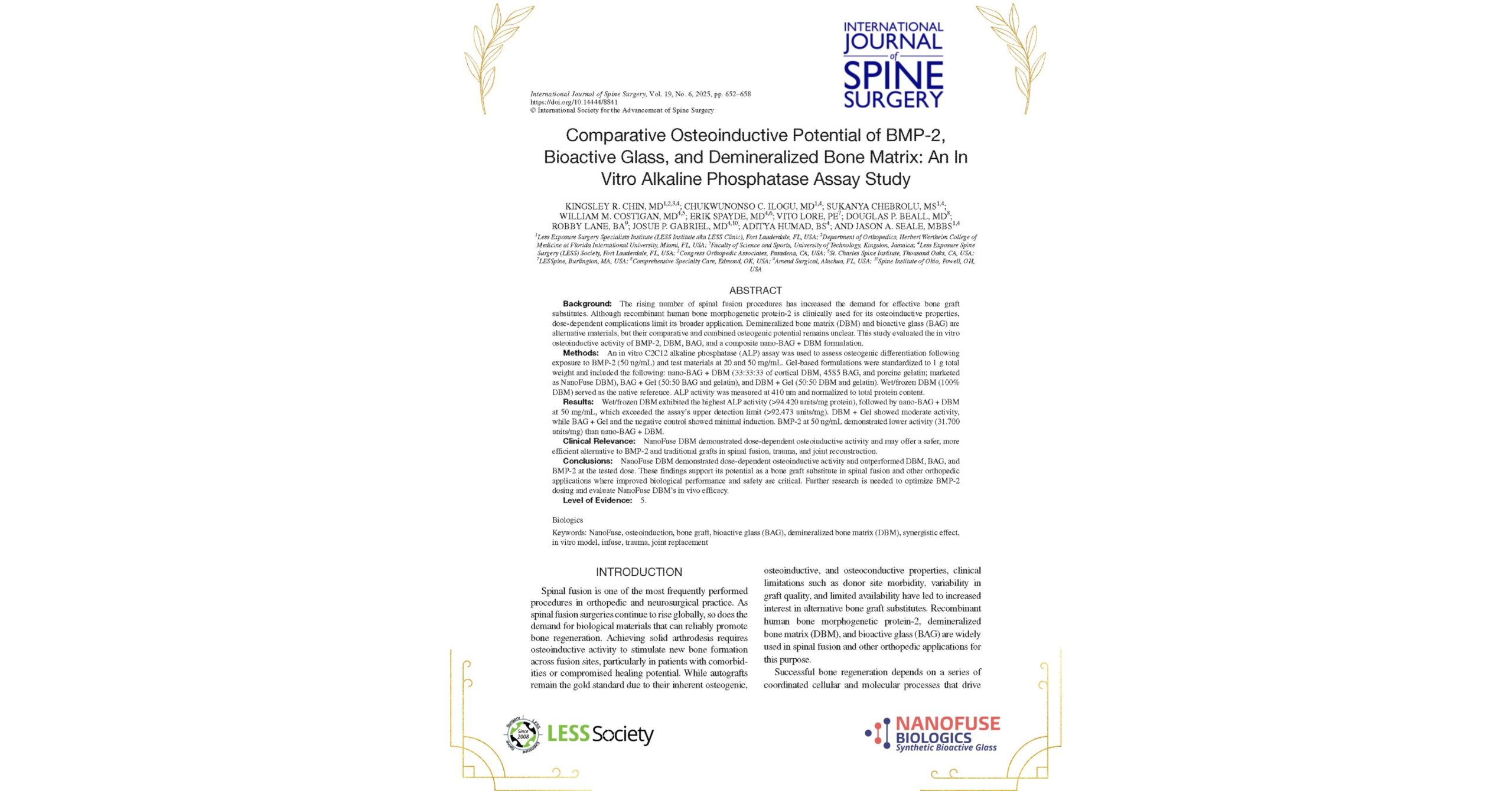
The study, “Comparative Osteoinductive Potential of BMP-2, Bioactive Glass, and Demineralized Bone Matrix: An In Vitro Alkaline Phosphatase Assay Study,” appears in Int J Spine Surg , Volume 19, Issue 6 (December 2025). Recombinant human BMP-2 was included in the study solely as a reference control to contextualize osteogenic signaling within a well-established biologic framework.
Scientific Purpose and Study Design
The objective of the study was to evaluate how bioactive ion release influences early osteogenic differentiation , particularly when bioactive glass is placed in close proximity to DBM. While DBM is widely used for its osteoinductive potential, its biologic activity can be variable. Bioactive glass, in contrast, is known to release osteostimulatory ions but lacks the organic signaling matrix present in DBM.
This study examined whether combining these two materials could produce a synergistic osteoinductive effect beyond that of either component alone.
The results demonstrated that the NanoFuse composite produced greater alkaline phosphatase activity , a key marker of early osteoblastic differentiation, compared with DBM alone and bioactive glass alone—supporting the biologic rationale for a composite, materials-based approach to bone regeneration.
Independent Expert Perspective on Bioactive Ion SynergyDr. Martin Crous, PhD , a recognized leader in osteobiologics research, viewed the findings as an important validation of materials-driven osteoinduction.
“This study provides compelling evidence that bioactive ions released in proximity to DBM can significantly enhance osteoinductive signaling,” said Dr. Crous. “What is particularly meaningful is the demonstrated synergy. Rather than relying on exogenous growth factors, this composite leverages materials science to stimulate a natural osteogenic response. The data suggest it may be more effective than DBM alone and has the potential to serve as a lower-cost, more predictable alternative to growth-factor–based strategies in appropriate clinical settings.”
Author Perspective: Engineering Biology Through MaterialsProfessor Kingsley R. Chin, MD, MBA , orthopedic spinal surgeon, Professor of Orthopedic Surgery, and senior author of the study, emphasized the scientific intent behind the work.
“The goal of this study was to understand biology—not to make commercial comparisons,” Professor Chin said. “BMP-2 served as a control to help contextualize osteogenic signaling. What the data clearly show is that combining bioactive glass with DBM produces a stronger and more consistent early osteoinductive response than either material alone. That insight is highly relevant as spine surgery continues to evolve toward safer, more efficient biologic solutions.”
Coauthor Clinical Perspectives: Implications for PatientsDr. Erik Spayde, MD , orthopedic spine surgeon and coauthor, highlighted the clinical relevance of the findings.
“As surgeons, we are constantly balancing biologic efficacy with safety,” Dr. Spayde said. “These results reinforce our belief that materials-based biologics can deliver meaningful osteogenic activity without the risks associated with more aggressive biologic interventions. Ultimately, that matters most for patients.”
Dr. William M. Costigan, MD , orthopedic spine surgeon and coauthor, emphasized consistency and reproducibility.
“One of the most compelling aspects of this study is the reliability of the osteoinductive response,” Dr. Costigan noted. “Reducing variability in biologic performance is critical—especially as more fusion procedures move into outpatient and ambulatory settings.”
Regulatory Readiness and Broad Clinical ApplicabilityVito Lore, coauthor and technology lead, underscored that the biologic performance demonstrated in the study is supported by a platform designed for real-world clinical use.
“This technology has achieved FDA approval, is supplied in sterile packaging, and offers a five-year shelf life,” Lore said. “Those attributes are essential for broad clinical adoption. They enable efficient distribution, ease of use, and application across a wide range of surgical environments without compromising biologic integrity.”
Looking Ahead
The findings from this peer-reviewed study add to a growing scientific foundation supporting materials-based osteoinduction as a viable, scalable strategy for bone regeneration and spinal fusion. Additional studies, including clinical evaluations, are underway to further define its role across spine surgery.
Closing Thought
Rather than amplifying biology through pharmacology, this study demonstrates the potential of engineering biology through materials. By harnessing bioactive ion release in proximity to DBM, the NanoFuse composite represents a scientifically grounded approach to achieving consistent, efficient osteoinductive signaling for modern spine care.
About the Research
The study evaluated osteoinductive activity using a well-established in vitro C2C12 alkaline phosphatase assay. BMP-2, demineralized bone matrix, bioactive glass, and a nano–bioactive glass–DBM composite were tested at standardized concentrations, with ALP activity normalized to total protein content. The assay enabled direct, controlled comparison of osteogenic differentiation across materials under identical experimental conditions.
https://pubmed.ncbi.nlm.nih.gov/41456902/About NanoFuse Biologics
NanoFuse Biologics is a medical technology company focused on the development of next-generation synthetic biologics for bone regeneration and spinal fusion. The company’s proprietary platform combines bioactive glass technology with demineralized bone matrix (DBM) to create materials engineered to stimulate osteogenic activity through controlled bioactive ion release rather than reliance on exogenous growth factors.
NanoFuse products are designed to deliver consistent, reproducible biologic performance while prioritizing safety, scalability, and ease of use. NanoFuse received initial FDA clearance in 2012, with expanded clearance for spinal applications in 2015. The company offers FDA-cleared, sterile-packaged products with a five-year shelf life to support a broad range of clinical applications across hospital and outpatient spine surgery settings.
Guided by a science-first development philosophy, NanoFuse Biologics is building a robust foundation of peer-reviewed evidence to support its role in modern spine care and bone regeneration.
SOURCE NanoFUSE Biologics




Leave a Reply