

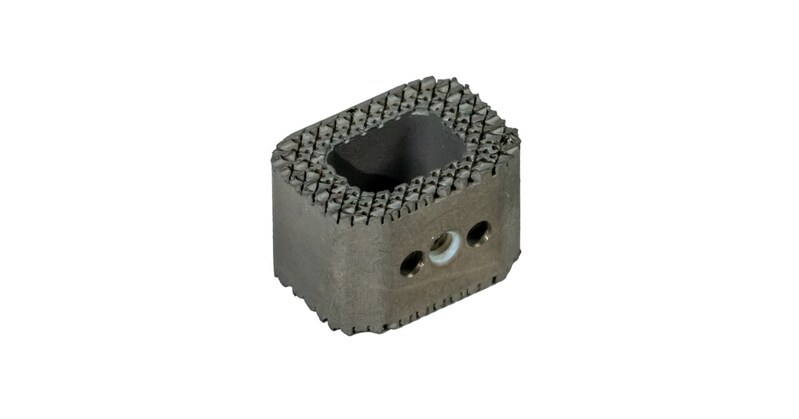
NanoPrime® utilizes a cutting-edge nano-engineering process involving evaporation and ion beam bombardment in a high vacuum environment. This technique allows intermixing of coating and substrate atoms, improving adhesion and minimizing risk of delamination, unlike conventional coatings.
Rather than relying on a single material’s strengths, Zavation’s NanoPrime® Labyrinth® Cervical interbody leverages the complementary benefits of two proven technologies:
NanoPrime®, a nano-textured titanium ion bond surface, creates a high-adhesion, nano-textured surface shown to support cellular activity associated with bone formation 1.
Labyrinth®, Zavation’s patented porous PEEK structure, designed to mimic cancellous bone architecture and improve the biological response compared to smooth PEEK or traditional solid structures 2,3.
Combined, these technologies deliver an implant platform that maintains the imaging clarity and elastic modulus of PEEK while introducing an osteoconductive nano-surface intended to promote early cell attachment, induce hydrophilic wicking, and reduce stress shielding 4,5.
A fellowship-trained spine surgeon, Dr. Freeland Ackley, specializes in degenerative, revision, and minimally invasive spine procedures for the comprehensive treatment of cervical, thoracic, and lumbar conditions. Dr. Ackley stated, “The NanoPrime® Labyrinth® Cervical Interbody reflects the kind of design philosophy I look for in an implant—thoughtful engineering that supports early bone integration and long-term stability. The combination of porous architecture with a nano-textured titanium interface gives me confidence in the construct I’m using in my practice”.
A Cohesive Biological Environment—Inside and Out
By applying NanoPrime® to the porous Labyrinth® structure, Zavation has created a fully integrated surface environment—from the macro-porous architecture to the nano-textured titanium interface. This synergy is engineered to:
Zavation is a fast-growing designer and manufacturer of spinal hardware and biologics headquartered in Flowood, Mississippi. Focused on innovation, surgeon collaboration, and superior customer support, Zavation delivers advanced spinal solutions that improve surgical outcomes and patient quality of life. References
- Encourage bony integration throughout the porous network 3
- Promote osteogenic cellular behavior associated with accelerated fusion 4
- Maintain mechanical properties and visualization advantages valued by surgeons
- Provide a predictable, uniform surface across the entire implant geometry
Zavation is a fast-growing designer and manufacturer of spinal hardware and biologics headquartered in Flowood, Mississippi. Focused on innovation, surgeon collaboration, and superior customer support, Zavation delivers advanced spinal solutions that improve surgical outcomes and patient quality of life. References
- Olivares-Navarrete, R., et al. “Implant Materials Generate Different Peri-implant Inflammatory Factors: PEEK Promotes Fibrosis and Microtextured Ti Promotes Osteogenic Factors.” Spine, vol. 40, no. 6; 2015, pp. 399–404.
- Warburton, A., et al. “Biomaterials in Spinal Implants: A Review.” Neurospine, vol. 17, no. 1, Mar. 2020, pp. 101–110.
- Data on File.
- Olivares-Navarrete, R., et al. “Rough Titanium Alloys Regulate Osteoblast Production of Angiogenic Factors.” Spine Journal, vol. 13, no. 11; Nov. 2013.
- Cabraja, M., et al. “Anterior Cervical Discectomy and Fusion: Comparison of Titanium and Polyetheretherketone Cages.” BMC Musculoskeletal Disorders, vol. 13, no. 172, 2012.
Source link










Leave a Reply