India 5th Generation Fighter Jet: The 21st century is the age of technology and defense sector is no exception. AI is being used in everything from fighter jets to drones and missile technology. Defense experts believe that AI will play a crucial role in 6th-generation fighter aircraft.

Updated: May 1, 2026 10:32 AM IST
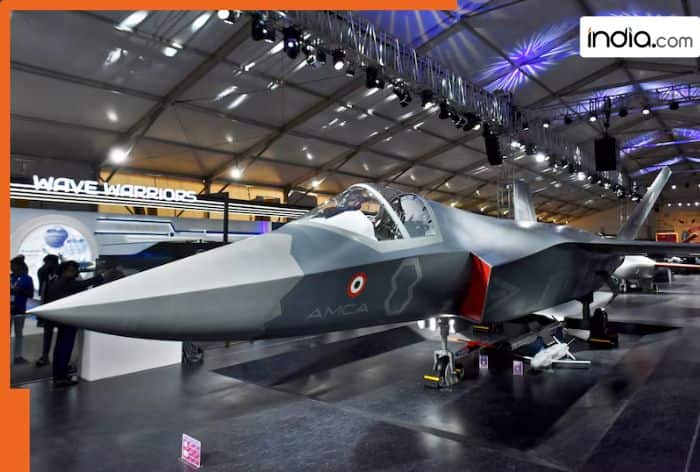
A major update has come to the fore on India’s Advanced Medium Combat Aircraft (AMCA) where defense scientists are going to use tracking technology in the fighter jets developed under this program, which will enable them to intercept even targets that often escape radar. This will increase the aircraft’s capabilities many times over. The fighter jets being developed under AMCA will be many times more powerful than the Rafale and Su-30MKI. These aircraft will also compete with the US’ F-35 and Russian Su-57.
India’s indigenous fifth-generation fighter aircraft program AMCA is set to receive a major technological push. The aircraft will incorporate a state-of-the-art, indigenous passive infrared search and track (IRST) system, developed to meet the needs of a stealth battlefield. This system will be able to detect low-visibility enemy targets at long ranges without emitting any signal, thereby maintaining the aircraft’s own stealth capabilities.
The most significant feature of this advanced IRST system is its dual-band capability, operating in both the mid-wave infrared (MWIR) and long-wave infrared (LWIR) spectrums. This allows it to detect not only the hot exhaust plume from the engine but also the hard-body heat signature of stealth aircraft. This makes the system highly effective against modern stealth fighters.
IN PICS: Top 10 best fighter jets of the world; Where does India stand

Even F-35 and F-22 will not be able to survive
According to a report in Indian Defence News, this system may be able to track US stealth fighter jets such as the F-35 Lightning II and F-22 Raptor at strategically significant distances. This capability could prove to be a significant advantage for the Indian Air Force, especially in situations where the use of radar is risky. This IRST is a completely passive system, meaning it does not emit any radiation or signals. This prevents the enemy from detecting the aircraft’s location and makes it effective even in electronic warfare environments. It will be integrated into the nose section of the aircraft as an electro-optical targeting system (EOTS), thereby maintaining the aircraft’s radar cross section (RCS).
Impossible for enemy to escape
The project is being developed under the leadership of the Defence Research and Development Organisation (DRDO) and is being pursued under the Mach-II category of India’s defence procurement process, which prioritises indigenous technologies. It is also considering the use of advanced technologies such as gallium nitride (GaN) chips, which offer improved performance and greater efficiency in high temperatures. Scientists are also working on a conformal IRST dome, which could further enhance the aircraft’s stealth capabilities and enable 360-degree surveillance. Flight trials are planned on platforms such as the Hawker 800 to test the system, which will be a crucial step in its validation and refinement.
Defence preparedness reaches new heights
Defense experts believe that this IRST system will be crucial for both the Mk1 and Mk2 variants of the AMCA. This system will provide the Indian Air Force with a strategic advantage, especially in situations where radars may be inoperable or disrupted. Overall, this technology is considered a significant step towards taking India’s indigenous defense program to new heights.