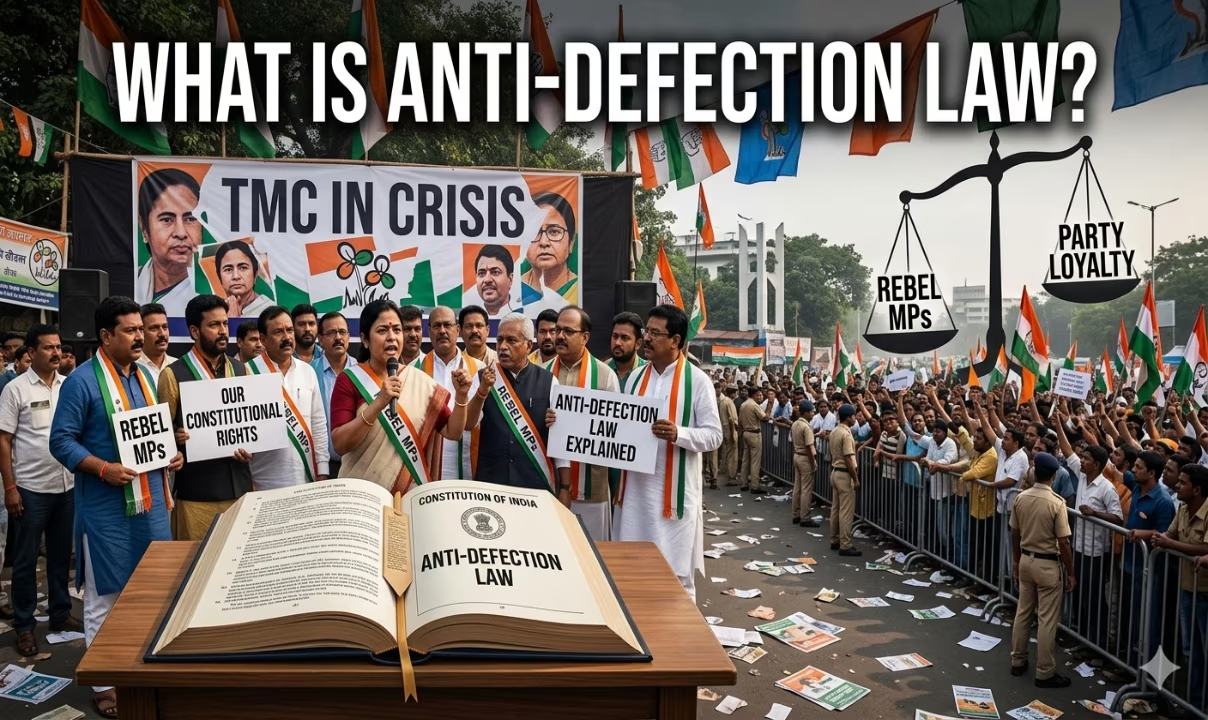
TMC Rebel MPs & Anti-Defection Law India: Mamata Banerjee has not only lost power in the state, but has also lost control over her party’s MPs. She now faces the risk of losing control of the party.
Updated: June 15, 2026, 12:54 PM IST
Share Article
https://www.india.com/news/india/what-is-anti-defection-law-amid-tmc-crisis-will-mamata-banerjee-lose-her-party-constitution-updates-abhishek-banerjee-8447010/
What is anti-defection law amid TMC crisis? Will Mamata Banerjee lose her party? Constitution says…(AI image)
Defection has become common during times of political turmoil. But political parties or rebels often pay a heavy price for it. Rebellion and joining other parties attracts the provisions of the anti-defection law. Consequently, the membership of MPs or MLAs in the Lok Sabha or Assembly could be in jeopardy.
The rapidly changing political landscape has caused significant political upheaval in West Bengal. Mamata Banerjee has not only lost power in the state, but has also lost control over her party’s MPs. She now faces the threat of losing control of the party. According to reports, 20 Trinamool Congress (TMC) MPs have rebelled. These 20 rebel MPs have sent a letter to the Lok Sabha Speaker informing them of their group’s merger with the Nationalist Citizens Party of India (NCP). The question now is whether these MPs’ Lok Sabha membership will remain intact or whether they face the threat of disqualification under the anti-defection law.
What does anti-defection law say?
The Anti-Defection Law is a provision in the Tenth Schedule of the Constitution of India, which was added in 1985 through the 52nd Constitutional Amendment.
Through this, an attempt was made to stop defection due to political gain and temptation and to ensure stability in governments.
It says that if an elected member voluntarily gives up the membership of his parent political party or votes in the House against the guidelines (whip) issued by the party or remains absent from voting, and the party does not condone him within 15 days, his membership can be terminated.
But the catch is that only mergers are now considered a valid exception. This means that MPs must prove that their move is not merely a defection but a legally valid merger. This also includes exceptions.
Read More: TMC Crisis: Abhishek Banerjee appears before CID for questioning in ‘forged signature’ case
Is merger of only MPs sufficient?
This is precisely the issue that has posed a legal dilemma for Trinamool Congress. Recent decisions concerning the Shiv Sena have clearly stated that the legislative party and the parent political party cannot be considered separate. In this context, Trinamool Congress argues that the decision of a group of MPs alone cannot be considered a party merger. Based on this, Mamata Banerjee’s MP allies have urged the Lok Sabha Speaker not to recognize the rebel faction. However, the rebels have cleverly merged with the NCPI party. They have informed the Lok Sabha Speaker of their move.
Dispute can also go to court
In fact, under the anti-defection law, the Speaker of the Lok Sabha has the authority to make the initial decision in cases involving the disqualification of MPs. As has been the tradition, the Speaker will first verify the signatures and claims of the MPs. After this, it will be decided whether they should be recognized as a separate group. However, the Speaker’s decision is not considered final. Under a 1992 Supreme Court ruling, the presiding officer’s decision is subject to judicial review. Therefore, if the affected party is dissatisfied with the Speaker’s decision, the matter can also go to the Supreme Court.
All eyes are on decision of Lok Sabha Speaker
Although the membership of the 20 TMC MPs is not in immediate danger, as they claim to be eligible for merger protection under Paragraph 4 of the Tenth Schedule of the Constitution, the final decision will depend on whether the Lok Sabha Speaker, and if necessary, the Supreme Court, consider this to be a valid political merger. If the two-thirds majority and the merger conditions are legally proven, the MPs’ membership may be saved. Otherwise, the path could be opened for disqualification under the anti-defection law.