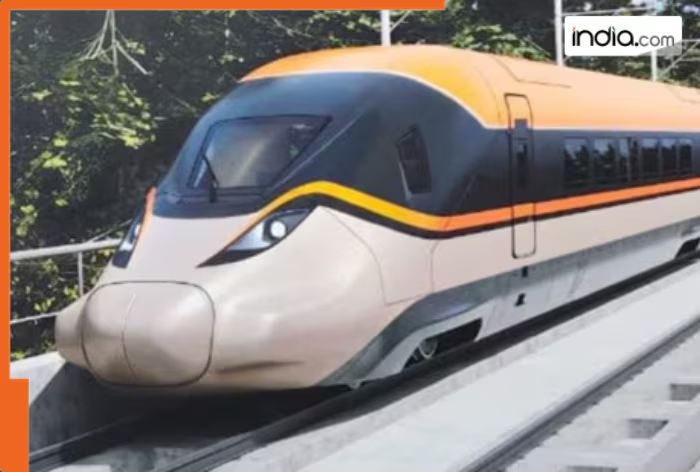
The RRTS network is planned and designed to strengthen regional integration by connecting major economic and residential centres through fast, reliable transit links while generating employment and supporting planned urbanisation.
Published: June 17, 2026, 2:19 PM IST
Share Article
https://www.india.com/news/india/namo-cities-narendra-modi-manohar-lal-khattar-uttar-pradesh-haryana-delhi-ncr-gautam-buddha-nagar-noida-greater-noida-region-ghaziabad-hapur-meerut-bulandshahr-8448872/
Namo Cities
New Delhi: Under the Regional Plan 2041, the Narendra Modi government is set to develop four greenfield cities, to be known as “Namo Cities,” in the National Capital Region (NCR). The primary objective of the plan is to promote balanced regional growth and reduce pressure on existing urban centres. The decision was taken at a high-level meeting of the National Capital Region Planning Board (NCRPB), chaired by Union Housing and Urban Affairs Minister Manohar Lal.
According to the Regional Plan 2041, the NCR is expected to become increasingly urbanised over the coming decades, with the urban population projected to reach around 57 per cent by 2031 and 67 per cent by 2041. While talking to the reporters after the meeting, Union Minister Lal said, “In the meeting, it was decided that four greenfield cities will be developed. These cities will be called ‘NAMO Cities’.”
Who attended the meeting?
The meeting was attended by Delhi Chief Minister Rekha Gupta, Haryana Chief Minister Nayab Singh Saini, and urban development ministers from Uttar Pradesh and Rajasthan. It is important to note that the draft plan outlines a long-term strategy for decentralised urban development through the creation of new economic and residential hubs across NCR states, including Haryana, Uttar Pradesh and Rajasthan.
What Are Greenfield Cities?
A “greenfield city” is referred to as a completely new city built from scratch on previously undeveloped land rather than through the expansion or redevelopment of an existing urban area. As per Urban planning, such cities are planned before construction begins, with roads, housing, public transport systems, utilities, schools, hospitals and commercial districts designed as part of a comprehensive master plan.
The objective is to create modern, well-planned urban centres capable of supporting future population growth while reducing pressure on existing cities.
Has the government announced the locations of the cities?
Notably, the government has not yet announced the locations of the four proposed cities. Talking to the reporters, Manohar Lal Khattar said that the states would submit proposals for potential sites, following which four cities would be picked through a competitive challenge process.
“States will submit their proposals and these four cities will be selected through a challenge,” he said. The minister further added that Rs 5,000 crore would be allocated for the development of the new urban centres.
Haryana Chief Minister Nayab Singh Saini said proposals had been invited from states for the development of four new greenfield cities along the Regional Rapid Transit System (RRTS) corridors.
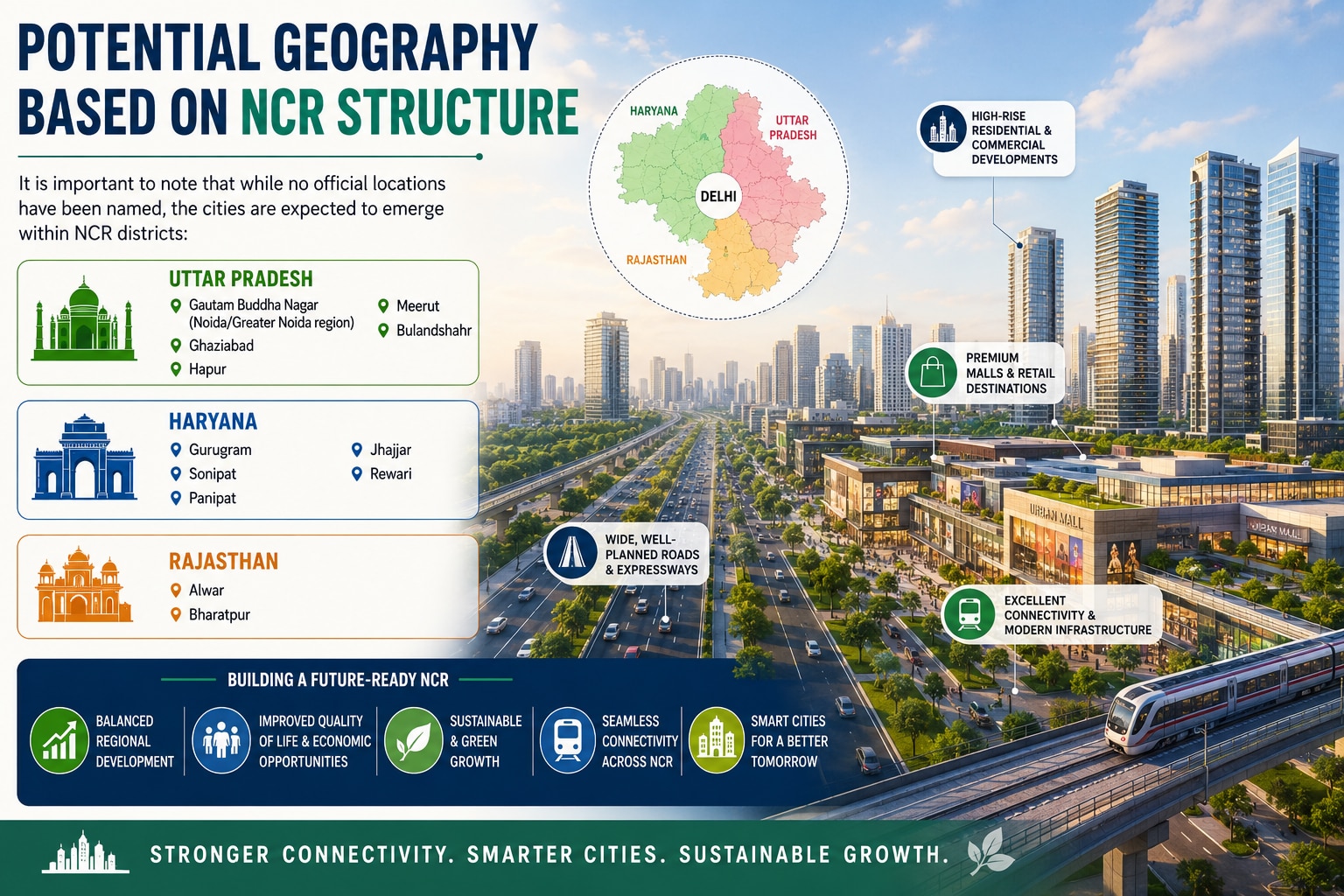
Potential Geography Based on NCR Structure:
It is important to note that while no official locations have been named, the cities are expected to emerge within NCR districts:
Uttar Pradesh:
- Gautam Buddha Nagar (Noida/Greater Noida region)
- Ghaziabad
- Hapur
- Meerut
- Bulandshahr
Haryana
- Gurugram
- Sonipat
- Panipat
- Jhajjar
- Rewari
Rajasthan
RRTS Corridors In NCR
With an aim to improve connectivity across NCR through semi-high-speed rail corridors, the government has developed the Regional Rapid Transit System. Currently, the Namo Bharat train runs at speeds of up to 160 kmph on sections of the Delhi-Ghaziabad-Meerut RRTS corridor.
The RRTS network is planned and designed to strengthen regional integration by connecting major economic and residential centres through fast, reliable transit links while generating employment and supporting planned urbanisation.
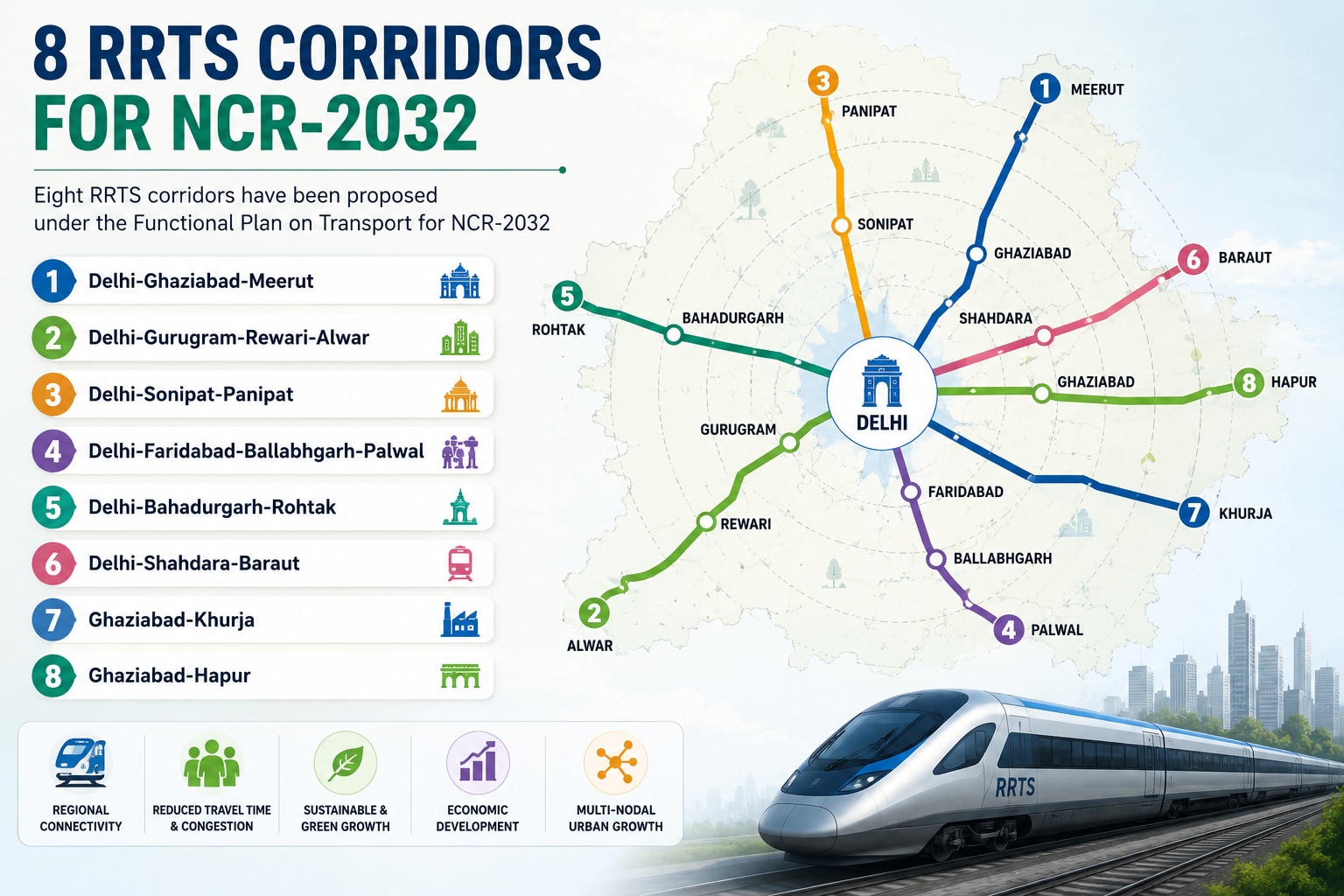
Eight RRTS corridors have been proposed under the Functional Plan on Transport for NCR-2032:
- Delhi-Ghaziabad-Meerut
- Delhi-Gurugram-Rewari-Alwar
- Delhi-Sonipat-Panipat
- Delhi-Faridabad-Ballabhgarh-Palwal
- Delhi-Bahadurgarh-Rohtak
- Delhi-Shahdara-Baraut
- Ghaziabad-Khurja
- Ghaziabad-Hapur
Following the Delhi-Meerut corridor, two other priority corridors are the Delhi-Gurugram-SNB (Shahjahanpur-Neemrana-Behror) line and the Delhi-Panipat line.
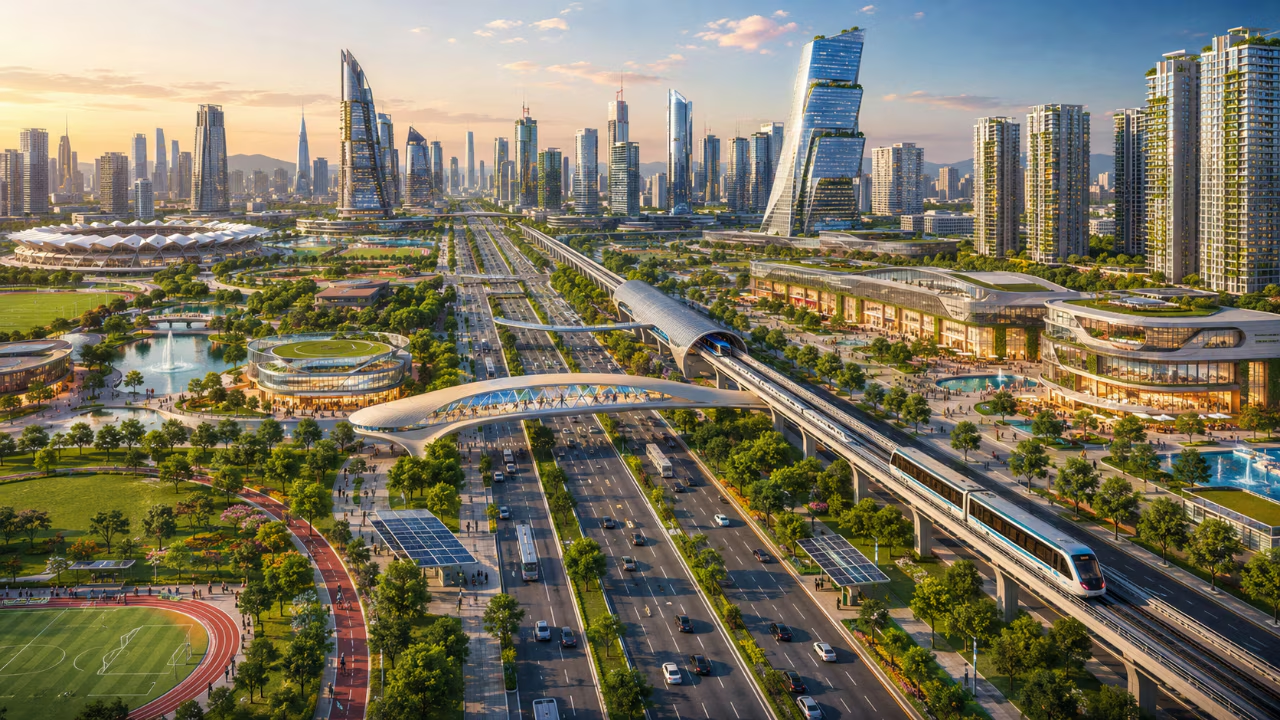
Envisioned as a comprehensive urban development project, the Namo Cities will integrate residential housing, commercial districts, logistics hubs, and industrial clusters into a single, properly planned ecosystem. The city is likely to feature state-of-the-art social infrastructure, including educational institutions, healthcare facilities, and recreational spaces, ensuring a high quality of life for residents. Additionally, a strong regional mobility network is planned to enhance connectivity, facilitate the movement of people and goods, and support long-term economic growth across the region.
Why NCR’s Current Growth Model Needs a Rethink
As per the draft plan, the population of NCR is likely to rise from 5.81 crore in 2011 to nearly 11.3 crore by 2041. The urbanisation levels are expected to jump majorly as more people move to cities in search of jobs and better opportunities.For decades, Delhi, Gurugram and Noida have absorbed much of this growth. But experts say that model is reaching its limits.
“Delhi can no longer remain the sole centre for jobs, housing and infrastructure,” said Mohit Goel, Managing Director of Omaxe to NDTV. With NCR’s population projected to approach 11 crore by 2041, Mohit believes the region’s future lies in creating multiple growth centres that can distribute economic activity and housing demand more evenly.
Speaking to NDTV, Parvinder Singh, CEO of Trident Realty, said the plan marks a significant departure from the traditional Delhi-centric growth model. According to him, the vision is to create a multi-nodal urban ecosystem driven by Regional Rapid Transit Systems (RRTS), integrated multimodal transport networks, and a new generation of greenfield cities designed to support sustainable and balanced regional development.