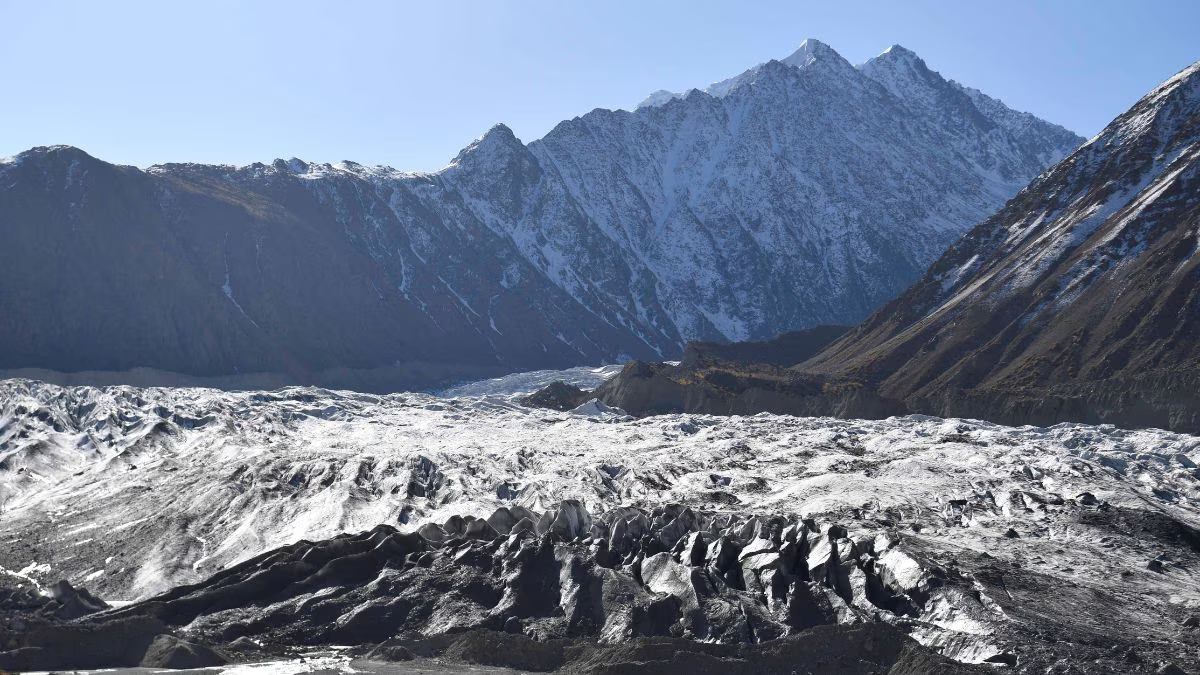
Earthquakes are pretty common in Afghanistan due to its placement on an active tectonic collision zone. However, what levaes many people scratching their heads is why are the tremors felt as far as in India? Here’s a look at why this happens
Published: June 29, 2026, 12:12 AM IST
Share Article
https://www.india.com/news/india/why-are-earthquakes-in-afghanistan-frequently-felt-across-north-india-explained-8460397/
Following a strong earthquake in Afghanistan, tremors were felt in northern parts of India as well. Representational image
Afghanistan was struck by a 6.2-magnitude earthquake on Saturday (June 27), with its tremors felt as far as Delhi, Jammu and Kashmir and several other north Indian states. The latest tremor came amid a series of recent earthquakes in the region and elsewhere.
On June 24 alone, Pakistan recorded four earthquakes, including a 5.5-magnitude tremor in Balochistan, while a 5.8-magnitude earthquake struck near eastern Honshu in Japan. In Venezuela, a fresh 4.9-magnitude quake hit off Aragua days after two powerful earthquakes, as rescue efforts continued and the death toll rose.
However, the tremors of the one that struck Afghanistan were felt not just in Pakistan but some parts of India as well. Let us take a look at why this happens.
Afghanistan lies in an active tectonic collision zone
Afghanistan sits directly atop a chaotic tectonic junction where the Indian Plate is continuously smashing northward into the Eurasian Plate. The Indian Plate moves northward at a rate of roughly 4 to 5 centimeters per year. As it rams into Eurasia, it builds up immense, unsustainable stress along major fault lines, particularly in the rugged Hindu Kush mountain range of northeastern Afghanistan.
Also Read | Massive 6.1-magnitude earthquake hits Japan; authorities urge citizens to stay alert, no tsunami threat
Unlike many coastal fault zones, the collision in the Hindu Kush creates exceptionally deep-seated earthquakes (often between 150km to 250 km beneath the surface). Unlike shallow quakes that release energy close to the surface, Hindu Kush earthquakes frequently strike at significant depths, often between 150 to over 200 kilometers underground.
Hindu Kush earthquakes are often deep-focus earthquakes
Notably, the Hindu Kush region, located in northeastern Afghanistan and the bordering areas of Tajikistan, is one of the most active deep-to-intermediate seismic zones on Earth, leading to frequent earthquakes and seismic waves being felt in surrounding regions.
The region features intense deformation resulting from the ongoing tectonic collision between the Indian and Eurasian plates. High-magnitude quakes often originate at depths ranging from 150 to 300 kilometers below the surface as the Indian tectonic plate sinks into the Earth’s mantle. Deep-focus earthquakes occur at depths greater than 70 kilometers. Because the energy is released so far underground, the seismic waves have less destructive energy concentrated at the immediate surface epicenter. Instead, the energy dissipates evenly and travels vast horizontal distances through the Earth’s crust.
Seismic waves from the Hindu Kush travel highly efficiently across the uniform and deep sedimentary layers of the Indo-Gangetic Plain, allowing tremors to be distinctly felt hundreds of kilometers away in North and Northwest India.
The impact of seismic waves felt in India
The Indo-Gangetic Plain’s thick, soft alluvial sediments cause seismic waves to slow down and accumulate energy. The process, known as soil amplification, magnifies the intensity of earthquakes originating from active tectonic zones, allowing tremors to travel long distances and be felt intensely across populated regions of India.
When seismic waves transition from stiff, rigid mountainous bedrock to thick, soft sediments, the velocity of the waves decreases while their amplitude (shaking intensity) spikes. Due to this efficient transmission, high-energy or deep-focus earthquakes occurring in the Hindu Kush region of Afghanistan or along the Himalayan Arc are frequently felt as noticeable tremors across North India.
Higher magnitude earthquakes
The stronger the earthquake, the chances of it being felt across a wider region are higher. Therefore, an earthquake of 6.2 magnitude in Afghanistan will be felt across neighbouring regions like India and Pakistan as compared to a 2-3 magnitude earthquake. In this case, since the quake originated at a deep focal point, the seismic energy traveled vast distances, allowing people to feel the shaking without major structural damage in India.
Also Read | Strong Earthquake hits Delhi NCR, tremors felt across Northwest India, Pakistan
Earthquake magnitude is tied directly to the elastic energy released, with every 1.0 increase in magnitude releasing about 31 times more energy. And while local tremors are caused by massive events in the Himalayas or neighboring countries, the level of impact in India depends heavily on two core factors, namely magnitude, depth and distance. Shallow, close-proximity quakes carry devastating energy to the surface, while deep events lose significant impact by the time waves reach cities like Delhi and Kanpur.
High-rise buildings enhance the sensation
India is home to skyscrapers and other tall buildings and it is a known fact that high-rise buildings physically amplify the sensation of shaking. Thus, when tremors are felt in Delhi-NCR and Punjab among other regions, they get amplified due to the number of high-rise buildings that are inhabited in the region. Because tall buildings are built to be flexible, they sway more in response to distant, slow seismic waves (far-field earthquakes), causing those on upper floors to feel tremors much more intensely than people on the ground.
Although advanced high-rises in Indian metropolises increasingly use specialised engineering features like base isolation (shock-absorbing pads/rollers at the foundation) and tuned mass dampers to counteract dangerous oscillations. However, just like a swinging pendulum, the movement is heavily magnified at the top of a skyscraper, even though the structural movement at the base is minimal. Thus, sways can be easily felt in India.