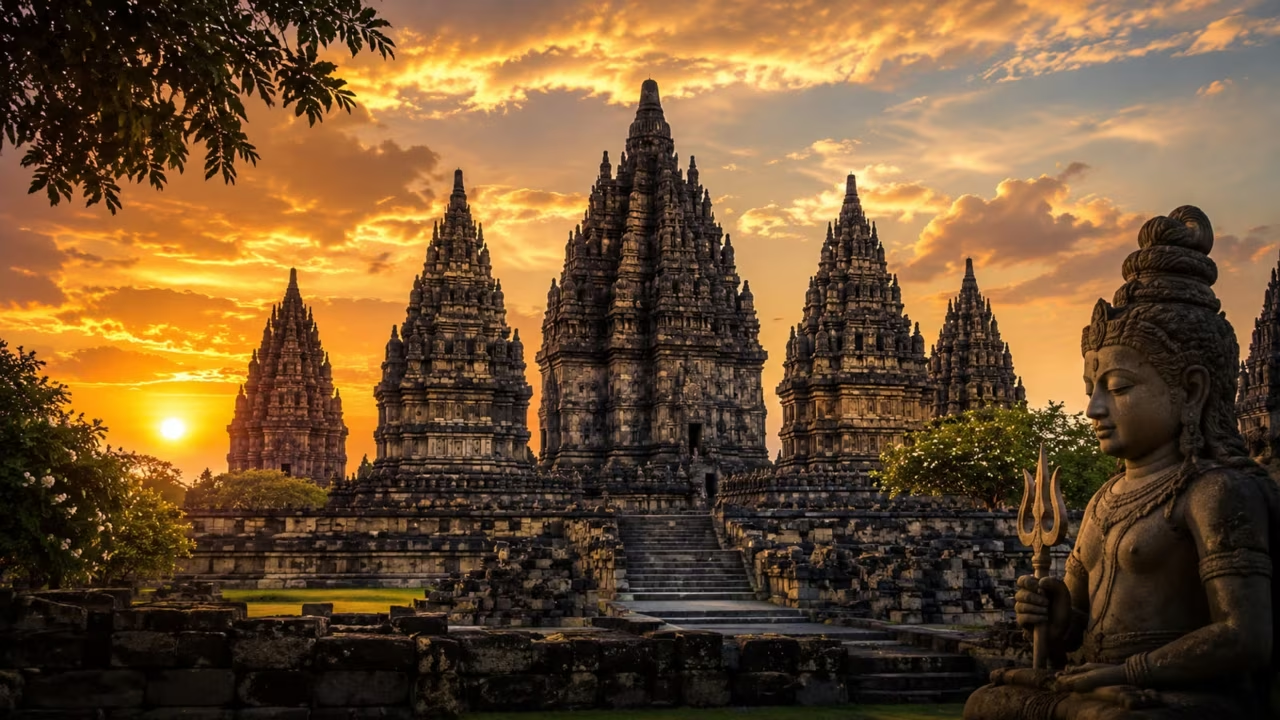
During Prime Minister Narendra Modi visit to Indonesia, India has agreed to provide technical assistance in the restoration of the 1170-year-old Prambanan Shiva temple complex on the island of Java. This temple was built by the kings of the Hindu Sanjaya dynasty and is today a UNESCO World Heritage Site.
Updated: July 7, 2026, 11:03 AM IST
Share Article
https://www.india.com/news/india/prambanan-temple-indonesia-shiva-temple-how-a-1170-year-old-shiva-temple-holds-a-hidden-secret-in-indonesia-and-whats-its-connection-to-india-8467390/
How a 1,170-year-old Shiva temple holds a hidden secret in Indonesia and what’s its connection to India (AI image)
PM Modi Indonesia Visit : During Prime Minister’s visit to Indonesia, it is agreed upon that India is going to help renovate an ancient Shiva temple there. Most people know that Indonesia has the world’s largest Muslim population. People certainly know about the island of Bali, where Hindus live. But Indonesia has also had a Hindu and Buddhist culture throughout its history, and Indonesia is one of those countries that doesn’t deny its history before the advent of Islam.
1170-year-old Shiva temple
Excavations conducted in the 19th and 20th centuries revealed inscriptions written in Old Sanskrit and the ancient Javanese language on the walls and stones of the temples. One inscription read “Shivagriha” and was dated 856, meaning 1170 years ago. Upon reading it, it was revealed that this was a Shiva temple, built by Hindu kings of the Sanjaya dynasty. King Rakai Pikatan initiated the project around 850. The main Shiva temple was inaugurated by King Lokapala in 856. This suggests that these large and beautiful Hindu temples were built near Yogyakarta, on the Indonesian island of Java. This complex is called the Prambanan Temple. King Rakai Pikatan, of the Hindu Sanjaya dynasty of the Mataram Empire, commissioned this temple.
Who built the Shiva temple?
Later, his successor, King Lokpal, completed the main Shiva temple. But it’s not just a Shiva temple. It’s dedicated to the three main Hindu deities: Brahma, Vishnu, and Shiva. Therefore, it’s also known as the Trimurti Temple. The largest and tallest temple in the center is the Shiva temple, standing approximately 47 meters tall. To its left and right are temples dedicated to Vishnu and Brahma, and hundreds of smaller temples surround it. In total, the entire complex comprises approximately 250 temples. And, the entire story of the Ramayana was found carved into the very stones on the temple walls. The statue, which the locals had previously believed to be the princess from the story, is actually a statue of Durga Mahishasuramardini. Research conducted after the excavations revealed that the temple was magnificent when it was built, and the surrounding area was a major center of Hindu culture.
How did Hinduism reach Indonesia?
And now it is believed that about 100 years after the temple was built, the nearby Merapi volcano erupted, causing several earthquakes. You know that even today, when volcanoes erupt in Indonesia, flights are often canceled. The same thing happened then. People had to flee eastward. Therefore, it is believed that Hinduism survived on the island of Bali. But how did Hinduism reach there? Did Indian kings invade and conquer it? No, in the first century, that is, about 2000 years ago, Indian traders arrived in Indonesia by sea. These were traders from South India. Indonesia is located east of what is today Tamil Nadu.
What is the connection between India and Indonesia?
Those traders traded spices, textiles, gold, and silver. Hindu culture travelled with them. Indonesia revered nature, so the people there found Hindu traditions similar to their own. But most importantly, the kings were impressed by the fact that in India, where these traders came from, the king was considered an incarnation of God. They wanted to spread this belief among their subjects so that their rule would not be challenged. Just as kings in India had Brahmin advisors, they also brought Brahmins from India. And these people brought their Hindu culture with them: the stories of the Ramayana and Mahabharata, the worship of Shiva and Vishnu, the Sanskrit language, and the art of temple construction.
Hinduism is still alive in Indonesia
Brahmins taught Hinduism to kings, and the same worship system spread naturally among the people. Buddhism also arrived via the sea in a similar way. By the 8th-9th centuries, large Hindu-Buddhist kingdoms had emerged in Java and Sumatra, such as the Mataram Empire, which built the Prambanan Temple, and later the Majapahit Empire. Through trade, friendship, and the will of the kings, Hinduism gradually spread there and took on a unique form. Islam arrived with traders from Persia and Arabia in the 13th century. And so, on islands like Java, the old temples remained in ruins for centuries.
This temple is a world heritage site
In the early 20th century, when the true nature of the Prambanan temples was discovered, the Dutch government commissioned the restoration of the temples. This work was carried out using anastylosis techniques. This meant that the temples were reconstructed by matching the old stones that were scattered around, determining where they fit. Indonesia then gained independence, and even after independence, the Indonesian government continued this work. The main Shiva temple was fully completed in 1953. In 1991, UNESCO declared the entire Prambanan complex a World Heritage Site. Although another earthquake struck the area in 2006, the damage has been repaired.
Indian government building this temple
Now, news is that India will help restore this ancient temple. Experts from India’s ASI have already inspected the temple. The stones from the smaller temples throughout the complex will first be reassembled using the same anastylosis method. This means that the original scattered stones will be carefully reassembled to restore the temples’ original appearance. New stones will be used only when necessary. Therefore, there’s talk of starting a pilot project on one or two smaller temples first, to better understand the method used to build these temples.