

Iconic by ONE VISION, led by Founder Abhinav Reddy, has unveiled India’s largest Digital Out-of-Home (DOOH) display at SAS Tower in Hyderabad, setting a new benchmark for premium outdoor advertising in the countryThe launch is part of the company’s broader national expansion, which already spans five cities and will extend to Gurugram by the end of 2026, with further expansion into new states planned for 2027It reflects a growing shift toward technology-enabled, high-impact consumer engagement, as brands look beyond traditional media to connect with audiences in more dynamic and immersive ways.
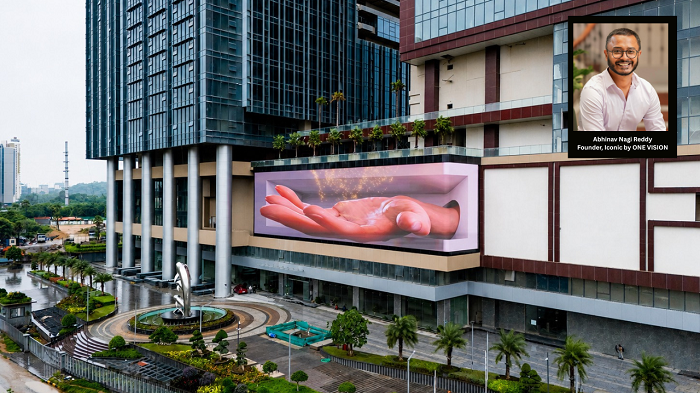 |
Hyderabad just got India’s first 8K, largest anamorphic DOOH screen, built on Absen A25 LED panels for deep-perspective 3D without glassesThe company eyes Gurugram next
DOOH is emerging as one of the fastest-growing segments within the advertising ecosystem, driven by its ability to deliver data-driven, real-time, and visually striking brand experiences at scaleWith this launch, Hyderabad joins a select group of global cities investing in next-generation digital infrastructure for advertising and public engagement.
Spanning 586.14 square meters of continuous L-shaped display area (roughly the size of eight pickleball courts, or two basketball courts), the installation at SAS iTower in Nanakramguda is India’s largest cinematic digital screen and Hyderabad’s first-ever 8K DOOH displayIt is powered by advanced Absen A25 series LED panels and programmed for deep-perspective anamorphic content, creating hyper-realistic 3D visual effects, without the need for 3D glasses, that make objects appear to leap off the flat panelsThe display has already become a landmark media wall in Hyderabad’s Financial District, drawing crowds and generating viral attention for its high-definition cinematic content and brand activations.
To put its scale in context: the average DOOH screen across India measures roughly 20ft x 10ft, and the largest screen in Hyderabad prior to this installation stood at 80ft x 10ftThe new display at SAS iTower significantly surpasses both benchmarks, positioning Hyderabad among a small set of Indian cities with large-format, 8K-capable cinematic DOOH infrastructure.
Screen and Technology Specifications
-
Size: 586.14 sqm of continuous L-shaped display area (~8 pickleball courts / 2 basketball courts) -
Resolution: Hyderabad’s first 8K DOOH display -
Technology: Absen A25 series LED panels -
Visual Effects: Deep-perspective anamorphic content enabling realistic 3D depth without glasses
“Outdoor advertising in India is at an inflection pointBrands don’t just want visibility anymore, they want screens that make people stop, look up, and remember what they sawThat’s the space Iconic by ONE VISION was built for,” said Abhinav Reddy, Founder, Iconic by ONE VISION“We set out to build large-format, cinematic-grade DOOH infrastructure across India’s growing cities, and today we’re present in five: Bangalore, Bhopal, Jaipur, Thiruvananthapuram and BhubaneswarHyderabad is our biggest canvas yet, but it’s far from the lastWe’re entering Gurugram by the end of this year, with more states to follow in 2027This is just the start of what we’re building.”
Strong Brand Traction from Day One
Since going live, Iconic by ONE VISION’s screens have already attracted major national brands, including Apple’s iPhone 17 launch campaign on the company’s Bhopal screen and Prestige Group’s apartment launch campaign in BangaloreThe Hyderabad installation is off to a strong start of its own: three campaigns already booked within its second week of operations, an early signal of demand for large-format, high-impact DOOH in the cityAcross its network, Iconic by ONE VISION works with leading names in real estate, jewellery and hospitality, the categories most drawn to the format’s scale and visibility.
With premium ad slots filling up quickly, the company is inviting brands in real estate, jewellery, automotive and financial services to plan campaigns ahead of the festive season, as slots around Dussehra are expected to sell out.
A Growing National Footprint
The Hyderabad launch adds to Iconic by ONE VISION’s presence across six cities: Bangalore, Bhopal, Jaipur, Thiruvananthapuram, Bhubaneswar and HyderabadIts screen at DB Mall in Bhopal holds a similar distinction locally, as the largest anamorphic display in Madhya PradeshIn its first year of operations, the company crossed Rs1 crore in overall business, a milestone Reddy credits to growing brand appetite for large-format, immersive advertising formats across India’s metro and emerging urban markets.
Key highlights of the launch include:
-
A landmark for Hyderabad’s advertising ecosystem: the vision behind bringing India’s largest DOOH display to the city and its significance for local brands and businesses. -
A technological first: Hyderabad’s first 8K DOOH display, over 7x the size of the city’s previous largest screen. -
The future of outdoor advertising: how DOOH is transforming static formats into dynamic, data-driven, and immersive brand experiences. -
A premium channel for brand visibility: why digital outdoor media is becoming essential for brands seeking stronger recall and engagement. -
A national growth story: five cities, Rs1 crore in first-year business, and expansion into Gurugram and new states on the horizon.
A glimpse of the installation can be viewed here: Instagram Reel
About Iconic by ONE VISION
Founded by Abhinav Reddy in July 2024, Iconic by ONE VISION builds large-format, cinematic-grade digital out-of-home (DOOH) infrastructure, including some of India’s most technically advanced anamorphic 3D screensThe company operates across six cities, Bangalore, Bhopal, Jaipur, Thiruvananthapuram, Bhubaneswar and now Hyderabad, and has run campaigns for national brands including Apple and Prestige GroupIn its first year of operations, Iconic by ONE VISION crossed Rs1 crore in business, and continues to expand nationally, with Gurugram set to go live by the end of 2026.