The Rashtriya Swayamsevak Sangh is widely considered the world’s largest voluntary organisation, yet it operates solely as a non-governmental entity. Here’s how it stays out of formal political power
Published: June 20, 2026, 10:40 PM IST
Share Article
https://www.india.com/news/india/how-rss-rashtriya-swayamsevak-sangh-shapes-policy-without-contesting-elections-8452510/
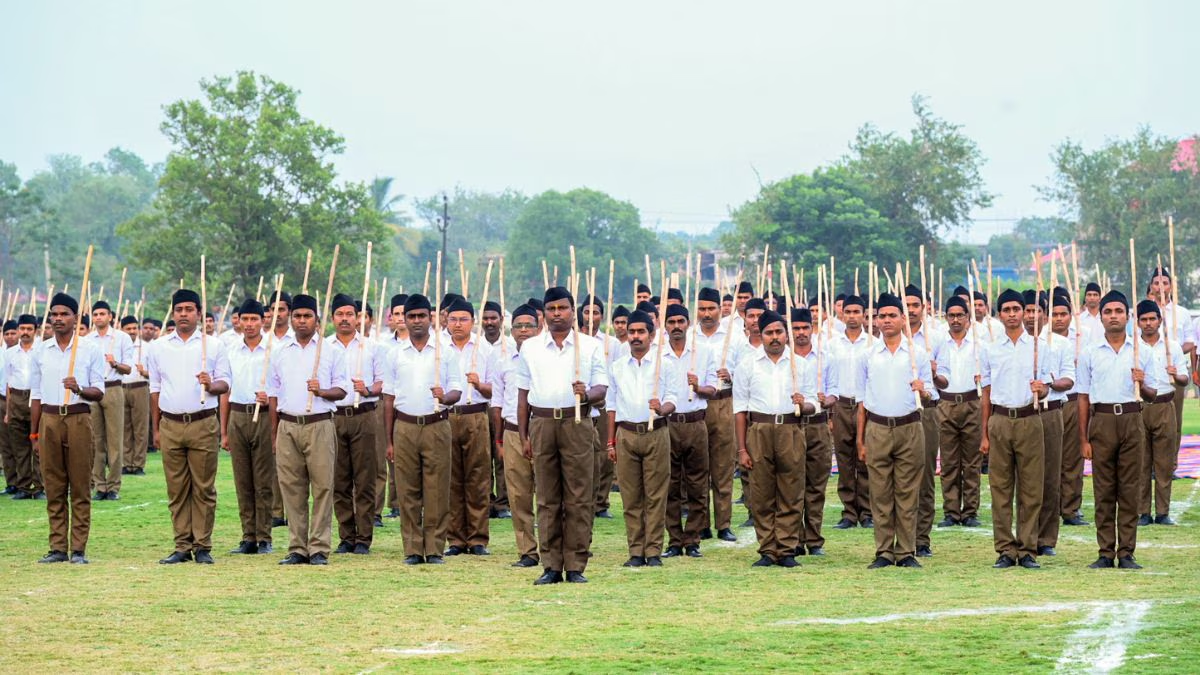
The long-term grassroots presence helps the organisation shape narratives around nationhood, governance. PTI/File image
The Rashtriya Swayamsevak Sangh (RSS) has once again come under discussion after Karnataka Minister Priyank Kharge questioned its transparency, legal status, and financial reporting, saying organisations with wide public influence should be more accountable. However, despite being the world’s largest voluntary organisation, it operates strictly as a non-governmental entity, choosing never to contest elections or hold formal state power.
Let us take a look at how the RSS exerts profound policy influence without ever appearing on a ballot.
Read more:
Nagpur University Introduces RSS Role in Nation-building , Its History in Varsity s Syllabus
Ideological foundation and long-term influence
At its core, the Rashtriya Swayamsevak Sangh functions as a cultural and ideological organisation. Founded in 1925, it promotes a vision of national identity rooted in cultural nationalism. Over decades, it has built a structured network of volunteers (swayamsevaks) who participate in social work, education initiatives, disaster relief, and community activities.
This long-term grassroots presence helps the organisation shape narratives around nationhood, governance, and social priorities. Instead of direct political campaigning, its influence is often exercised through shaping how issues are framed in public debate, such as cultural identity, education reforms, nationalism, and social cohesion.
Indirect political influence through affiliated organisations
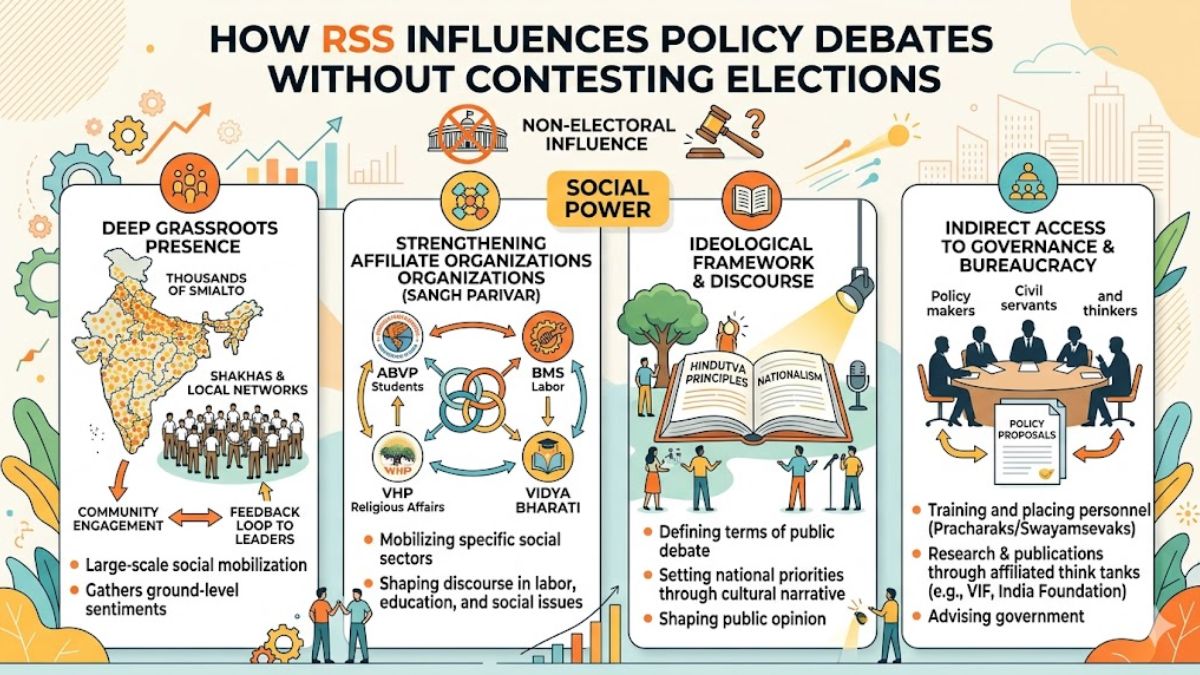
One of the key ways the RSS influences policy debates is through its extensive network of affiliated organisations, often referred to as the ‘Sangh Parivar.’ These groups work in diverse sectors, including labour, education, student politics, rural development, and trade unions. Through these organisations, policy preferences are articulated in multiple forums, ranging from university campuses to labour negotiations and civil society discussions. This creates a layered ecosystem where ideas are tested, refined, and eventually enter mainstream political discourse.
For example, student and youth organisations affiliated with the broader ecosystem often participate in debates on education policy, curriculum changes, and national identity issues. Similarly, labour and farmer groups contribute to discussions on economic reforms and rural development policies.
Influence on political leadership and decision-making
Although the RSS itself remains formally separate from electoral politics, many leaders of political parties in India have historically been associated with it at some stage of their careers. This creates a shared ideological foundation between the organisation and sections of the political leadership.
Policy influence also occurs through what scholars often describe as policy diffusion. AI-generated image
This connection allows for informal consultation and ideological guidance on major policy questions. While decisions are ultimately made by elected governments, the RSS’s perspectives often find resonance in policy discussions on issues related to cultural policy, education, civil society regulation, and national security. It is important to note that this influence is not always direct or uniform. Different governments and leaders interpret or engage with these ideas in varying degrees depending on political context and governance priorities.
Shaping public discourse and narratives
The RSS influences policy debates by shaping public discourse beyond political institutions. Through its publications, public meetings, training camps, and intellectual forums, it promotes specific interpretations of historical, cultural, and social issues.
These narratives often enter mainstream media discussions and policy debates, particularly during periods of national significance such as constitutional reforms, education policy revisions, or major social legislation.
In democratic systems, public opinion plays a critical role in shaping policy direction. By influencing how citizens and opinion-makers understand issues, the RSS indirectly contributes to the policy-making environment even without holding office.
Role in civil society engagement
The organisation is involved in large-scale service activities, including healthcare camps, disaster relief operations, rural development projects, and educational initiatives. These activities help build trust and grassroots legitimacy in many regions.
This presence enables the organisation to remain closely connected to social realities, which in turn informs its policy perspectives. Issues raised through these networks often feed into broader debates on governance priorities such as rural infrastructure, education access, and social welfare.
Institutional ecosystem
Policy influence also occurs through what scholars often describe as “policy diffusion.” Ideas developed within ideological or think-tank ecosystems gradually move into formal policy spaces. In the case of the RSS, affiliated think tanks and intellectual forums contribute research, position papers, and policy suggestions that are sometimes adopted or adapted by policymakers.
This process does not imply direct control over government decisions, but rather a gradual alignment of ideas through sustained engagement over time. The strength of this model lies in continuity, ideas are not introduced as isolated proposals but as part of an ongoing intellectual tradition.