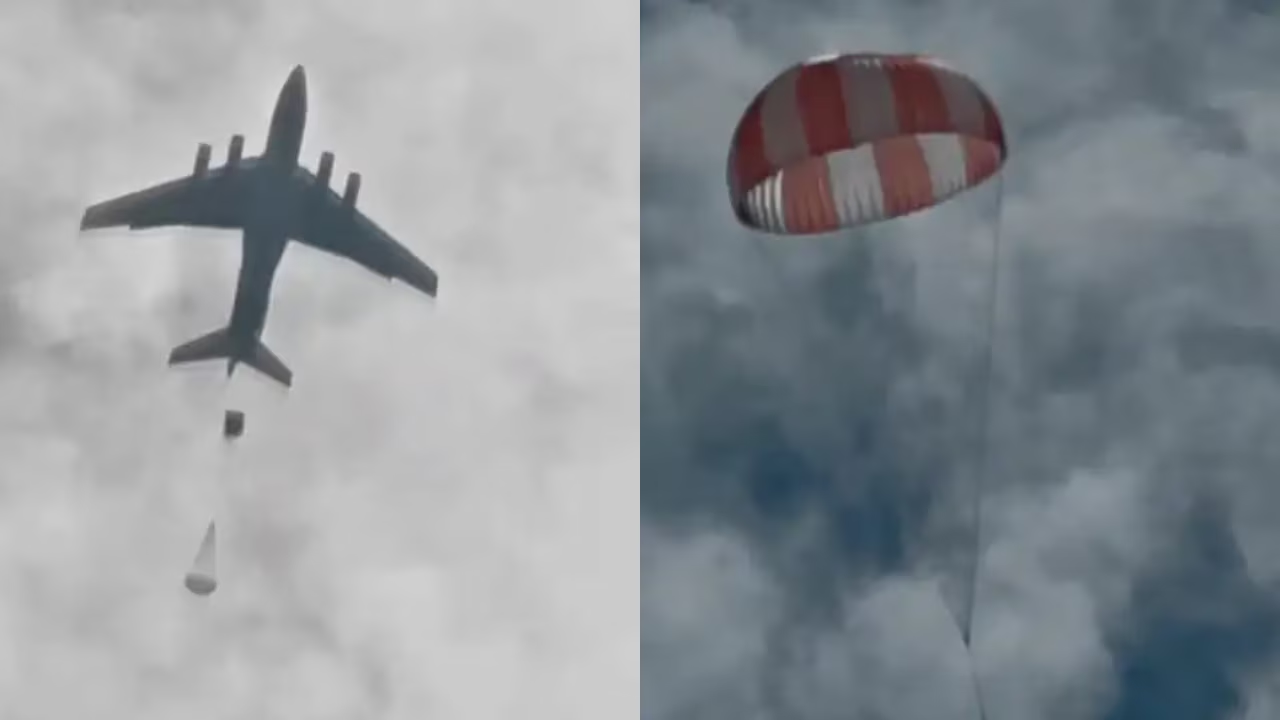
Indian Space Research Organisation (ISRO) successfully conducted a critical Integrated Main parachute Airdrop Test (IMAT) for the Gaganyaan Missions.
Published: July 10, 2026, 11:33 AM IST
Share Article
https://www.india.com/news/india/why-is-the-parachute-system-considered-one-of-the-most-critical-safety-components-of-the-gaganyaan-mission-critical-test-main-parachutes-gaganyaans-crew-module-successful-explained-8470128/

ISRO successfully conducts critical test on main parachutes for Gaganyaan’s crew module(Photo Credit: ISRO’s official website)
Indian Space Research Organisation (ISRO), the space agency of India, has been making strides in the space programme. Its key mission is to design and in the developloment of launch vehicles and related technologies for providing access to space and design and development of satellites and related technologies for earth observation, communication, navigation, meteorology, and space science. Meanwhile, its upcoming mission ‘Gaganyaan’ has been in the news headlines.
ISRO successfully conducts critical test on main parachutes for Gaganyaan’s crew module
Earlier, on July 7, Indian Space Research Organisation (ISRO) successfully conducted a critical Integrated Main parachute Airdrop Test (IMAT) for the Gaganyaan Missions. The test was carried out at the Aerial Delivery Research and Development Establishment (ADRDE) drop zone in Sheopur, Madhya Pradesh.In a statement on Wednesday, the space agency stated, ” The deceleration system of Gaganyaan Crew Module comprises of a total of 10 parachutes of 4 types. The descent sequence begins with two Apex Cover Separation parachutes that remove the protective cover of the parachute compartment, followed by two Drogue Parachutes that stabilize and decelerate the module. Upon release of the drogues, three Pilot Parachutes are deployed to extract three Main Parachutes, which further slows down the Crew Module to ensure a safe splashdown in the sea.”

Photo Credit: Taken from the official website of ISRO
What is the primary objective of the test?
The primary objective of this test was to qualify the Main Parachute for its structural integrity & design margins under the maximum expected load conditions in the first uncrewed Gaganyaan G1 mission. A simulated assembly of single main parachute and a dummy mass was dropped from an altitude of 2.5 km using an Indian Air Force IL-76 aircraft. The complex descent sequence began with an extractor parachute that deployed a Drogue parachute to stabilize oscillations. Upon achieving the requisite conditions, the main parachute was deployed, which slowed the payload to a safe terminal speed.

Photo Credit: Taken from the official website of ISRO
This is the fifth test in a series of Integrated Main parachute Airdrop Tests (IMAT) to qualify the critical Main Parachute for the Gaganyaan Mission. The successful completion of IMAT-05 provides necessary confidence in the performance and reliability of the Main Parachute System for the first Uncrewed Gaganyaan Mission (G1).
ISRO conducts critical test on main parachutes for Gaganyaan’s crew module| Watch video
Speaking of the parachute system, it is one of the most key features in terms of the safety of the mission. The parachute system plays a crucial role in ensuring crew safety during re-entry. After the crew module descends through Earth’s atmosphere at high velocity, a meticulously sequenced deployment of parachutes will slow it to a safe landing speed.
The agency has launched hundreds of Indian and foreign satellites, supporting services such as weather forecasting, disaster management, agriculture, education, telecommunications, navigation, and environmental monitoring. The organisation has achieved several landmark milestones, including the Chandrayaan lunar missions, the Mars Orbiter Mission (Mangalyaan), the Aditya-L1 solar mission, and the SpaDeX mission for in-space docking technology. According to the official website of ISRO, Gaganyaan project envisages demonstration of human spaceflight capability by launching crew of 3 members to an orbit of 400 km for a 3-day mission and bring them back safely to earth, by landing in Indian sea waters.
“The project is accomplished through an optimal strategy by considering inhouse expertise, experience of Indian industry, intellectual capabilities of Indian academia & research institutions along with cutting edge technologies available with international agencies. The pre-requisites for Gaganyaan mission include development of many critical technologies including human rated launch vehicle for carrying crew safely to space, Life Support System to provide an earth like environment to crew in space, crew emergency escape provision and evolving crew management aspects for training, recovery and rehabilitation of crew,” reads the website.