
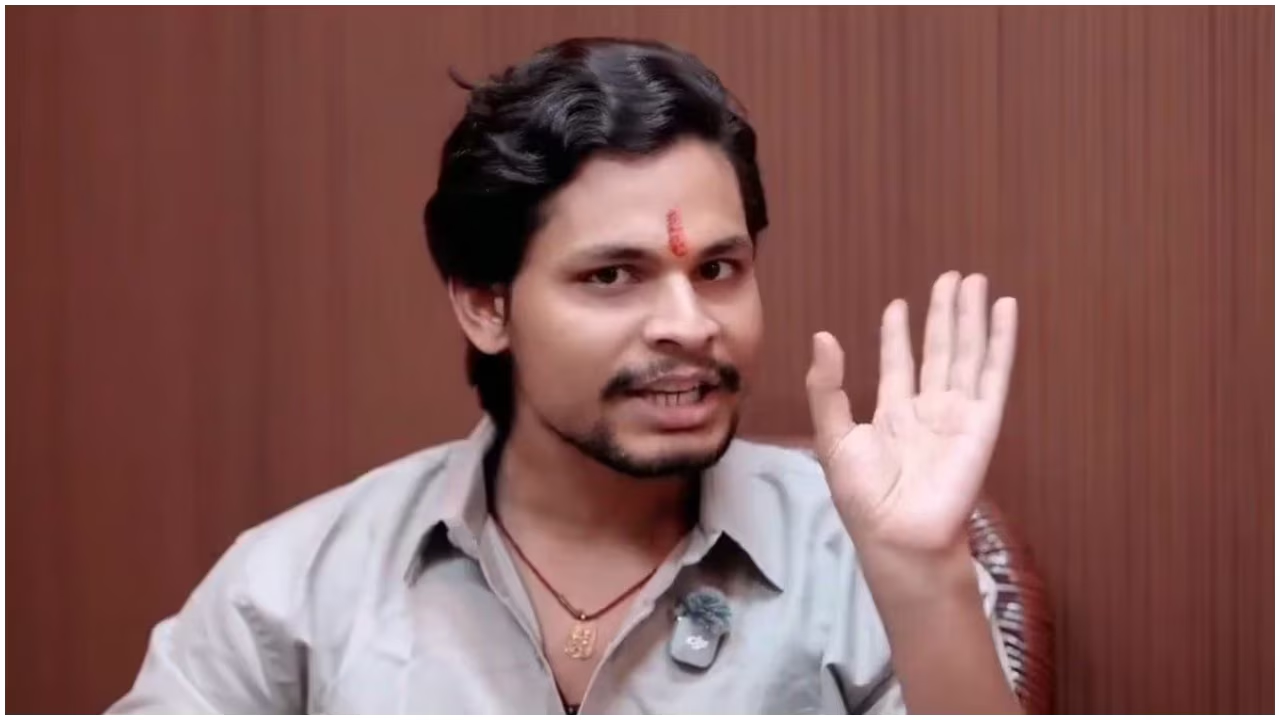
A Delhi court on Monday extended the judicial custody of Swatantra Bhardwaj till September 21
Share Article
https://www.india.com/news/india/swatantra-bhardwaj-sent-to-judicial-custody-till-sept-21-in-cjp-assault-case-jantar-mantar-assault-case-sanjay-azad-8518906/
Swatantra Bhardwaj sent to judicial custody till Sept 21 in CJP assault case | IOmage: X
Jantar Mantar Assault Case: In the latest development in the alleged assault of Sanjay Azad during a Cockroach Janta Party (CJP) protest at Jantar Mantar, a Delhi court on Monday extended the judicial custody of Swatantra Bhardwaj for 14 days, till September 21Police produced Bhardwaj before Special Judge Saurabh Pratap Singh Laler of Patiala House Court, who passed the order extending his judicial custody for 14 daysBhardwaj was presented before the court via video conferencing from Tihar Jail after the expiry of his one-day police custody.
The Delhi Police had moved an application seeking 14 days’ judicial custody of Bhardwaj, which was allowed by the courtHe will now be produced before the court on September 21.
The court also permitted Bhardwaj’s counsel to obtain his signed Vakalatnama from Tihar Jail.
Bhardwaj had earlier been remanded to one-day judicial custody on September 6 by the duty magistrate after his one-day police custody endedHe was produced through video conferencing before Duty Judicial Magistrate First Class Anjali Singh, who granted the one-day judicial remand after hearing the matter at her residence.
Before that, Special Judge Laler had remanded Bhardwaj to one-day police custody on September 5He was produced at the residence of the concerned judge at the Karkardooma Court complex citing safety and security concerns.
Bhardwaj was detained in Bulandshahr, Uttar Pradesh, by the Delhi Police Crime Branch on September 4 and subsequently brought to DelhiHe was arrested in connection with an FIR relating to the alleged assault of Sanjay Azad during the CJP protest at Jantar Mantar on June 23.
The case was initially registered under provisions relating to causing hurt and wrongful restraintThe Delhi Police subsequently added provisions of the SC/ST (Prevention of Atrocities) Act and criminal intimidation to the FIRA separate POCSO case has also been registered in connection with alleged threats to a minor, according to reports.
According to the grounds of arrest cited before the court, the matter came to light again after a podcast interview in which Bhardwaj allegedly claimed that he had hit Sanjay Azad on the head with a kada he was wearingThe alleged assault took place during the CJP protest on June 23.
The Delhi Police had earlier said that Sanjay Azad sustained a head injury from a kada during a scuffle and that his injuries were medically assessed as simplePolice have also said that Bhardwaj and another accused, Suraj Kumar, were detained and questioned after the incident and that due legal action was being taken.
The arrest followed renewed demands for action against Bhardwaj after his remarks in the podcast circulated widely on social mediaThe CJP and other supporters of Sanjay Azad had subsequently approached the Parliament Street Police Station, demanding his arrest and the addition of appropriate provisions of the SC/ST Act.
Advocate Rishav Ranjan, appearing for the complainant, had said that a meeting was held with a senior Delhi Police officer, during which the family was assured that appropriate SC/ST Act provisions would be added and Bhardwaj would be arrested within 72 hours.
MP Chandrashekhar Azad, Sanjay Azad and other lawyers were also present during the meeting at the Parliament Street Police Station.
(wiht ANI inputs)