


The Hypospadias Foundation at MITR Hospital, Kharghar, Navi Mumbai celebrates 18 years today, with completion of more than 2000 hypospadias surgeries and provision of care for patients from across India and more than 30 countriesOn the occasion, the Foundation’s doctors called for earlier diagnosis, timely referral to experienced teams, and more open conversation about a condition that is common at birth but rarely discussed.
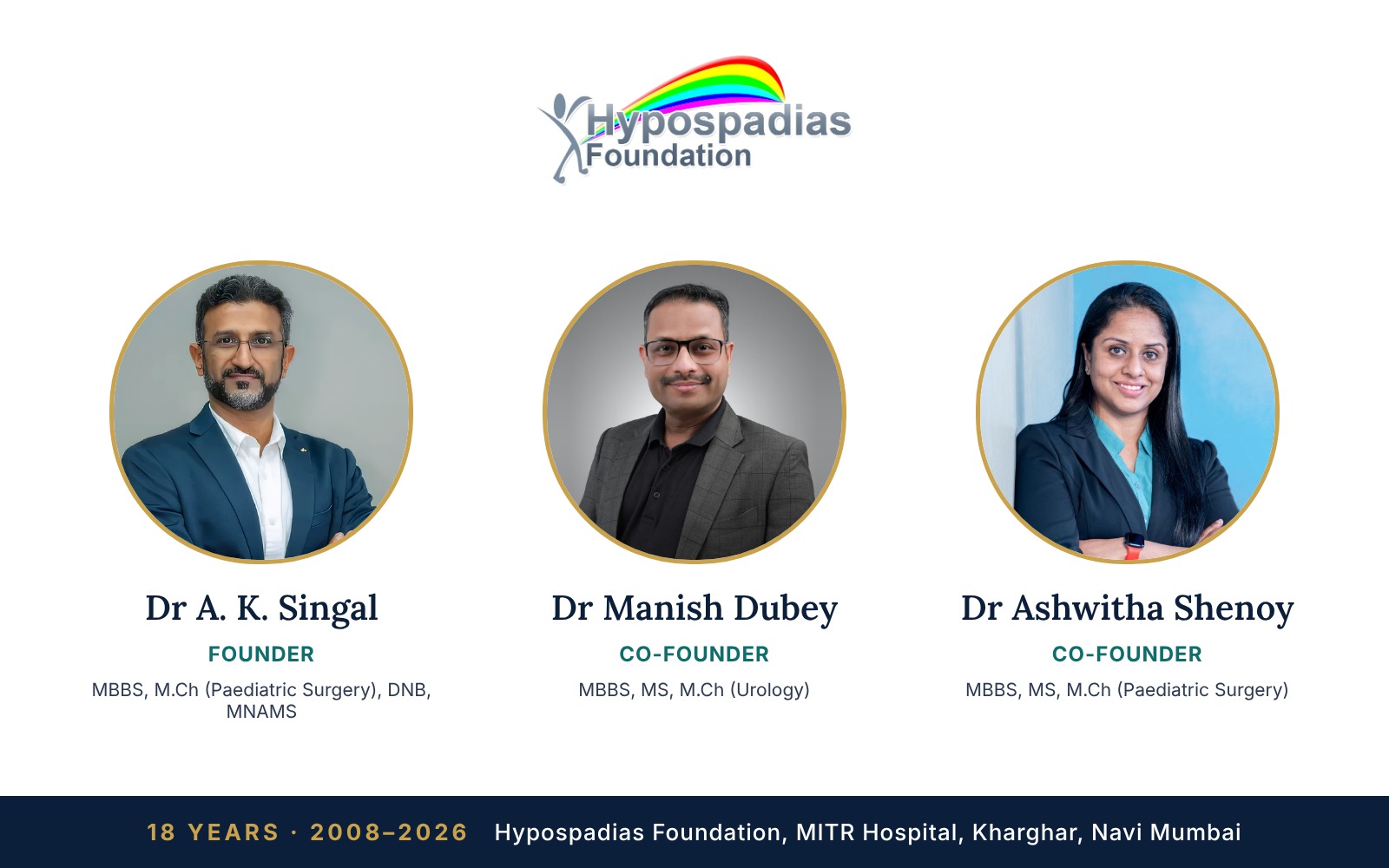 |
Hypospadias Foundation Doctors celebrate 18th Anniversary
Hypospadias is a congenital condition affecting boys in which the urinary opening is on the underside of the male organ instead of at its tipIt affects an estimated one in every 200 to 300 boys at birthBecause it involves the male organ, many families hesitate to seek advice, delay treatment, or do not reach a team experienced in the conditionSome children undergo repeated operations, and some adults live for years with the consequences of unsuccessful childhood surgery.
Started to close a gap in care
The Foundation was established on 26 November 2008 by Dr AKSingal and Dr Manish DubeyDuring his M.Chtraining at AIIMS, Dr Singal had seen that many children undergoing hypospadias surgery were not getting satisfactory results, and that many stayed in hospital for seven to ten days after the operation.
“We started the Foundation with a clear mission: to improve not just the surgical result, but the entire experience of a child undergoing hypospadias surgery,” said Dr AKSingal, Pediatric Urologist & Founder, Hypospadias Foundation, “Hypospadias is a treatable conditionWith proper assessment, the right surgical expertise and good postoperative care, children can do very wellParents should not have to accept repeated surgeries or poor results as inevitable.”
18 years of protocol-led hypospadias care
Over 18 years, the Foundation’s team has developed protocols for each stage of hypospadias treatmentBefore surgery, these cover detailed evaluation, hormonal assessment and optimisation where indicated, and individualised surgical planningDuring surgery, they cover refined techniques, careful tissue handling, appropriate instruments and anaesthesia with strong pain controlAfter hypospadias surgery, they cover pain relief, judicious antibiotic use, dressings, double-diaper care and early mobilisationAccording to the Foundation, most children now go home after a single night in hospital, including many with complex conditions.
The Foundation has also chosen to share what it has learnedVarious surgical technique videos are available on its YouTube channel, made for surgeons worldwide, and they have been viewed about five million times, and its treatment protocols are published on its website for other clinicians to use.
Since 2017, Foundation has also collaborated with Ibn Al Nafees Hospital in Bahrain to launch Hypospadias Clinic with Dr Singal visiting Bahrain and providing care to children in Bahrain along with support from Dr Mahmood AbbasMore than 100 children have been treated there as well.
A growing share of complex cases
Around 40% of patients who reach the Foundation have already had one or more hypospadias operations elsewhereSuch redo surgeries are more demanding because of scarring, altered anatomy and less healthy tissue available for reconstructionIn 2026 alone, the team has treated more than 50 patients with scrotal hypospadias, one of the more severe forms of the conditionThe Foundation has also managed more than 200 patients with differences of sex development (DSD).
“Almost every week we see a child or an adult who has already been through more than one operation,” said Dr Ashwitha Shenoy, Pediatric Urologist & Co-founder, Hypospadias Foundation“These cases need careful assessment, counselling and, often, staged reconstructionEarly referral to an experienced team can spare a family a great deal of distress.”
Care that continues into adulthood
The Foundation says a hypospadias repair must serve the child for life, not only in childhoodIts pathway includes transition to an adult urology team as patients grow older, so that they have a place to return to if questions or problems arise later.
“Because this condition involves a private part of the body, children often grow up with unanswered questions and parents carry guilt they do not need to carry,” said Dr Manish Dubey, Adult Urologist & Co-founder, Hypospadias Foundation“Good care includes counselling and an environment where families can talk without embarrassment.”
A message to paediatricians and families
Marking its 18th year, the Foundation thanked the paediatricians and family physicians who refer children to itIt urged them to look out for hypospadias at the newborn examination and to refer early to an experienced teamIt also advised parents not to have a baby with hypospadias circumcised until a specialist has examined the child, because the foreskin may be needed for the repair.
“The first 18 years of Hypospadias Foundation were about building expertise,” Dr Singal said. “The next 18 must be about awareness, so that no family has to struggle alone with uncertainty or silence.”
About the Hypospadias Foundation
Established on 26 November 2008 and based at MITR Hospital, Kharghar, Navi Mumbai, the Hypospadias Foundation is dedicated to the care of children and adults with hypospadias and differences of sex development (DSD)Its work spans primary and complex reconstructive surgery, management of previously unsuccessful repairs, protocol development, counselling for patients and parents, medical education and public awarenessThe clinical team is led by Dr AKSingal, [MBBS, MCh Ped Surgery, DNB, MNAMS, RegNoMMC2006031839]; Dr Manish Dubey, [MBBS, MS, MCh Urology, RegNoMMC 76486]; and Dr Ashwitha Shenoy, [MBBS, MS, MCh Ped Surgery, RegNo MMC 2020106004.].