


New Delhi, Delhi, India
-
15 finalist teams from across 9 Indian states and Delhi will travel to Mumbai to participate in the first-ever Children’s Earthshot, a two-day programme at the Museum of Solutions, alongside The Earthshot Prize’s 2026 Summit. -
Five winners, one from each Earthshot category, will be announced at the Children’s Earthshot Awards CeremonyEach winning team will receive US$2,000 to further develop and implement its environmental solution. -
The I CAN Earthshot Challenge marks the biggest youth outreach initiative in The Earthshot Prize’s history, engaging close to one million students across 15,000 schools in 24 Indian states. -
India has produced more Earthshot Prize Winners and Finalists than any other country, underscoring its growing contribution to environmental innovation and solutions.
The Earthshot Prize, the world’s most prestigious environmental award, in partnership with Brazilian organisation Alana and global youth movement Design for Change, today announced the 15 finalists of the inaugural I CAN Earthshot ChallengeI CAN Earthshot ChallengeThe initiative celebrates young changemakers from across India who are creating practical solutions to some of the most pressing environmental challenges facing their communities.
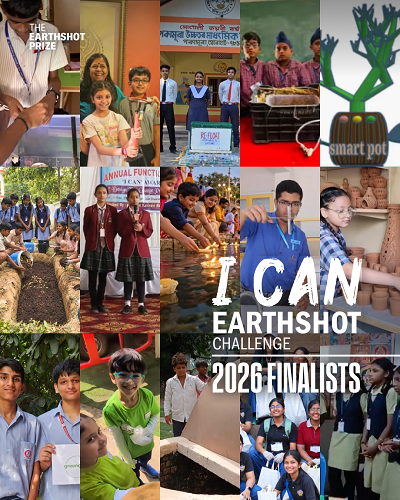 |
I CAN Earthshot Challenge 2026 finalists driving environmental change
Marking the biggest youth outreach initiative in The Earthshot Prize’s history, the Challenge has reached close to one million students through more than 15,000 schools across 24 Indian states, alongside an open digital platform accessible nationwideThe initiative invited children aged 9 to 17 to look beyond environmental awareness and take meaningful action, empowering them to become part of the generation driving solutions to repair and restore the planet following the five Earthshots: Protect and Restore Nature, Revive our Oceans, Clean our Air, Build a Waste-Free World and Fix our ClimateChildren submitted their ideas between June and October.
From tackling air pollution in classrooms and reducing food spoilage to protecting rivers, conserving water and managing waste, the entries demonstrate how young people are developing practical solutions to environmental challenges in their communitiesInnovations range from a low-cost air filter that recorded a reduction in AQI from approximately 160 to 98 during testing, to biodegradable, oil-free diyas designed to reduce pollution in the Godavari River, and a student-led initiative that has collected nearly six tonnes of waste paper for recycling.
The finalists will travel to Mumbai this November to participate in The Children’s Earthshot, a dedicated two-day programme at the Museum of SolutionsThe finalists will present their ideas and receive feedback and take part in workshops covering all five Earthshots.
The programme will culminate in The Children’s Earthshot Awards Ceremony on Tuesday 17 November at the Museum of Solutions where the five winning teams, one for each Earthshot category, will be announcedEach winning team will receive a US$2,000 grant to help further develop its solution, expand its reach and create lasting impact within its community.
The I CAN Earthshot Challenge brings together The Earthshot Prize’s global mission to identify, celebrate and back environmental solutions, Alana’s commitment to championing children’s rights and participation, and Design for Change’s approach to empowering young people to create positive change.
With one of the world’s largest youth populations, India has a significant opportunity to harness the creativity and determination of young people to address environmental challengesIt is already home to more Earthshot Prize Winners and Finalists than any other country, including 2026 Finalists Mahindra Last Mile Mobility and Mahila Housing Trust.
As the country prepares to host The Earthshot Prize Summit in Mumbai this November, the Challenge puts India’s next generation of environmental innovators in the spotlight, demonstrating how solutions developed in classrooms and local communities can contribute to wider environmental progress.
Jason Knauf, CEO of The Earthshot Prize, said, “The extraordinary ingenuity shown by these young finalists demonstrates that the next generation is not waiting for the future to act; it is already building environmental solutions right nowAs we prepare to host The Earthshot Prize Summit in Mumbai, these remarkable children remind us that local community action, driven by youthful optimism and determination, is vital to repairing our planetWe can’t wait to celebrate them in Mumbai for our biggest edition yet.”
Pedro Hartung, CEO of Alana, said, “Children have the right to participate in shaping the world they live in, not simply to prepare for the world they will inheritThe young people recognised through this challenge are identifying problems in their own communities, reimagining and transforming their reality through creativity, empathy and collective actionSupporting their efforts means recognising children as citizens and changemakers today, while creating the conditions for their ideas and contributions to be taken seriously.”
Kiran Bir Sethi, Founder of Design for Change, said, “When children transition from asking ‘Can I?’ to declaring ‘I CAN’, their capacity to transform their surroundings is limitlessThrough the Feel, Imagine, Do and Share framework, these finalists have looked deeply at the environmental challenges in their neighbourhoods and taken courageous, practical steps to solve themThey are proving to the world that empathy combined with action creates unstoppable change.”
From classrooms to communities: Young Indians driving environmental change
Through Design for Change’s Feel, Imagine, Do and Share (FIDS) framework, participating students worked in teams to identify environmental challenges in their communities, develop creative ideas and put their solutions into actionTheir projects addressed issues aligned with The Earthshot Prize’s five goals: Protect and Restore Nature, Revive Our Oceans, Clean Our Air, Build a Waste-Free World and Fix Our Climate.
Following a two-stage evaluation process involving design professionals, educators, youth advocates, and student representatives, 15 finalist teams from across 9 Indian states and Delhi have been shortlistedThe entries were evaluated on their understanding of local challenges, creativity, practical implementation and demonstrated community impact.
Meet India’s young environmental changemakers
The shortlisted projects highlight the potential of children to create meaningful environmental change, with solutions rooted in the everyday challenges faced by their communities.
The finalists of the I CAN Earthshot Challenge are:
Protect and Restore Nature:
-
Boond-Boond Sahejein, Bhavishya Sanwarein | Jamnalal Kaniram Bajaj Trust, Sikar, Rajasthan: To address rainwater accumulation that left the school playground muddy and unusable, students developed a rainwater recharge system using pipes and a filtration pit layered with sand, gravel and stonesImplemented over more than 30 days, the system redirected rainwater underground and successfully prevented waterlogging on the playgroundThe project reports benefiting 280 people and has been shared with over 100 community membersThe students now plan to demonstrate the system at parent meetings and encourage other schools and communities to adopt similar groundwater recharge solutions. -
Tiny Actions, Mighty Impact | Kaligi Ranganathan Montford Matriculation Higher Secondary School, Tamil Nadu: Students launched a school-wide environmental initiative to address vehicle emissions, water wastage, plastic waste and declining green coverOver 15–30 days, they established four student-led teams and a Carbon-Neutral School Dashboard to track environmental indicators, alongside initiatives to reuse air-conditioner condensation water, segregate waste, collect plastic for recycling and plant treesThe project reports reaching 23,000 people through school and community activities and plan to maintain daily monitoring, expand student participation and sustain its tree-planting and community outreach programmes. -
SPARC – Sustainable Purification & Agricultural Runoff Control | Brainz Edu World, Meerut, Uttar Pradesh: To address groundwater contamination from agricultural runoff, students developed a low-cost, electricity-free filtration system combining bentonite clay settling with gravel, sand, zeolite, ferric oxide and biochar-based filtrationBuilt and tested over 7–15 days using water samples collected around Village Chhilora, the prototype demonstrated reduced turbidity and improved water clarityThe project reports engaging 20 people, including local farmers and community representatives and the team plans to train farmers and village youth to maintain the system, introduce regular water-quality monitoring and explore deployment across neighbouring agricultural communities.
Revive Our Rivers, Lakes and Oceans:
-
A Diya for the River, A Light for Life | Espalier The Heritage School, Nashik, Maharashtra: To address potential oil and solid-waste pollution in the Godavari during the upcoming Kumbh Mela, Grade 8 students developed biodegradable, oil-free diyas using natural, food-based materials and camphorOver 15–30 days, they experimented with different materials and refined their designs, producing approximately 200 diyasThey submitted 100 to the Kumbh authorities, who appreciated the initiative and accepted the proposal for considerationThe project reports reaching 1,000 people, with support from local vendors and priestsStudents now plan to work with the school, authorities and community to encourage adoption during Diya Daan. -
Clean rainwater harvesting by installing a counterweight cover on an unused well | Purva Madhyamik Vidyalaya Ghosiyar, Balrampur, Uttar Pradesh: Students worked with villagers to restore a disused well affected by rubbish and polluted water, while exploring its potential for rainwater harvestingOver more than 30 days, they cleaned the surrounding area, repeatedly attempted to drain the well and safely relocated turtles to the nearby riverThey also built a low-cost plywood-and-bamboo counterweight lid prototype, successfully demonstrating its opening and closing mechanism using water-filled bucketsThe project reports benefiting 100 people, although the permanent well-cover system remains incompleteStudents hope to complete the well’s restoration and develop it into a rainwater collection resource for irrigation. -
Sunday Mandali – Turn the Tide | Sunbeam Suncity School & Hostel, Varanasi, Uttar Pradesh: To tackle plastic and other waste along the Ganga’s riverbanks and ghats, students established Sunday Mandali, a recurring clean-up movement supported by Kudabazar FoundationImplemented over more than 30 days, the initiative has mobilised 150+ Sunbeam students and 500+ college student volunteers, who collect, segregate, weigh and map wasteThe group reports collecting 800+ plastic waste items and reaching 100,000 peopleActivities have included clean-ups on both sides of the river and a Plogathon at Ravidas GhatThe team plans to continue weekly drives and encourage schools and colleges in other cities to adopt the model.
Clean Our Air:
-
PureVaYu: A Breath of Change | National Public School, Yeshwanthpur, Bengaluru, Karnataka: To address indoor air pollution in schools and homes near industrial areas, students developed a low-cost, electricity-free air filter using jute, activated biochar, bamboo silica, zeolite and cottonOver 15–30 days, they tested different material combinations using a smoke-box setup and particulate sensorTheir recorded readings showed AQI falling from approximately 156–160 to 96–98, while PM2.5 readings decreased from 98 to approximately 12–30The filter was tested for ten days in a community hall and installed in more than four homes and the schoolThe project reports 127 people impacted and 50,000 reached onlineThe team plans further installations in schools, hospitals and community spaces, supported by affordable filter-maintenance materials. -
Heal the World | Mother’s Pet Kindergarten, Sadar Chhaoni, Nagpur, Maharashtra: Concerned about dust and vehicle emissions from 800+ vehicles entering the school premises during pick-up and drop-off hours, young students introduced two initiatives: encouraging slower driving and promoting FriendPool, a car-sharing arrangement among parentsOver more than 30 days, they used placards and daily interactions to encourage participationThey also developed a prototype exhaust-pipe filter called Smoffler to explore ways of reducing vehicle smokeThe school reports fewer vehicles, reduced visible dust and promising initial prototype resultsThe initiative reports benefiting 1,000 peopleStudents now hope to refine Smoffler with automotive engineers and present the concept to transport authorities. -
B-Air, Clean Air, One Small Space at a Time | Jasudben M.LSchool, Mumbai, Maharashtra: To address stuffy air and lingering odours in enclosed classrooms and other small spaces, Grade 5 students developed a manually operated air-filtering device using a bicycle pump and a cartridge containing coconut-shell activated carbon, cotton wool and gauzeFollowing several unsuccessful prototype designs, they tested the device inside a sealed box using incense smokeAfter 100 pump strokes, their air-quality monitor recorded an AQI reduction from 500 to 100, alongside a reported reduction in smoke and odourDeveloped over 15–30 days, the project reports impacting 30 people, although classroom trials have not yet taken placeStudents plan to conduct workshops in schools, refine the device and explore a sensor-enabled version.
Build a Waste-Free World:
-
Decom POSSIBLE | SSATN Panchayat Union Middle School, Ammaiyappan (West), Tamil Nadu: To address mixed waste disposal, plastic pollution and the difficulties faced by sanitation workers, students developed an alternative to polythene waste bags using old newspapers, jute handles and a moisture-resistant coating made from discarded crayonsOver more than 30 days, they conducted household visits, distributed the bags and established a school composting pit measuring 8 × 2 × 3 feet, where segregated organic waste was converted into manure within a monthThe initiative reports benefiting 502 people and helped revive a previously inactive community composting centre within two weeksFollowing the initiative, the local panchayat announced that separately segregated waste would be required for collection from 1 OctoberStudents plan to sustain the practice through household composting and encourage adoption by neighbouring schools and panchayats. -
RE-Float: From Waste to Life Line | Pokamura Higher Secondary School, Jorhat, Assam: Responding to the twin challenges of plastic waste and flood preparedness in Assam, a team of eight students developed a floating platform designed to hold essential emergency supplies during floodsOver 7–15 days, they collected and reused more than 300 discarded plastic bottles, experimenting with bottle arrangements and testing the prototype in water to improve its buoyancy and stabilityThe project reports reaching 261 people, including approximately 250 community members, eight teachers and three School Management and Development Committee membersEncouraged by community interest in creating similar platforms, the students plan to continue testing and refining the prototype and work with local families to develop affordable models using reused materials. -
Greenswap | Vidya School, Gurugram, Haryana: To prevent usable paper from being discarded, students launched a notebook and paper collection initiative supported by a developing online platform for swapping, donating and selling unused itemsOver more than 30 days, they surveyed 563 students, raised awareness among 1,200 students and mobilised more than 700 participantsThrough seven collection drives involving the school and corporate contributors, the project reports collecting approximately 5,990 kg of paper, of which 690 kg had been recycled at the time of submission, with the remainder undergoing processingThe team plans to continue collection drives, strengthen recycler partnerships, introduce participation rewards and expand the GreenSwap platform to additional schools and NGOs.
Fix Our Climate:
-
Cool Crate | Satya Elementary School, Dhulka, Punjab: To help roadside vegetable vendors protect produce from extreme heat, students developed a low-cost cooling crate using wood-wool pads and a small water pumpOver 15–30 days, they tested and refined the water flow, pipe openings and pad arrangement to improve evaporative coolingThe working prototype reduced direct heat exposure around vegetablesThe project has reached over 100 people, with positive feedback from local vendorsThe team now plans to conduct further trials with vendors, improve portability and water reuse, and explore wider adoption to reduce food spoilage. -
Solar Bloom – Smart Care for Plants | The High Range School, Munnar, Kerala: Students designed a solar-powered automated watering system combining soil-moisture sensors, two small solar panels and a water pump to prevent unnecessary water useDeveloped over 7–15 days, the design was tested and refined through Tinkercad simulations, which demonstrated that the system could detect dry soil and activate watering when requiredThe project reports engagement with 30 people and the team plans to develop and test the system for use in homes, schools and resorts, monitor water conservation and encourage wider adoption. -
Evapocool | Bluebells School International, New Delhi: Responding to uncomfortable classroom temperatures affecting approximately 300 students in Classes 3–5, students developed Clay Ka AC, a low-cost cooling prototype using clay pots and natural evaporative coolingOver 15–30 days, they raised funds, built the model at school and worked beyond regular school hours to complete itThe project reports 301 people impacted, and the team plans to replicate the model in more classrooms, demonstrate it through school exhibitions and parent meetings, and promote lower-energy cooling solutions.
Canto Press Hub
A launch video will be available here
About The Earthshot Prize
For more information about The Earthshot Prize, visit: www.earthshotprize.org
Follow The Earthshot Prize on Instagram, X, LinkedIn, Facebook, YouTube and TikTok
Founded by Prince William and incubated in The Royal Foundation in 2020 for a year before becoming an independent organisation, The Earthshot Prize is the world’s most prestigious environmental award designed to identify, back and celebrate groundbreaking leadership in environmental actionInspired by President John FKennedy’s Moonshot, which united millions of people around the goal of reaching the moon, The Earthshot Prize is designed to mobilise a decade of action for the planetThe five challenges are: Protect and Restore Nature; Clean Our Air; Revive Our Oceans; Build a Waste-Free World; and Fix Our Climate.
The Earthshot Prize aims to turn the current pessimism surrounding environmental issues into optimism by championing inspiring leadership and helping to scale incredible cutting-edge solutionsIt will discover 50 Winners over 10 years with the power to repair the planetMore than an award, The Earthshot Prize works in partnership with a Global Alliance of Partners to support the scaling of the solutions discovered and selected each year.
The Global Alliance Founding Partners are a group of leading global organisations and philanthropists, which act as strategic funding partners to the Prize, including Aga Khan Development Network, AL Philanthropies, Allen Family Philanthropies, Amazon, Marc and Lynne Benioff, Bezos Earth Fund, Bloomberg Philanthropies, Breakthrough Energy Foundation, Builders Vision, Matt Cohler, Coleman Family Ventures, DP World, Elaine and Eduardo Saverin Foundation, Eleven Eleven Foundation, Giving Grousbeck Fazzalari, Holch Povlsen Foundation, NVIDIA, Sandy and Paul Edgerley, Standard Chartered Bank, Stelios Philanthropic Foundation, Temasek Trust, and Uber.
Global Alliance Partners are non-profit environment and sustainable development organisations that bring expertise, global reach and serve as nominating organisations each yearFor a full list of our Global Alliance Partners, visit: https://earthshotprize.org/people-partners/global-alliance/
Global Alliance Members are some of the world’s largest and most influential companies and brands that will support The Earthshot Prize, implement ambitious changes within their businesses and accelerate the advancement of the solutions of The Earthshot Prize Finalists and WinnersThey are Arup, Bloomberg L.P., British Airways, Deloitte, Herbert Smith Freehills Kramer, Hitachi, Ingka Group (IKEA), Microsoft, The Multichoice Group, Natura &Co, Safaricom, Salesforce, Unilever, Vodacom Group, and Walmart.
About Alana
Alana is a socio-environmental impact ecosystem dedicated to improving the living conditions of children in Brazil and around the worldIt works across multiple fronts — education, science, entertainment, and advocacy — to protect children’s rights and influence public and cultural policies that shape their present and futureThe ecosystem comprises Instituto Alana, Alana Foundation, and Maria Farinha FilmesTogether, they develop initiatives spanning scientific research, advocacy campaigns, cultural content, political engagement, and legal actionAll organizations operate in an integrated, convergent manner, with the shared mission of building a more just, sustainable, and inclusive society for all children.
About Design for Change
Design for Change (DFC) is the world’s largest movement of change by and for childrenFounded in India in 2009 by educator and social entrepreneur Kiran Bir Sethi, DFC was created to nurture in every child the belief that they are not helpless, that change is possible, and that they can drive itInspired by Mahatma Gandhi’s call to “Be the Change,” DFC developed the simple Feel, Imagine, Do, Share (FIDS) framework that enables children to identify challenges around them, imagine solutions, take action, and share their stories to inspire others.
Through FIDS, children are encouraged to:
-
Feel – empathise with and understand challenges around them; -
Imagine – envision ways to make things better; -
Do – work collaboratively to bring solutions to life; and -
Share – inspire others through stories of change.
What began as an idea in Ahmedabad, India, has grown into a global movement spanning more than 69 countries and regionsWorking with schools, educators, communities and partners around the world, DFC has enabled millions of children to take action on issues ranging from environmental sustainability and inclusion to health, education and community wellbeingAt its heart is a simple conviction: every child can say, “I CAN,” and every child can be a changemaker.
