


The Shape of Belonging, a documentary film by Priyansh Sinha, a Class 11 student at Shiv Nadar School, Noida, premiered today at Magnolia, India Habitat Centre, Lodhi Road, New Delhi, bringing together architects, urban planners, educators, disability advocates and accessibility professionals for an afternoon dedicated to reimagining inclusive design.
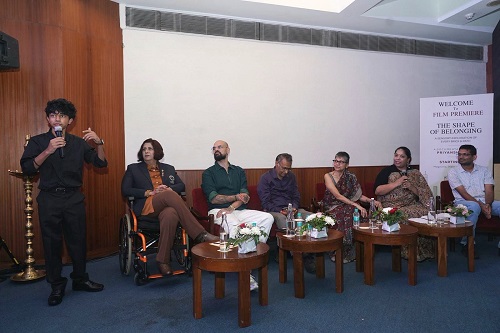 |
Priyansh Sinha addressing the crowd and panel
Described as A Sensory Exploration of Every Brick and Path, the documentary examines the relationship between people and the spaces they inhabit, asking what it truly means for a space to be accessible and inclusiveThe film explores accessibility across two broad dimensions — physical accessibility, including mobility, vision and hearing-related needs, and cognitive and sensory accessibility, including experiences associated with autism, intellectual disabilities, dementia, sensory processing differences and mental health conditions.
According to the 2011 Census, India has 26.8 million persons with disabilities, accounting for 2.21% of the country’s populationWhile accessibility has gained greater attention through policy, regulations and developments in architecture and urban planning, much of the conversation continues to centre on physical interventions such as ramps, elevators and accessible infrastructureThe Shape of Belonging sought to expand this dialogue by exploring the less visible aspects of accessibility — including sensory stimulation, navigation, spatial design and cognitive comfort — and how these factors shape the way individuals experience and engage with their surroundings.
The screening was followed by a panel discussion featuring MsAnshu Sharma, Vice Principal – International Curriculum, Shiv Nadar School, Noida; DrDeepa Malik, Padma Shri, Khel Ratna and Arjuna Awardee, Paralympic medallist and author; DrSewa Ram, Dean (Research), School of Planning and Architecture, Delhi; MsMerry Barua, Founder Director, Action for Autism; and MrMohit Ahuja, Founder, Know DisabilityThe discussion brought together perspectives from architecture, education and disability advocacy, reflecting on the themes raised in the film and the broader opportunity to bring greater attention to cognitive and sensory inclusion in the design of homes, public spaces, institutions and urban environments.
DrDeepa Malik, Paralympic medallist, Padma Shri, Khel Ratna and Arjuna Awardee said, “Accessibility conversations in India have largely focused on ramps and infrastructure, but true inclusion goes far beyond thatFilms like The Shape of Belonging push us to think about dignity and independence as design principles, not afterthoughtsIt’s heartening to see a young student engage with this issue so thoughtfully.”
MsMerry Barua, Founder Director, Action for Autism said, “For individuals with autism and sensory processing differences, the built environment can either be a source of comfort or a daily challengeThis documentary brings much-needed visibility to cognitive and sensory accessibility — a dimension of inclusion that is too often overlooked in mainstream design conversations.”
Priyansh Sinha, the documentary film maker, said, “Accessibility should be integral to how we imagine and design the spaces around usThe Shape of Belonging brings an important perspective to this conversation by looking beyond physical accessibility and drawing attention to the need for greater cognitive and sensory inclusionI am grateful & encouraged to get such large participation from academicians to architects to disability rights champions for this cause.“
The event, held from 3 PM to 5 PM followed by high tea, drew faculty and students from the School of Planning and Architecture, Delhi and Shiv Nadar School, alongside architects, urban planners, psychologists, accessibility professionals, organisations working with persons with disabilities, and members of the media.
With The Shape of Belonging, Priyansh Sinha hopes to encourage a broader understanding of accessibility — one that considers not only whether people can enter and navigate a space, but also whether they can experience it with comfort, dignity, independence and a genuine sense of belongingThe premiere marks the film’s public launch, with plans for wider screenings and outreach to follow.
Watch the film here: youtu.be/tN4E1y4QNc4?si=k7tKDDR3sSPcBKhD