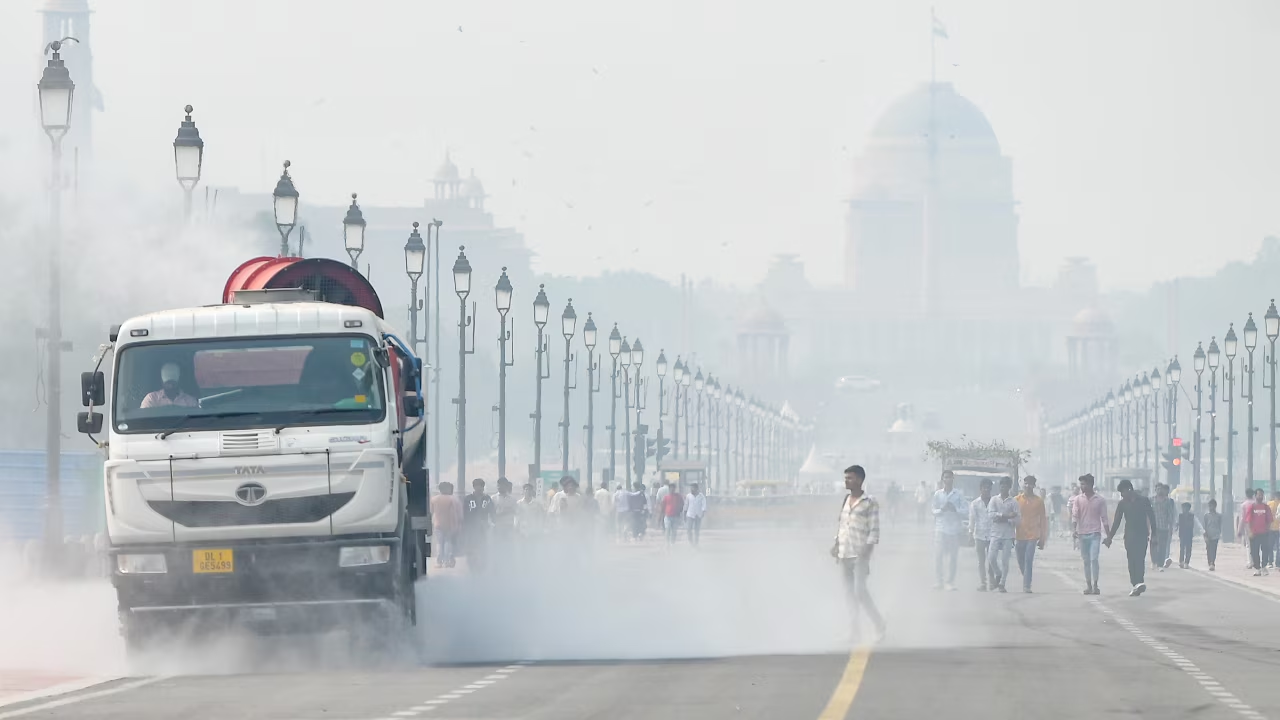
Delhi’s air quality remained in the ‘poor’ category on Monday, with the overall AQI reaching 236 at 8 amSeveral areas, including Sirifort, ITO and Talkatora Garden, recorded ‘very poor’ air qualityWith GRAP Stage II restrictions continuing across Delhi-NCR.
Share Article
https://www.india.com/news/india/delhi-aqi-november-23-no-respite-from-toxic-air-as-several-areas-slip-into-very-poor-category-check-area-wise-pollution-levels-grap-restrictions-details-8547251/
Delhi AQI: No respite from toxic air as several areas slip into ‘very poor’ category; Check area-wise pollution levels, GRAP restrictions (PTI)
Delhi continued to breathe polluted air on Monday, November 23 as the city’s overall Air Quality Index (AQI) stood at 236 at 8 amThe reading falls in the ‘poor’ category, according to real-time data from the Central Pollution Control Board (CPCB)PM2.5 remained the main pollutant, raising concerns over the health risks for residents, particularly children, elderly people and those with respiratory problems.
While most monitoring stations across the national Capital recorded poor air quality, several areas reported AQI levels in the ‘very poor’ categorySirifort recorded the highest AQI at 333, followed by Talkatora Garden at 317 and ITO at 301.
Read more:
Delhi air pollution: AQI at 267 as winter chill continues across national capital, details
The latest readings come amid continued efforts by authorities to control pollution in Delhi-NCRThe Commission for Air Quality Management (CAQM) has also introduced a new accountability framework that aims to reduce the region’s pollution load by 15 to 20 per cent by 2027.
Delhi AQI today: Check area-wise pollution levels
Several parts of Delhi continued to record high pollution levels on Monday morningHere is a list of AQI readings at different monitoring stations, according to the data provided by CPCB.
| Monitoring station | AQI |
|---|---|
| Sirifort | 333 |
| Talkatora Garden | 317 |
| ITO | 301 |
| Aya Nagar | 296 |
| CRRI Mathura Road | 296 |
| Burari Crossing | 295 |
| Commonwealth Sports Complex | 293 |
| Shadipur | 288 |
| JNU | 288 |
| Punjabi Bagh | 283 |
| North Campus | 281 |
| Mundka | 279 |
| Uttam Nagar | 276 |
| Bawana | 275 |
| Chhawla | 272 |
| Jahangirpuri | 272 |
| DTU | 271 |
| NIH Narela | 256 |
| R.KPuram | 254 |
| Ghummanhera | 253 |
| Rohini | 253 |
| Karala | 245 |
| Sri Aurobindo Marg | 244 |
| Narela | 240 |
| Burari | 239 |
| Maidan Garhi | 237 |
| Anand Vihar | 236 |
| Nangloi | 229 |
| Pusa | 196 |
An AQI between 201 and 300 falls in the poor category, while readings between 301 and 400 are classified as very poorThis means that people living in areas such as Sirifort, Talkatora Garden and ITO are facing worse air quality than several other parts of the city.
Delhi weather and AQI forecast: Will pollution levels improve?
There is little immediate relief expected for Delhi residentsAccording to the Air Quality Early Warning System developed by the Indian Institute of Tropical Meteorology (IITM), the city’s AQI is likely to remain in the poor category from November 23 to November 25.
The forecast also points to unfavourable conditions for the dispersion of pollutants on Tuesday and WednesdayDelhi is likely to experience mainly clear skies, with maximum temperatures between 24 and 26 degrees Celsius.
Northwesterly winds are expected to reach speeds of up to 20 kmph on MondayHowever, the overall weather conditions are not expected to bring a major improvement in air quality.
GRAP Stage II restrictions continue in Delhi-NCR
Meanwhile, Stage II of the Graded Response Action Plan (GRAP) continues to remain in force across Delhi-NCRUnder this stage, authorities are required to increase mechanised cleaning of roads, sprinkle water to control dust and ensure proper disposal of construction wasteConstruction sites are also under stricter monitoring to prevent dust pollution.
Other measures include increasing the frequency of public transport services, encouraging people to use public transport and enforcing parking-related measures to discourage unnecessary private vehicle use.
The Commission for Air Quality Management (CAQM) had revoked Stage III restrictions on November 17 after Delhi’s AQI showed an improving trendHowever, it cautioned that pollution levels could continue to fluctuate between poor and very poor categories.
CAQM sets 15-20% pollution reduction target for 2027
In a major move to tackle the recurring pollution problem, CAQM has asked Delhi and neighbouring NCR states to prepare fresh action plans for 2027The Commission wants the states to reduce their overall pollution load by at least 15 per cent, with a target of achieving up to 20 per cent reduction compared to 2026.
For the first time, the authorities have been asked to prepare separate action plans for individual districts instead of depending only on state-level strategies.
The new framework also focuses on fixing responsibility for pollution-control workOfficials will be identified by their names and ranks and held accountable for completing the assigned tasks within the given deadlines.
The action plans will cover different sources of pollution, including vehicle emissions, road dust, construction activities, industrial pollution and crop residue burningCAQM will also ask state governments to include additional measures based on previous enforcement records and changing pollution conditions.
Delhi CM Rekha Gupta says air quality has improved over the years
Despite the continuing pollution problem, Delhi Chief Minister Rekha Gupta has said that the city’s overall air quality has improved considerably compared to the situation around a decade agoHer remarks come at a time when several parts of the national Capital are recording poor and very poor AQI levels.
However, the latest readings show that air pollution remains a major concern, particularly during the winter months when weather conditions often make it difficult for pollutants to disperse.