
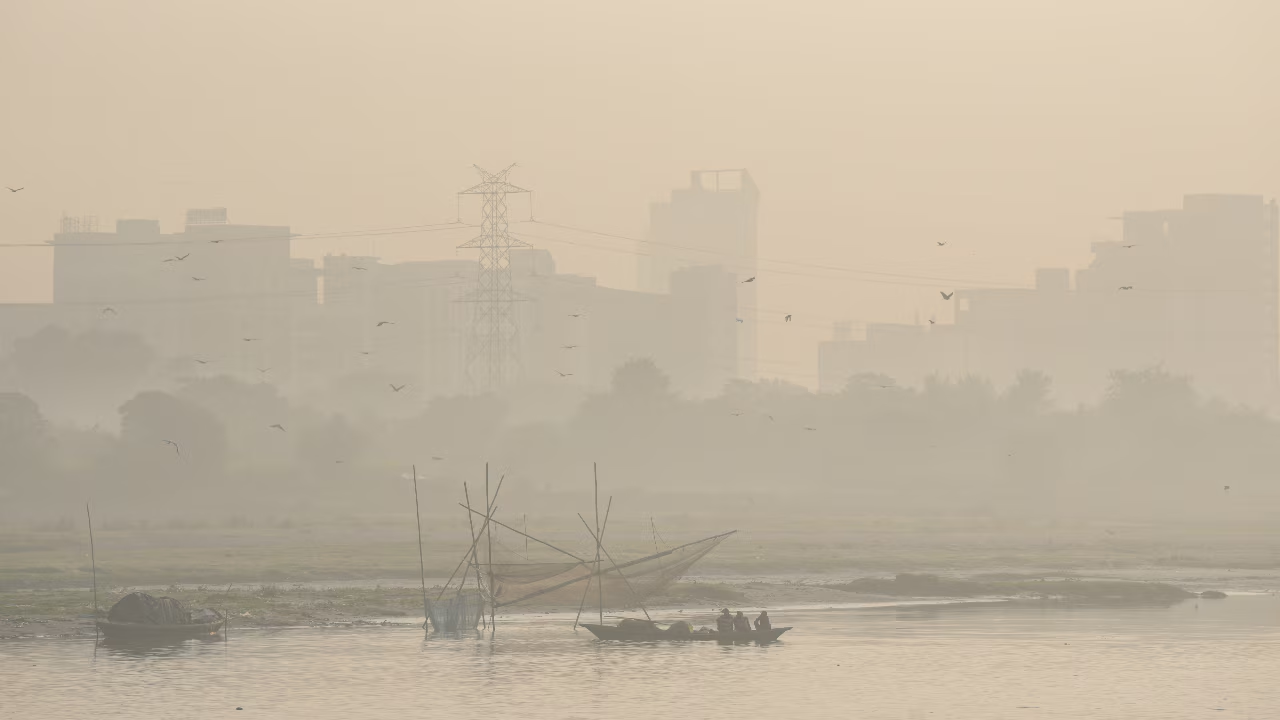
Delhi’s air quality remained in the ‘moderate’ category on Monday morning, with the Air Quality Index (AQI) at 164 at 7.05 am, according to the Central Pollution Control Board’s (CPCB’s) All India AQI portal.
Share Article
https://www.india.com/news/india/delhi-pollution-national-capital-aqi-air-quality-noida-faridabad-ghaziabad-jahangirpuri-vivek-vihar-punjabi-bagh-rk-puram-rekha-gupta-8539242/
Delhi Pollution Latest Update (PTI)
New Delhi: The Air Quality Index (AQI) of Delhi stood at 164 at 7 am on Monday, placing the national capital in the ‘moderate’ category, as per the Central Pollution Control Board (CPCB), indicating a marginal improvement in air quality55 of the 60 air quality monitoring stations across the national capital were reporting, with PM2.5 identified as the lead pollutant at 30 stations, according to the monitoring station data.
Delhi-NCR is facing a double environmental blow, with toxic white foam reappearing on the Yamuna River near Kalindi Kunj and air quality across the region slipping into the ‘unhealthy’ category, with the overall Air Quality Index (AQI) touching 168 on Sunday.
Here are some of the key details:
- Jahangirpuri recorded the highest AQI among the monitoring stations at 246
- Followed by Vivek Vihar at 235, CRRI Mathura Road at 231, Punjabi Bagh at 225 and R K Puram at 223.
- All five stations were categorised as ‘Poor’.
- PM2.5 was the lead pollutant at Jahangirpuri, Vivek Vihar, Punjabi Bagh and R K Puram, while PM10 was the lead pollutant at CRRI Mathura Road.
- PM2.5 and PM10 continue to be the dominant pollutants.
- Monitoring stations across the city showed local variations, with readings as low as around 110 at PGDAV College, Sriniwaspuri, while several other stations recorded levels between 118 and over 180.
GRAP Stage 1 Activated:
The deterioration had prompted the Commission for Air Quality Management (CAQM) to invoke Stage 1 of the Graded Response Action Plan (GRAP) across Delhi-NCR on October 21 to curb air pollution.
Under GRAP-1, the use of coal and firewood is banned in tandoors at hotels, restaurants, and open-air eateries, and diesel generator usage is restricted to essential or emergency purposes.Visuals from the Kalindi Kunj area depicted massive blankets of toxic white foam floating across the water’s surface, highlighting persistent pollution challenges in the river.
A Noida-based environmental activist, Manoj Kumar, has said that weather conditions play an important role as well“During October and November, lower wind speeds and changes in temperature can trap pollutants close to the ground, making the air more harmful to breatheFirecrackers during festivals can add to the pollution loadThe exact contribution of each source varies with the season and weather,” he said to The New Indian Express.
PM2.5 and PM10 are common indicators of particulate pollutionSources include vehicle exhaust, road dust, construction activity, industrial emissions and the burning of fuelsWeather conditions, including wind speed and atmospheric mixing, influence how quickly these pollutants disperse.