



In 2025, stubble burning made a limited contribution to Delhi’s PM2.5 levels, with emissions from farm fires accounting for more than 10% of the city’s air pollution on only seven days and exceeding 20% on just one dayOn most days, its contribution remained below 5%.
Share Article
https://www.india.com/news/india/delhi-pollution-grap-noida-ghaziabad-faridabad-stubble-burning-rekha-gupta-cpcb-jahangirpuri-pusa-8537719/
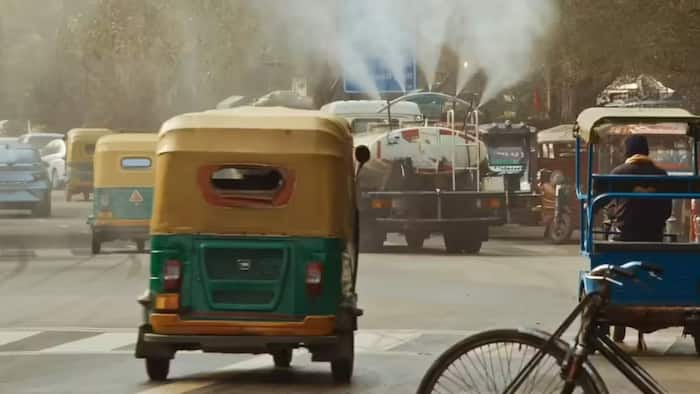
Image for representational purposes
New Delhi: The air quality of the national capital has deteriorated over the last few daysThe contribution of stubble burning to the city’s PM2.5 levels has already reached 4.1 percent, the highest level of the season so farUntil now, its contribution had remained below 1 percent, making it negligibleHowever, the impact of stubble burning on Delhi’s air quality is expected to rise sharply over the next three days.
Owing to the deteriorating air quality, the GRAP restrictions could also be imposed todayAccording to the reports, the Decision Support System (DSS) has estimated that stubble burning’s contribution to Delhi’s PM2.5 levels could rise to around 8 percent today (October 21), 13.3 percent tomorrow (October 22), and 10.4 percent on Friday (October 23).
Read more:
Mask Up Delhi as National Capital records first ‘poor’ air reading of the season, AQI touches 227
The DSS operates under the Union Ministry of Earth SciencesIt has also cautioned that the actual impact of paddy residue burning on Delhi’s air quality will depend on the intensity of the fires and the direction and speed of the wind.
Stubble-Burning Incidents Likely to Increase
Wind direction is likely to shift to the northwesterly direction, which could carry smoke towards DelhiThe harvesting pattern is different this year compared to previous yearsParts of Punjab and Haryana experienced floods last year, but the monsoon has been weak this yearAs a result, harvesting has been delayed, and stubble-burning incidents in fields are also likely to peak later than usual.
— Professor Gufran Beig, Founder of SAFAR.
National Capital records first ‘poor’ air reading of the season; AQI touches 227
In a concerning development, the National Capital on Wednesday recorded its first poor air quality reading of the seasonAccording to the official data, the Air Quality Index (AQI) stood at 227 at 7.05 amThe Central Pollution Control Board (CPCB) data highlights that the air quality turned poor overnight into WednesdayThe deterioration followed Dussehra celebrations on Tuesday evening, when effigies were burnt and firecrackers were set off in several parts of the city, adding to emissions from Durga Puja festivities.
Here are some of the key details:
- An AQI of 0-50 is classified as good, 51-100 as satisfactory, 101-200 as moderate, 201-300 as poor, 301-400 as very poor and 401-500 as severe, according to the CPCB.
- Delhi last recorded poor air quality on July 12 and 13, when the AQI stood at 261 and 246, respectively.
- CPCB’s hourly AQI for the city stood at 227 at 7 am, up 48 points from 179 in Tuesday’s 4 pm bulletin.
- It crossed 200, the threshold for the “poor” category, at 2 am and has not dipped in any hour since.
- The air quality remained in the moderate category for most of October, barring brief improvements on October 12 and 16 following rainfall.
- The AQI stood at 187 on October 18, 139 on October 19 and 179 on October 20.
- Data from 56 of Delhi’s 59 air quality monitoring stations showed that two stations — Jahangirpuri and Pusa — recorded very poor air quality, with AQI readings of 308 and 314, respectively.
- At 16 stations, including Anand Vihar, the air quality remained in the moderate category.
Delhi to bar entry of BS-IV and older commercial vehicles from November 1
Commercial goods vehicles conforming to BS-IV or lower emission standards will be barred from entering Delhi from November 1, except those running on CNG or electricity, Gurugram traffic police said.
The restriction will apply to Light Goods Vehicles (LGVs), Medium Goods Vehicles (MGVs), Heavy Goods Vehicles (HGVs), other trucks and buses, according to an advisory issued by the traffic police.