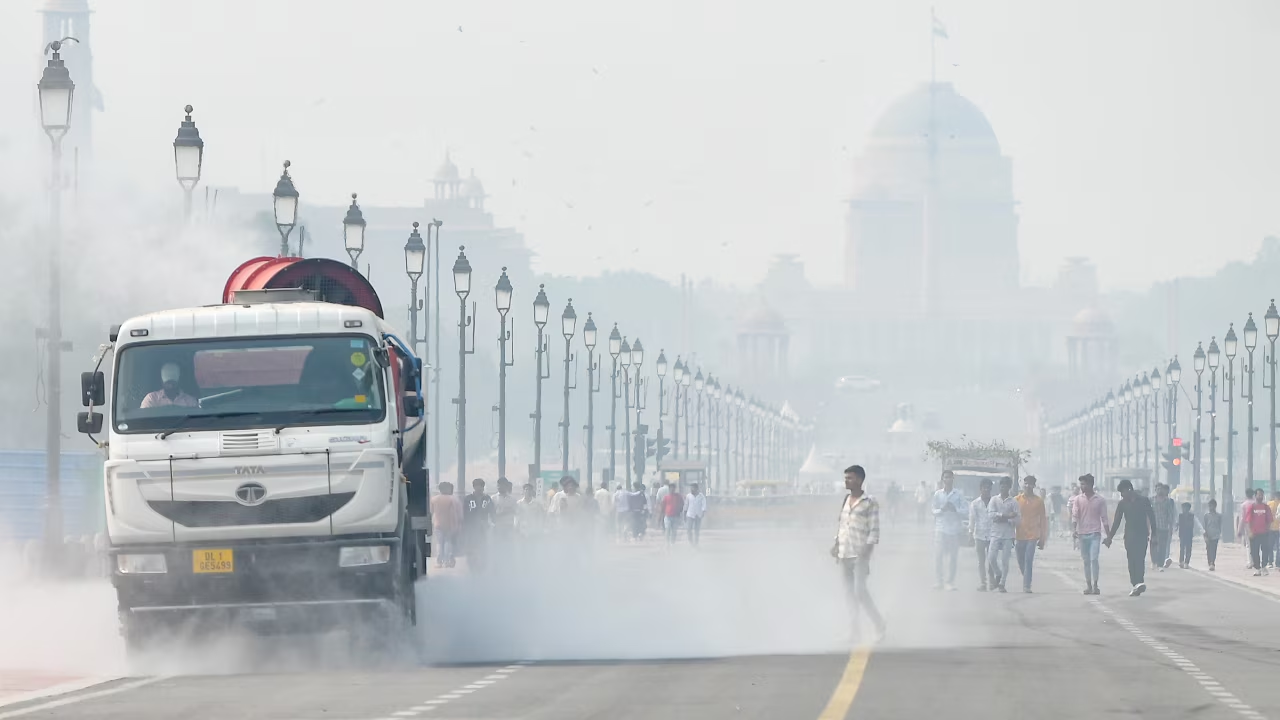
Delhi pollution update: Delhi’s air quality continued to remain in the “poor” category on Thursday, extending its streak of poor air quality days to 12 consecutive days, with the overall Air Quality Index (AQI) settling at 224Of the 55 monitoring stations across the national capital that recorded data, 40 stations registered air quality in the “poor” category, 14 fell in the “moderate” category, and one station ITO slipped into the “very poor” category.
According to daily air quality data, Thursday marked the 12th straight day of “poor” air in Delhi, following an AQI reading of 227 on November 24 and a slight dip to 220 on November 25 before rising again to 224 on ThursdayAs per the Central Pollution Control Board (CPCB) classification standards, an AQI between 0 and 50 is considered “good”, 51 to 100 “satisfactory”, 101 to 200 “moderate”, 201 to 300 “poor”, 301 to 400 “very poor”, and 401 to 500 “severe”.
According to real-time source apportionment estimates for Delhi on Thursday, secondary organic aerosols were the largest contributor to PM2.5 pollution, accounting for 24.8 per cent of the estimated loadThese aerosols are formed in the atmosphere when gases released by sources, such as vehicles, industries and other combustion activities, react with other compounds in the air to form fine particles.
Vehicular emissions contributed 20.6 per cent, followed by biomass burning at 19.7 per cent and secondary inorganic pollutants at 12.5 per centWaste burning accounted for 11.4 per cent, road dust, soil and mineral sources 4.5 per cent, industrial emissions 2.7 per cent, coal combustion 1.6 per cent, firecrackers 1.4 per cent and mixed combustion 0.6 per cent.
The India Meteorological Department’s (IMD) Air Quality Early Warning System has forecast that Delhi’s air quality is likely to remain in the “poor” category on November 26 and November 27, before deteriorating to the “very poor” category from November 28-29The outlook for the six subsequent days indicates that the air quality is likely to remain in the “very poor” to “poor” category.
The predicted maximum mixing depth over Delhi was 1,350 metres on November 26, 1,050 metres on November 27 and November 28, and 1,150 metres on November 29Mixing depth refers to the height up to which pollutants can disperse and mix in the atmosphereA lower mixing depth limits the vertical dispersion of pollutants, allowing them to accumulate closer to the ground.
The ventilation index was forecast at 4,500 square metres per second on November 26, 1,200 square metres per second on November 27, 1,300 square metres per second on November 28 and 2,500 square metres per second on November 29.
A ventilation index below 6,000 square metres per second, coupled with an average wind speed of less than 10 kilometres per hour, is considered unfavourable for the dispersion of pollutants, the IMD said.