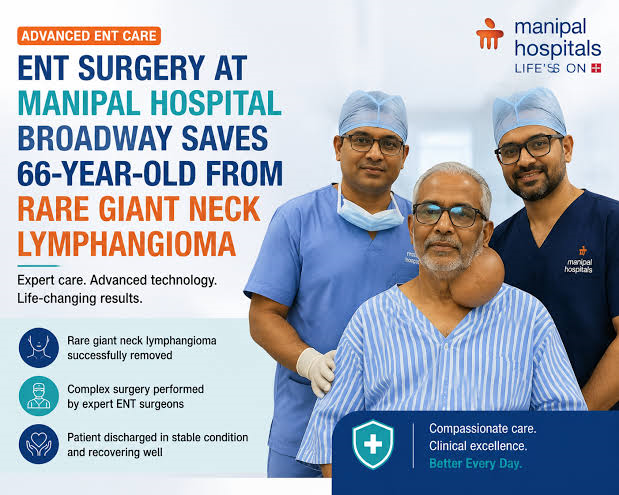
What began as a slowly growing swelling on the right side of a 66-year-old man’s neck eventually developed into a rare, giant tumour that threatened to compress his airway and some of the neck’s most critical blood vessels and nervesIn a highly complex surgery, doctors at Manipal Hospital Broadway successfully removed the massive 10 × 10 × 10 cm lymphangioma—a rare benign malformation of the lymphatic system, while carefully preserving the carotid artery, internal jugular vein and vagus nerveThe intricate procedure not only eliminated the tumour completely but also helped the patient recover without any post-operative complications.
The patient was admitted on 2 July with a swelling on the right side of his neck that had been gradually increasing in size for nearly one and a half yearsOver the previous few months, the swelling had grown rapidlyA contrast-enhanced CT scan, conducted on 23 May, revealed a large 10 × 10 × 10 cm fluid-filled mass in the neckThe tumour was located very close to the right common carotid artery and the thyroid gland, while also pressing against the internal jugular vein and pushing the windpipe and voice box slightly to the leftThese findings raised concerns that the swelling could affect the patient’s breathing if left untreatedBased on the scan, doctors suspected it to be a lymphangioma, a rare benign malformation of the lymphatic system.
Following a comprehensive pre-anaesthetic evaluation, the patient underwent complete surgical excision of the tumour under the leadership of DrKaushik Das, Senior Consultant – ENT, Head & Neck Surgeon, Manipal Hospital Broaway, along with DrUshirin Bose,Consultant -ENT ,Head &Neck Surgeon ,Manipal Hospitals .The anaesthesia team was led by DrTushar Kanti Ghosh, Senior Anaesthesiologist.
During the surgery, doctors found a large, multi-chambered fluid-filled mass wrapped around some of the neck’s most important structures, including the carotid artery (the main artery supplying blood to the brain), the internal jugular vein and the vagus nerveThe surgery was particularly challenging because these vital structures had to be carefully separated from the tumour without causing any damageThe surgical team successfully removed the entire mass while preserving these critical blood vessels and nervesBlood loss during the procedure was minimal, and a sample of the fluid from the cyst was sent for laboratory testing to confirm the diagnosisHistopathological examination later confirmed the diagnosis, validating the team’s initial clinical assessment.
Speaking about the case, DrKaushik Das, said, “Lymphangiomas are uncommon benign malformations of the lymphatic system and are usually detected during childhoodWhile smaller lesions may simply be monitored, larger lesions like this one require complete surgical removal, particularly when they compress vital structuresIn this case, the tumour had grown to a significant size and was closely related to the carotid artery, internal jugular vein and vagus nerve, making the surgery highly challengingThe key objective was to achieve complete excision while preserving these critical structures, as incomplete removal can lead to recurrenceWe are pleased that the surgery was successful and the patient has made an excellent recovery.”
DrUshrin Bose, said, “One of the most challenging aspects of this surgery was the distorted anatomy caused by the giant lymphangiomaThe tumour had displaced the carotid artery medially in the neck, leaving very little margin for error during dissection.Also , dissection was challenging to resect the lymphangioma en bloc without leaving any walls behind. Every step required meticulous planning and precise surgical technique to safely separate the mass while preserving the patient’s nerves and major blood vesselsCareful post-operative monitoring was equally important to ensure there were no breathing difficulties, nerve-related complications or wound issuesThe patient’s smooth recovery and excellent functional outcome reflect the value of a coordinated multidisciplinary approach and timely intervention.”
The patient’s post-operative recovery was uneventfulHe remained haemodynamically stable with satisfactory pain control and experienced no complicationsDaily assessments documented stable vital signs, minimal drain output, good oral intake and steady recoveryThe drain was removed on the second post-operative day, following which the patient was dischargedDuring a follow-up visit seven days later, the surgical stitches were removed, and the patient was found to be recovering well without any complications.
Doctors noted that if left untreated, giant lymphangiomas can progressively enlarge and exert pressure on surrounding structures, leading to difficulty swallowing, breathing problems and significant discomfortEarly diagnosis and timely surgical intervention are essential to prevent these complications and ensure complete recovery.