

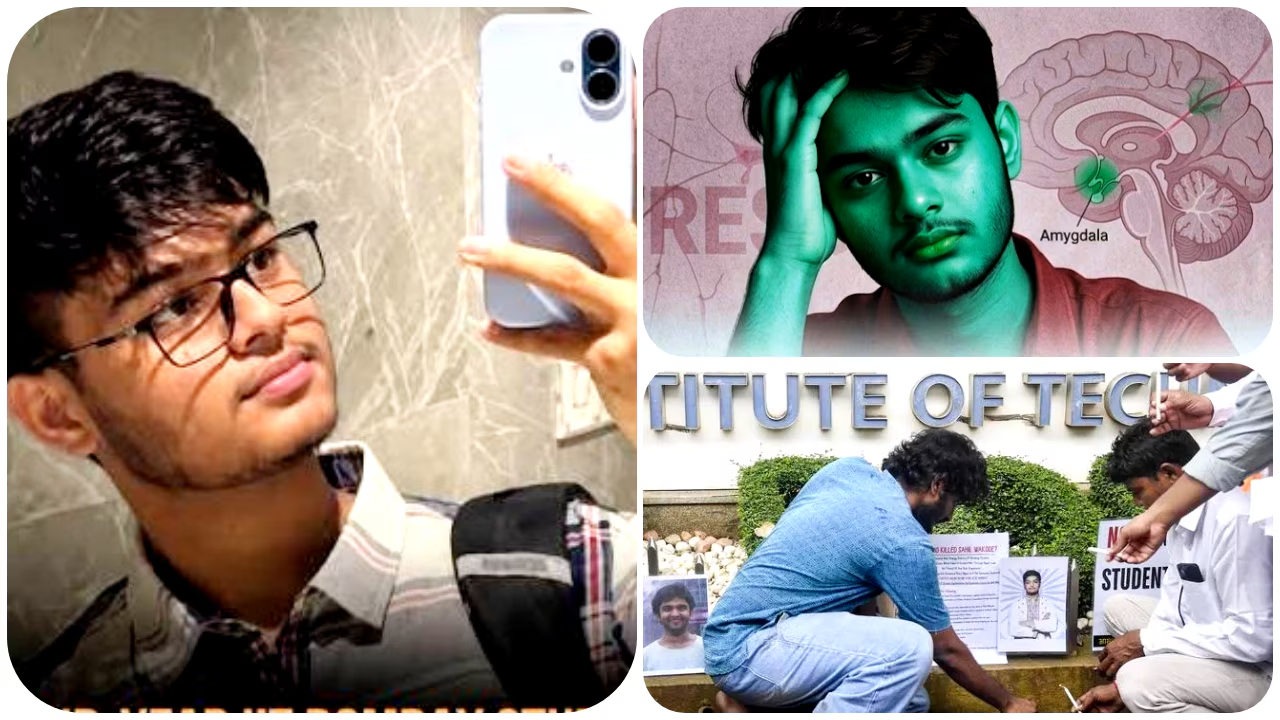
IIT-Bombay student Sahil Wakode’s death raises concerns over student pressure, mental health, academic stress and the need for timely intervention.
Published: September 23, 2026, 2:42 PM IST
Share Article
https://www.india.com/news/india/iit-bombay-student-death-sahil-wakodes-passing-raises-student-mental-health-concerns-heres-what-psychologists-advise-8529255/
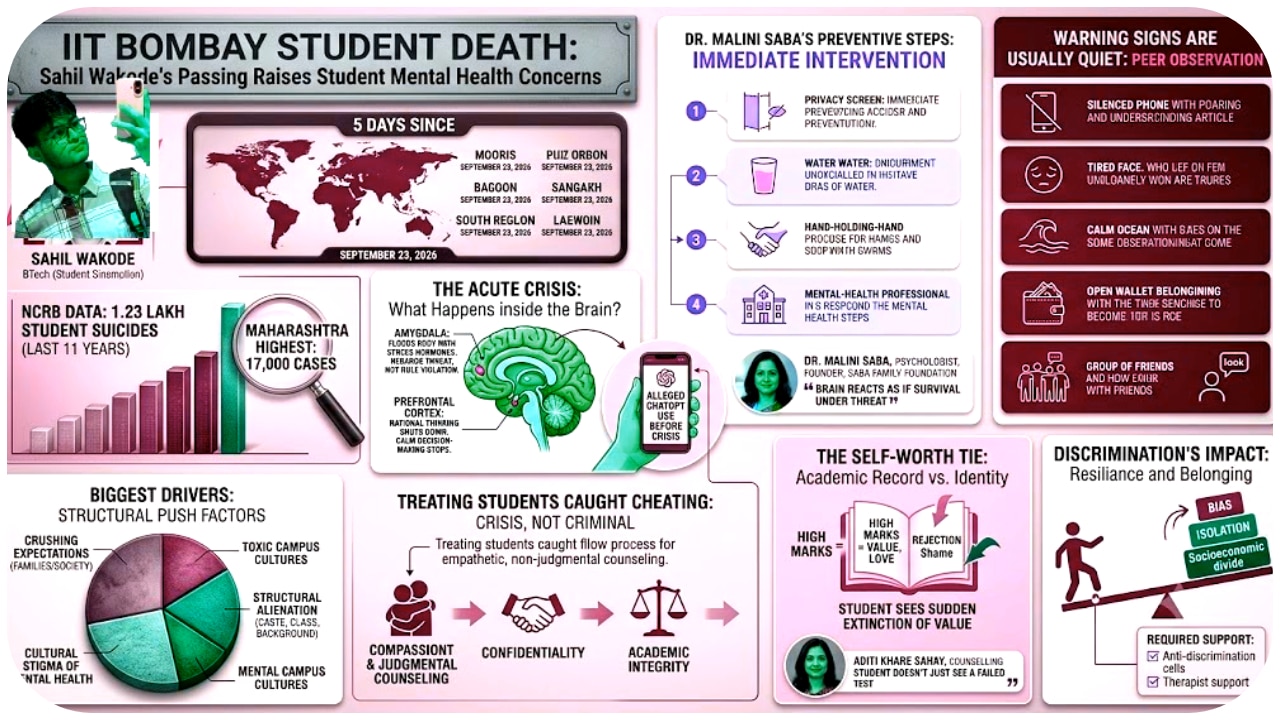
IIT Bombay Student Death: Sahil Wakode’s passing raises student mental health concerns – Here’s what psychologists advise | Image: AI
IIT Bombay Student Death: It’s been five days since Sahil Wakode, a BTech second IIT-Bombay student Sahil Wakode’s death raises concerns over student pressure, mental health, academic stress and the need for timely intervention.-year student at IIT-Bombay, was found dead in his hostel roomThe tragic incident took a whole new turn and became a criminal investigation after parents claimed that he was a victim of caste discriminationSahil was found hanging in his hostel room on the Powai campus on September 18 evening, hours after being caught by teachers allegedly using ChatGPT on his smartphone to write answers during a mid-semester examThe Mumbai Crime Branch is investigating the matter and the actual reason behind the BTech student’s death will be known soonBut it’s not just about Sahil, over 1.23 lakh students have died by suicide in the last 11 years, as per NCRB dataThe numbers are huge and they underline an urgent need to understand the tremendous pressure faced by Indian studentsThis data also connects to Sahil’s case, as Maharashtra reported the highest number of student suicide cases, at around 17,000.
There is an urgent need to know and understand the mental state of students who take extreme stepsExperts also raised concern over the issue.
Read more:
IIT Bombay Student Had Written The Suicide Note Naming Hostel Mate, Confirms Handwriting Analysis
The question arises when a student faces an immediate, highly stressful event – such as being caught cheating in an exam / facing strict disciplinary action – What psychological factors trigger an acute crisis and how can immediate help calm sudden panic?
During an interview with India.com, Dr Malini Saba, a psychologist, human and social rights activist and founder of the Saba Family Foundation, stated that when a student suddenly faces something intense, for instance, getting caught cheating or receiving serious disciplinary notice, their brain doesn’t treat it as a rule violationIt reacts as if their survival is under threat.
“The amygdala floods the body with stress hormones, and the prefrontal cortex, the part of the brain that handles rational thinking, long-term perspective, and calm decision-making; effectively shuts downIn that moment they can develop tunnel vision and genuinely feel like their whole life, their family’s reputation, everything is finished,” Dr Malini Saba said.
According To Dr Saba, The Preventive Step Should Be:
- Move the student somewhere private right awayDon’t question them in front of other students as public humiliation can be the final push.
- Check their physical state, let them sit, offer water, help them slow their breathing.
- Give them a clear sense of safety.
- Any major disciplinary shock is immediately followed by a private, supportive conversation with a trained mental-health professional.
On being asked what early emotional or behavioral signs of self-harm can peers spot in high-performing students and how can they respond?, Dr Saba said, “high-achieving students are often excellent at hiding how they’re really doingThey’re used to being the reliable, high-performing one, so when things fall apart inside they cover it with a smile, a nod, or silence.”
Warning Signs Are Usually Quiet:
- Suddenly pulling away from group chats or social plans
- Looking constantly tired, skipping meals
- An unnatural calm that appears after a period of stress, sometimes a sign they’ve decided on an “escape”
- Throwaway comments like “None of this will matter soon” or giving away things that matter to them
- Friends are usually the first ones to notice the changes.
What Are The Biggest Reasons/Push Factors Behind Student Suicides In India, How Do We Identify The Root Cause?
Dr Saba said that quick victim-blaming must be stopped immediatelyEvery tragedy should be followed by an independent psychosocial autopsy.
The Biggest Drivers Of Student Suicides In India Are Structural:
- Crushing, unrealistic expectations: The brutal pressure from families and society to secure a future through a narrow set of elite careers
- Toxic campus cultures: Rigid systems, public shaming, inflexible rules, and ranking systems that isolate rather than support
- Structural alienation: Discrimination based on caste, class, language, or background that leaves students feeling completely alone
- Cultural Stigma of Mental Health: The stigma around mental health that makes asking for help feel like admitting weakness
What Is The Best Way To Treat Students When Caught Cheating In Exams?
Dr Saba said if a student is caught cheating, treat them as a person in crisis, not a criminal.
“Cheating is almost always a symptom of desperation; fear of disappointing parents, panic about falling behind, or a complete psychological breakdown under pressurePublic humiliation or harsh threats about their future only make things worse,”
“Handle it with confidentiality and with some empathyMaintain academic integrity, but approach it as rehabilitation rather than pure punishmentAsk what’s really going onPair any disciplinary process with immediate, non-judgmental counselingMake it clear that one mistake on a paper does not define their character or end their life,” Dr Saba added.
Why Do Students In Competitive Environments Often Tie Their Entire Self-Worth To Academic Standing, Making A Potential Mark On Their Record Feel Like An End-Of-Life Scenario?
While talking to India.com, Aditi Khare Sahay, Counselling Psychologist, said that when students’ academic success is threatened, they may feel that they have lost their identity, value and place in the family or society.
“Years of strict operant conditioning teach students that praise and affection are earned only through high marks (positive reinforcement), while relentless studying is the only shield against family shame and rejection (negative reinforcement)Because academic success is the sole reinforced behavior, it becomes their entire identityWhen that record is threatened, the student doesn’t just see a failed test—they see the sudden extinction of their perceived value, love, and right to belong, making it feel like an absolute end-of-life scenario,” she said.
How Does Discrimination Affect Students’ Resilience And Sense Of Belonging And What Mental Health Support Do Marginalised Students Need?
Khare said that discrimination can make marginalised students feel isolated and emotionally drained, making it harder to deal with other pressures.
“Systemic bias, socioeconomic divides, caste- or race-based discrimination has been a part of society for centuries leaving marginalized students spending a lot of mental energy dealing with discrimination, insensitive comments, feeling unwelcome, or being isolatedOver time, constantly dealing with these experiences can leave them emotionally exhausted and less able to cope with other stress such as focusing on studiesAnd the reality is to accept that this practice is not going to change overnightInstitutes can provide the facility such as anti-discrimination cells, SC/ST cells, DEI grievance bodies But it cannot provide the emotional support that is much required to the studentsPsychological interventions, therapist support must be mandatorily provided in the institutes (school /Colleges) once the authority get to know about the discrimination.”