
The Supreme Court expressed strong concern over rising pollution in the Yamuna despite massive expenditure.
Updated: November 16, 2026, 6:01 PM IST
Share Article
https://www.india.com/news/india/pollution-only-increasing-supreme-court-on-yamuna-water-pollution-directs-cpcb-to-monitor-poor-health-of-river-8545356/
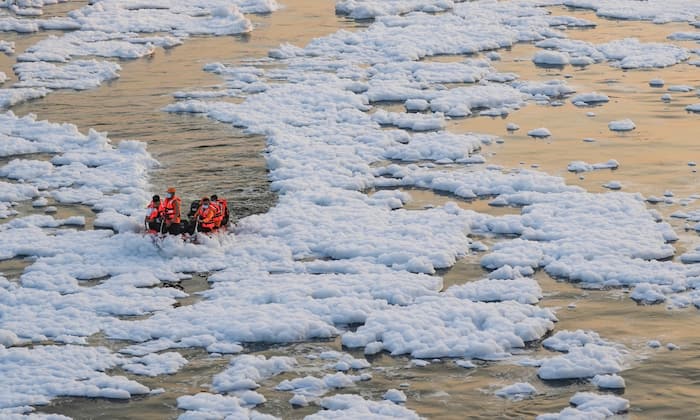
Devotees gather along the banks of River Yamuna, polluted with toxic foam, during the ‘Chhath Puja’ festival (PTI)
Yamuna water pollution: Expressing sharp concern that pollution in the Yamuna has only worsened despite massive public funds being spent on cleaning the river, the Supreme Court has directed the Central Pollution Control Board (CPCB) to regularly monitor water quality at the entry and exit points of every state, Union territory, and districtIn an order dated November 4, a Bench of Justices Manoj Misra and Manmohan stressed that industrial effluents and untreated sewage must be stopped at the source, noting that merely building more sewage treatment plants is insufficient.
What Supreme Court said on Yamuna water pollution?
In an order dated November 4, a bench of Justices Manoj Misra and Manmohan observed that industrial pollutants and untreated sewage must be stopped at the source, and merely constructing more sewage treatment plants is not sufficient to clean the river.
“This court is of the opinion that everything that is wrong with the civic administration in towns, cities and villages situated along the banks of the river is reflected in the poor health of the river and in the 520 drains that discharge wastewater into the Yamuna.
“This is why, despite huge sums being spent on cleaning the river, pollution in the Yamuna has only increased,” the bench said while hearing a plea related to cleaning of the river.
Top court on industrial pollution and untreated sewage
The top court said industrial pollution and untreated sewage must be curtailed, if not stopped altogether, at the source.
“Where that is not possible, the sewage must first be tapped and then treatedHowever, tapping will remain a challenge in absence of a robust sewage system and due to joining of stormwater and sewage drains.
“This court is further of the opinion that it would be difficult, if not impossible, for civic authorities to tap sewage in most illegal and unauthorised colonies built on encroached land, since they have not been built on a grid layout and have hardly any space for laying a sewage system,” it said.
The apex court said unless illegal and unauthorised colonies and ‘jhuggi-jhopdi’ (slum) clusters on the drains as well as on the river bed are removed, with rehabilitation of their occupants, their sewage will continue to pollute the river.
The court directed that if water quality deteriorates while passing through a particular state, Union territory or district, the concerned authorities would be held accountable and penalised.
(With inputs from agencies)