

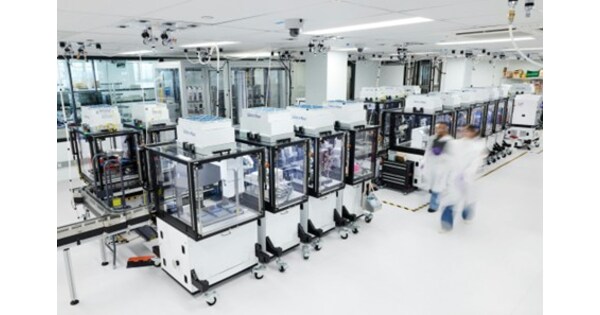
- Research conducted in collaboration with OpenAI using Ginkgo’s cloud laboratory
- Preprint describes how GPT-5-driven autonomous lab significantly reduced reaction costs in cell-free protein synthesis
- GPT-5-driven autonomous lab executed over 36,000 experiments
- Ginkgo now selling the AI-improved reaction mix in its reagents store, showing commercial potential of AI-driven science
The findings are described in a scientific preprint that has not yet undergone peer review. The full manuscript, “Using a GPT-5-driven autonomous lab to optimize the cost and titer of cell-free protein synthesis,” is available on OpenAI’s website and will soon be available on bioRxiv. About Ginkgo Bioworks
Ginkgo Bioworks builds the tools that make biology easier to engineer for everyone. The company offers autonomous laboratories that replace manual laboratory work with robotics in the lab, greatly improving the productivity of scientists. Ginkgo’s in-house autonomous lab is also available as a “cloud lab” through our Datapoints and Solutions contract research services. For more information, visit ginkgobioworks.com and ginkgobiosecurity.com, read our blog, or follow us on social media channels such as X (@Ginkgo and @Ginkgo_Biosec), Instagram (@GinkgoBioworks), Threads (@GinkgoBioworks), or LinkedIn. Forward-Looking Statements of Ginkgo Bioworks
This press release contains certain forward-looking statements within the meaning of the federal securities laws, including statements regarding the capabilities and potential success of Ginkgo’s autonomous laboratories. These forward-looking statements generally are identified by the words “believe,” “can,” “project,” “potential,” “expect,” “anticipate,” “estimate,” “intend,” “strategy,” “future,” “opportunity,” “plan,” “may,” “should,” “will,” “would,” “will be,” “will continue,” “will likely result,” and similar expressions. Forward-looking statements are predictions, projections and other statements about future events that are based on current expectations and assumptions and, as a result, are subject to risks and uncertainties. Many factors could cause actual future events to differ materially from the forward-looking statements in this press release, including but not limited to: (i) our ability to realize near-term and long-term cost savings associated with our site consolidation plans, including the ability to terminate leases or find sub-lease tenants for unused facilities, (ii) volatility in the price of Ginkgo’s securities due to a variety of factors, including changes in the competitive and highly regulated industries in which Ginkgo operates and plans to operate, variations in performance across competitors, and changes in laws and regulations affecting Ginkgo’s business, (iii) the ability to implement business plans, forecasts, and other expectations, and to identify and realize additional business opportunities, including with respect to our solutions and tools offerings, (iv) the risk of downturns in demand for products using synthetic biology, (v) the uncertainty regarding the demand for passive monitoring programs and biosecurity services, (vi) changes to the biosecurity industry, including due to advancements in technology, emerging competition and evolution in industry demands, standards and regulations, (vii) the outcome of any pending or potential legal proceedings against Ginkgo, (viii) our ability to realize the expected benefits from and the success of our Foundry platform programs and Codebase assets, (ix) our ability to successfully develop engineered cells, bioprocesses, data packages or other deliverables, (x) the product development, production or manufacturing success of our customers, (xi) our exposure to the volatility and liquidity risks inherent in holding equity interests in other operating companies and other non-cash consideration we may receive for our services, (xii) the potential negative impact on our business of our restructuring or the failure to realize the anticipated savings associated therewith and (xiii) the uncertainty regarding government budgetary priorities and funding allocated to government agencies. The foregoing list of factors is not exhaustive. You should carefully consider the foregoing factors and the other risks and uncertainties described in the “Risk Factors” section of Ginkgo’s annual report on Form 10-K filed with the U.S. Securities and Exchange Commission (the “SEC”) on February 25, 2025 and other documents filed by Ginkgo from time to time with the SEC. These filings identify and address other important risks and uncertainties that could cause actual events and results to differ materially from those contained in the forward-looking statements. Forward-looking statements speak only as of the date they are made. Readers are cautioned not to put undue reliance on forward-looking statements, and Ginkgo assumes no obligation and does not intend to update or revise these forward-looking statements, whether as a result of new information, future events, or otherwise. Ginkgo does not give any assurance that it will achieve its expectations. Contacts Ginkgo Bioworks investor contact:
[email protected] Ginkgo Bioworks media contact:
[email protected] SOURCE Ginkgo Bioworks

Source link





Leave a Reply