The Ministry had projected that the peak electricity demand this summer would reach up to 270 GW. However, on Thursday, the demand surpassed this threshold.

Updated: May 22, 2026 4:29 PM IST
New Delhi: Record-breaking heat is gripping several parts of the country, including the national capital, Delhi. Concurrently, the demand for electricity is setting new records on a daily basis. On Thursday, 21 May, the peak electricity demand reached a record level of 270.82 GW for the fourth consecutive day. Experts attribute this surge in demand to the increased usage of air conditioners, air coolers, and other appliances as mercury levels continue to rise. Given the escalating temperatures, both electricity demand and consumption are expected to witness further increases in the coming days.
Also Read: Amid roasting heat, demand for electricity surpasses government estimates, breaking records daily
What Does The Data Say?
According to data from the Ministry of Power, the peak electricity demand on Wednesday, 20 May, stood at a record high of 265.44 GW. The Ministry posted on the social media platform ‘X’: “Today (Thursday) marks the fourth consecutive day that the peak electricity demand has reached an all-time high. At 3:45 PM, the peak demand touched 270.82 GW. This demand was successfully met.”
Demand Exceeds Projections
Previously, the Ministry had projected that the peak electricity demand this summer would reach up to 270 GW. However, on Thursday, the demand surpassed this threshold—even before the onset of ‘Nautapa.’ The nine hottest days of the year are collectively known as ‘Nautapa.’ This year, Nautapa is scheduled to commence on May 25 and conclude on June 2. During this period, the Sun enters the ‘Rohini Nakshatra’ (lunar mansion), causing temperatures to peak and resulting in severe heatwave conditions across many parts of the country. Electricity demand is anticipated to reach its absolute peak during this specific period.

The Ministry of Power further noted that, in light of the prevailing weather conditions across the nation, the surge in demand is primarily driven by the increased use of air coolers and air conditioners to keep homes and offices cool. Thermal energy contributed the largest share—62.8%—in meeting Thursday’s peak demand. Additionally, solar energy contributed 22%, wind energy 5%, and hydroelectric power 5.8%, while the remaining share was met by other sources.
Records Broken Daily
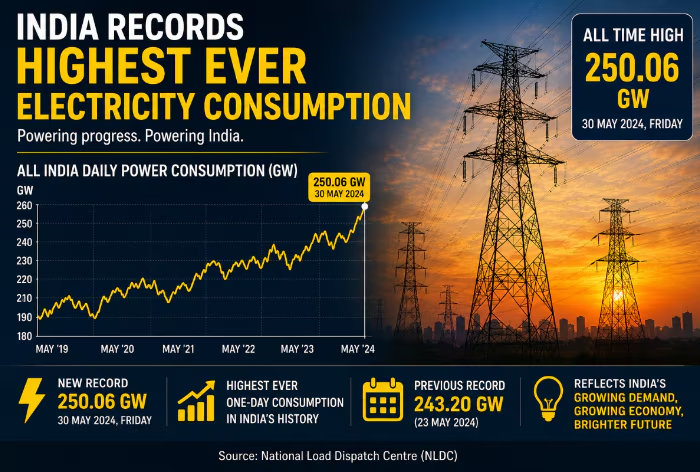
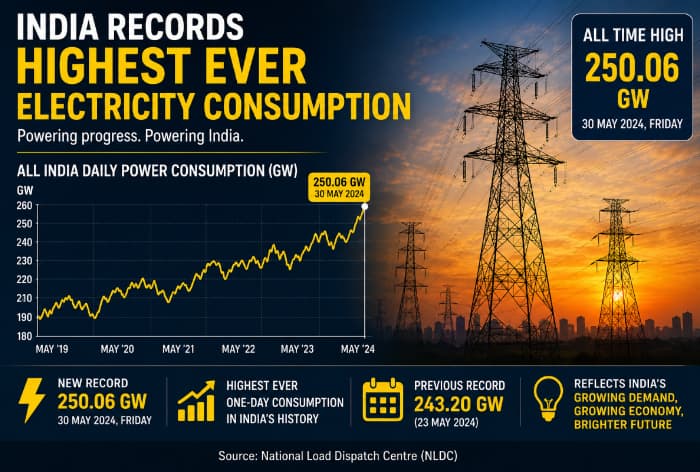
The Ministry stated that coal availability at thermal power plants is adequate and that supplies are being closely monitored. Prior to this, starting Monday, 18 May, the peak electricity demand had reached 257.37 GW. Subsequently, it stood at 260.45 GW on Tuesday, 19 May, and 265.44 GW on Wednesday, 20 May. During the previous summer, in June, the peak electricity demand recorded was 242.77 GW—a figure that fell short of the government’s projection of 277 GW.
(With agency inputs)