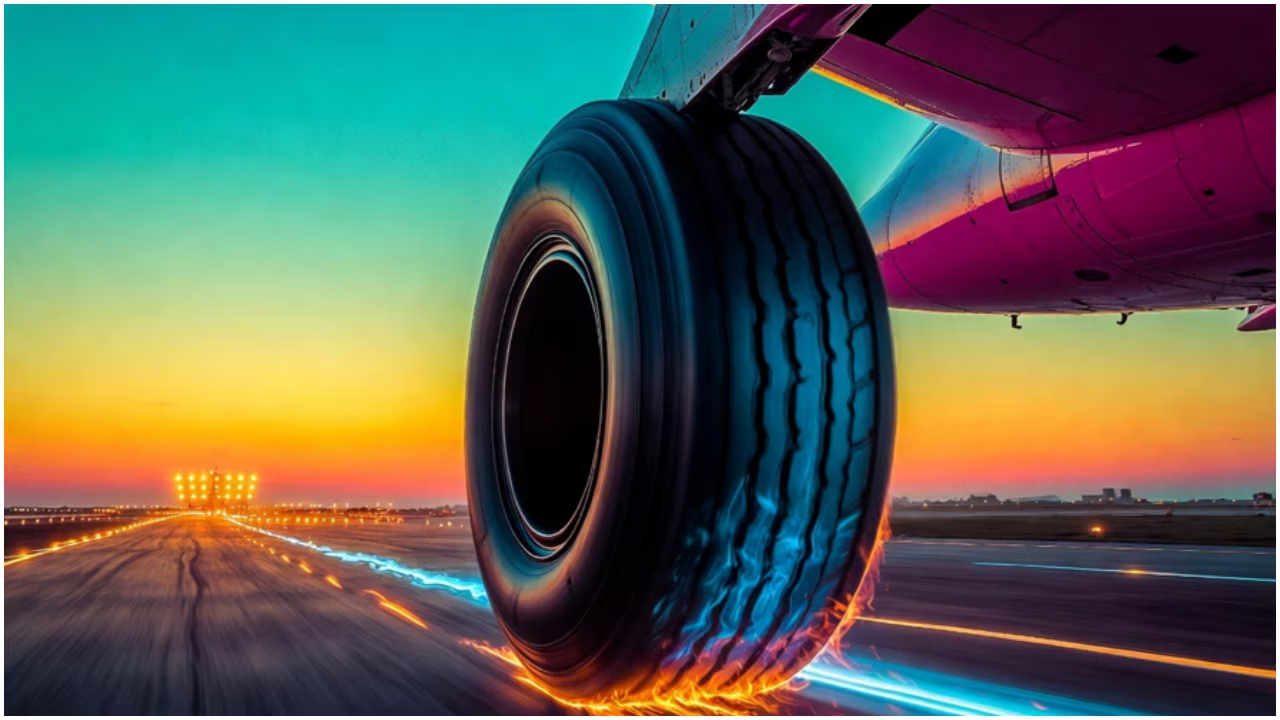
What is even more surprising is that all 18 tyres are exactly the same, including the nose wheel tyres. This is quite unusual, because many other aircraft use two different tyre sizes — one type for the nose and another for the main landing gear.
Share Article
https://www.india.com/news/india/the-shocking-number-of-landings-before-an-airplane-tire-is-changed-8430112/
The shocking number of landings before an airplane tire is changed
Have you ever wondered what makes an aircraft tyre so different from the ordinary tyre on your car or truck? They may look like the same black rubber, but believe me, they are worlds apart. Let me take you on a simple journey, and by the end you will also understand what a candle has to do with all this.
Let us start with the most obvious thing—the size. A tyre on the mighty Boeing 747, which people lovingly call the Queen of the Skies, is around 49 inches in diameter. Compare that to your normal car tyre, which is only about 28 inches. Quite a giant, no? Now here is an interesting point. The 747 is fitted with 18 such monstrous tyres, and each one is certified to carry a weight of 56,600 pounds. What is even more surprising is that all 18 tyres are exactly the same, including the nose wheel tyres. This is quite unusual, because many other aircraft use two different tyre sizes — one type for the nose and another for the main landing gear.
Now, do not think these tyres are just big and slow. They are tested at very high speeds, because during take-off and landing the aircraft moves almost like a Formula One car. That same 747 tyre is certified to handle speeds up to 378 kilometres per hour, which is just over 204 knots. Imagine that kind of speed while carrying the full weight of a loaded aircraft!
To carry such heavy loads, these tyres are filled to very high pressure. An aircraft tyre can be inflated to more than five times the pressure of a car tyre. The 747 tyre can take up to 200 pounds per square inch, while your average car tyre runs at only about 32 psi. And the strength is truly amazing. Dunlop Aviation once tested a Boeing 737 tyre beyond its limits, and it withstood more than four times its certified maximum pressure before bursting — some even crossing 900 psi. Now that is real toughness.
But here comes a clever question — what exactly are these tyres filled with? Your car tyre is simply filled with air. But an aircraft tyre faces such extreme temperature changes and harsh conditions that ordinary air becomes too risky to use. So instead, aircraft tyres are filled purely with nitrogen. Why nitrogen? Because nitrogen is an inert gas. This means it does not react with the rubber of the tyre or with the metal of the rim, and it does not allow any combustion inside the tyre. There is another smart reason too. Ordinary air contains water vapour, and at high cruising altitudes this water can freeze and form ice inside the tyre. Nitrogen is free of water vapour, so no ice can form. Simple and safe.
Now the big question that most people ask — how many landings can one aircraft tyre handle before it needs to be changed? The answer depends on the model of the tyre, but many aircraft tyres can perform around 150 to 200 normal take-off and landing cycles before they need servicing. And the good news is that they can be retreaded up to seven times before being completely replaced. Of course, this number is not fixed. It varies depending on the weight of the aircraft, its landing speed, the condition of the runway surface, and partly on how smoothly the pilot lands the plane. A gentle landing means a longer tyre life. Pilots and engineers also carefully check these tyres before every single flight, looking for flat spots or any damage, so that a small problem is caught early before it becomes dangerous.
And what happens in the rare case of a tyre blowout? Here too the engineers have thought ahead. The tyre is designed to keep its basic shape even after bursting, so that it does not suddenly throw the aircraft off balance on the ground. The designers have worked extremely hard to make sure that even in the worst situation, your safety is not put at risk.
Now finally, the candle. You must be thinking — Joe, what on earth does a candle have to do with an aircraft tyre? The answer lies in a brilliant little safety device called a fusible plug. Just as a candle melts when it burns, this plug is designed to melt when the temperature inside the tyre rises too high. Imagine the brakes overheating or even catching fire — maybe due to a rejected take-off, an emergency landing, or a leaking hydraulic line. In such heat, the nearby tyres could become over-pressurized and explode, which is extremely dangerous for the brave firemen rushing towards them.
Because of this fusible plug, which melts like a candle, the tyre slowly deflates at a controlled rate instead of exploding. Once melted, the tyre cannot be re-inflated until a maintenance team services it. But remember — the plug only saves the day when overheating is the cause. If the tyre is punctured by something sharp, a blowout can still happen.
Truly, even a humble tyre hides a world of clever engineering
(Girish Linganna is an award-winning science communicator and a Defence, Aerospace & Geopolitical Analyst. He is the Managing Director of ADD Engineering Components India Pvt. Ltd., a subsidiary of ADD Engineering GmbH, Germany.)