India has also maintained that the 1948 resolution of the United Nations Security Council (UNSC) called on Pakistan to withdraw its military forces and citizens from Jammu & Kashmir.
Published: June 5, 2026, 11:38 PM IST
Share Article
https://www.india.com/news/india/new-delhi-strongly-opposes-elections-in-gilgit-baltistan-by-pakistan-asserts-it-is-an-integral-part-of-india-8437692/
(File image)
New Delhi: India on Friday strongly objected to Pakistan’s plan to hold so-called legislative assembly elections in Pakistan-occupied Gilgit-Baltistan. Reiterating its position, India stated that the entire Union Territories of Jammu & Kashmir and Ladakh, including the so-called Gilgit-Baltistan region, are an integral and inseparable part of India.
Also Read: Massive fire breaks out at Noida’s IVY County Society days after Delhi’s Malviya Nagar blaze
What Did MEA Say?
In a statement issued by the Ministry of External Affairs (MEA), the Government of India said it had lodged a strong protest with Pakistan regarding the proposed general elections to the so-called “Gilgit-Baltistan Assembly” scheduled for June 7, 2026. India maintains that the region is part of Indian territory that has been illegally and forcibly occupied by Pakistan.
The MEA stated that the accession of Jammu and Kashmir to India in 1947 was complete, legal, and irrevocable. Therefore, all areas of Jammu & Kashmir and Ladakh, including Gilgit-Baltistan, are an integral part of India.
Pakistan Announces Voting In PoK
The statement came after Pakistan announced that voting for all seats of the legislative assembly in Pakistan-occupied Kashmir (PoK) would be held on July 27.
India said it completely rejects any attempt by Pakistan to alter the status of territories under its illegal occupation. Such actions, India emphasised, cannot change the fact that Pakistan continues to occupy Indian territory illegally and must vacate these areas.
MEA Issues Statement
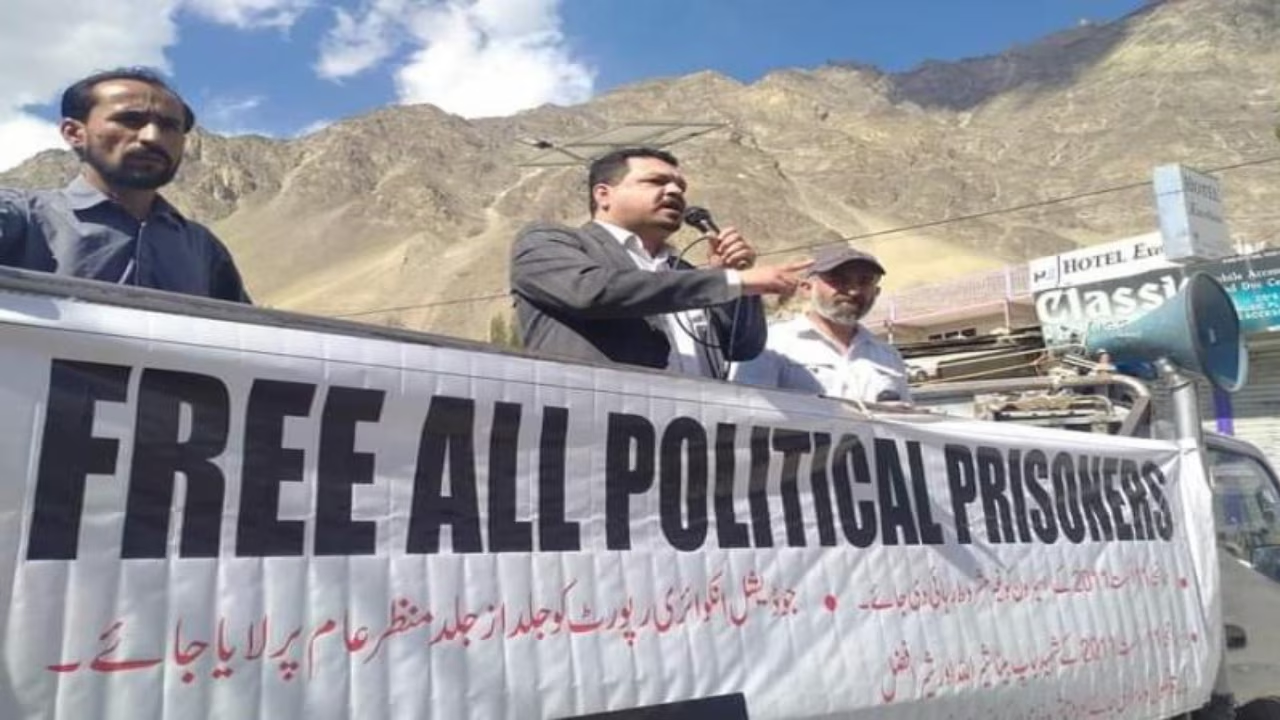
The Ministry further stated that fundamental issues in Gilgit-Baltistan and other Pakistan-occupied territories—including serious human rights violations, political repression, economic exploitation, and restrictions on people’s freedoms—cannot be concealed through electoral processes.
The statement said: “The Government of India categorically rejects all attempts by Pakistan to bring about any physical or administrative changes in the territories under its illegal occupation. Such actions cannot hide the reality that Pakistan continues its illegal occupation of Indian territories.”
At United Nations General Assembly
It is noteworthy that last year as well, India urged Pakistan to stop human rights violations in Pakistan-occupied Kashmir. Speaking at the United Nations General Assembly (UNGA), Bhavika Mangalanandan, First Secretary at India’s Permanent Mission to the UN, stated that people in Pakistan-occupied territories were openly protesting for their fundamental rights and freedoms but were being suppressed by the Pakistani military and its allied groups.
She told the United Nations that serious human rights abuses, military repression, and illegal exploitation of natural resources continue in Pakistan-occupied territories. India called on Pakistan to immediately stop such activities.
Mangalanandan also said that the participation of people in democratic elections in Jammu & Kashmir reflects the strength of India’s democracy and that Jammu & Kashmir and Ladakh are integral and inseparable parts of India.
India has also maintained that the 1948 resolution of the United Nations Security Council (UNSC) called on Pakistan to withdraw its military forces and citizens from Jammu & Kashmir. However, according to India, Pakistan continues to maintain illegal occupation over a portion of the region.
(With IANS inputs)