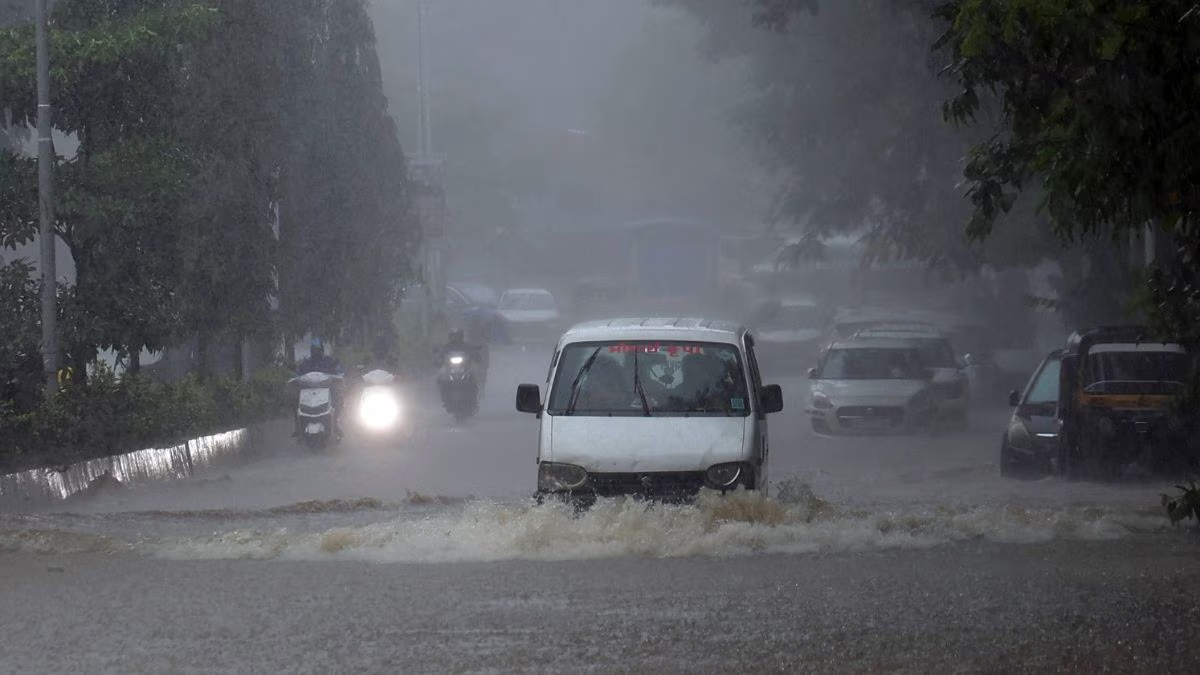
Incessant rainfall has been lashing Mumbai and Thane leading to waterlogging and road closures in many parts of the cities. India Meteorological Department has issued a red alert for rain. But, what is a red alert and how is it determined?
Published: July 4, 2026, 10:31 PM IST
Share Article
https://www.india.com/news/india/mumbai-weather-warning-what-triggers-red-alert-by-india-meterorological-department-monsoon-showers-8465605/
IMD has sounded the red alert in Mumbai and Thane following heavy rainfall. ANI
Mumbai and neighbouring Thane have been receiving heavy rainfall, leading to several low-lying regions getting flooded in the financial capital. Following the incessant rainfall, the India Meteorological Department sounded a red alert ranging from heavy to very heavy rainfall on July 5 across Mumbai, Thane and parts of the Konkan region.
Civic officials said that while the metropolis recorded over 100 mm of rain in several parts over the last 24 hours, public transport remains operational. Commuters, however, have reported delays in the suburban local train network throughout the day.
Most of us have heard of the red alert but remain clueless about what it is and how it is even determined. Here’s a look at it:
What is a red alert?
A Red Alert, the highest warning level issued by the India Meteorological Department (IMD), is reserved for the most severe weather events. It is issued for events such as extremely heavy rainfall, severe thunderstorms, cyclones or other hazardous weather that could cause widespread disruption, flooding, damage to infrastructure and risks to life and property.
The warning advises people to stay indoors unless absolutely necessary, follow official advisories and be prepared for emergency measures, including possible evacuations, road closures, transport disruptions and power outages.
How does IMD decide when to issue a red alert?
The weatherman issues a red alert based on the following data:
Decision matrix – The IMD determines the alert level by assessing two main factors, namely the probability of the weather event and the extent of its potential impact on the region.
Specific weather thresholds – Weather conditions like the intensity of the rainfall and thunderstorms play a key role in determining whether it is a red alert or not. A Red Alert is triggered when the IMD forecasts isolated extremely heavy rainfall, widespread heavy to very heavy rain, or additional heavy rainfall over areas that are already grappling with floods.
If heavy to very heavy rain occurs consecutively for two days and is expected to continue, the alert is upgraded to Red on the third day. Meanwhile, in case of thunderstorms, a red alert is issued for severe thunderstorms with wind speeds between 62–87 kmph or “very severe” storms exceeding 87 kmph, as well as storms accompanied by hail.
What is the process to issue an alert?
For cities like Mumbai, the IMD goes beyond rainfall forecasts by using Impact-Based Forecasting. Its i-Flows (Mumbai Flood Warning System) analyses local topography and land-use patterns to predict where and when heavy rain could cause flooding or waterlogging.
Firstly, forecasters continuously monitor real-time information from Doppler Weather Radars, satellite imagery and numerical weather prediction models to assess developing weather conditions. However, before finalising an alert, officials from the NDMA and MMDA State centers hold video conferences to discuss observations and remove any discrepancies in the forecast.
Notably, since a red alert requires a very high level of confidence, it is typically only issued for events expected within 24 to 48 hours.
How many millimeters of rain actually trigger a ‘red Alert’ compared to an orange or yellow alert?
While a red alert is triggered by extremely heavy rainfall, which is defined as 204.5 mm or more within 24 hours, an orange alert is issued very heavy rainfall, which is between 115.6 mm and 204.4 mm in 24 hours. Meanwhile, a yellow alert is triggered by heavy rainfall between 64.5 mm and 115.5 mm in 24 hours.
Schools across Mumbai, Thane remain closed
As heavy rain continued to lash the city, schools in Mumbai and Thane remained closed on Saturday. The civic body has urged Mumbaikars to step out of homes only if required. A spokesperson of the BMC said that the decision was taken keeping in mind the safety of students amid the forecast of extremely heavy rains. The BMC also appealed to citizens to step out of homes only if necessary as heavy rains continue to lash several parts of the city, he told PTI.