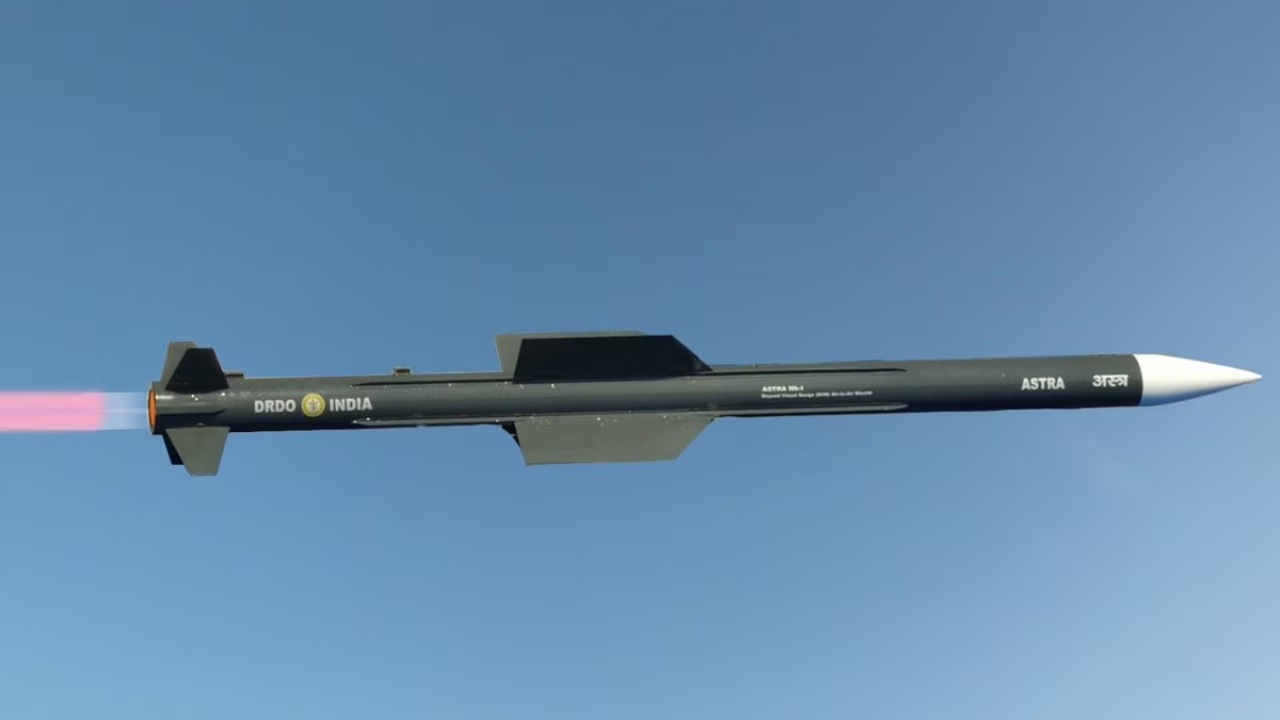
Indonesia is set to become the first foreign country to purchase India’s indigenous Astra Mk1 missile. But what exactly is a Beyond Visual Range Air-to-Air Missile (BVRAAM), and how does it shoot down enemy fighter aircraft without being visible to the naked eye?
Published: July 7, 2026, 4:20 PM IST
Share Article
https://www.india.com/news/india/what-is-beyond-visual-range-air-to-air-missile-indonesia-plans-to-buy-astra-mk1-which-can-target-enemy-aircraft-even-at-ranges-far-beyond-pilot-visual-range-8467763/
What is Beyond Visual Range Air-to-Air Missile? Indonesia plans to buy Astra Mk1 which can target enemy aircraft even at… (Pic: X)
India’s indigenous Astra Mk1 missile is going to get its first foreign customer. The United States is preparing to purchase this missile. The Astra Mk1 is a Beyond Visual Range Air-to-Air Missile (BVRAAM). This missile is capable of destroying enemy aircraft even at ranges far beyond the pilot’s visual range. This capability is considered a key strength in modern aerial warfare.
What is a BVRAAM?
The full name of BVRAAM is Beyond Visual Range Air-to-Air Missile. Beyond Visual Range (BVR) means a distance where the pilot cannot see the enemy aircraft with his naked eyes. Air-to-Air Missile means a missile launched from a fighter aircraft that targets another fighter aircraft. In simple words, this is a missile which attacks the enemy sitting at a distance without seeing him, only by detecting it with the help of radar and sensors.
How does a BVRAAM work?
If two fighter jets are 100 kilometers apart, the pilot would be unable to see the aircraft in front. However, the radar on modern fighter jets can detect the enemy. A BVRAAM, such as the Astra Mk1, is launched. In the initial phase, the missile is guided by the aircraft’s computer. In the final phase, the missile’s active radar seeker activates automatically. The missile then pursues its target and destroys it directly.
This is the reason why in today’s air battles, pilots often cannot even see each other and the fight ends.
What are the special features of the Astra Mk1?
Developed by the DRDO, the Astra Mk1 is India’s first indigenous BVRAAM. Its key features include:
Strike range up to approximately 110 km (depending on launch conditions) / Mach 4+, i.e., speeds exceeding four times the speed of sound / Equipped with Active Radar Seeker, capable of engaging targets even amidst electronic jamming / Capable of engaging high-speed fighter aircraft with a single missile / Day and night, all-weather operations
Which aircraft can it be launched from?
In the Indian Air Force, the Astra Mk1 is primarily integrated on the Su-30MKI + LCA Tejas. In the future, it may also be used on platforms such as the Tejas Mk1A, Tejas Mk2, Rafale (if integrated), and AMCA. Many countries have BVRAAMs today. USA – AIM-120 AMRAAM Europe – Meteor Russia – R-77 China – PL-15 India – Astra Mk1. The Astra Mk1 puts India in a select club of countries with the capability to develop and export their own state-of-the-art air-to-air missiles.
Why is this missile important for Indonesia?
Indonesia is a vast island nation with maritime and air borders stretching for thousands of kilometers. Therefore, it needs modern missiles capable of intercepting enemy aircraft from long ranges. The induction of the Astra Mk1 will provide the Indonesian Air Force with: long-range strike capability. The advantage of engaging enemy aircraft first. It will enhance its capabilities in modern aerial warfare.
Why is this a major achievement for India?
Indonesia’s decision to purchase the Astra Mk1 is not just a defense deal. It signals that India is no longer just an arms importer, but is also becoming a reliable exporter of cutting-edge missile technology. The first export of the Astra Mk1 is considered a major achievement for the Indian defense industry, DRDO, and the ‘Make in India’ campaign.