In simple words, delimitation is the process of redrawing Lok Sabha and Assembly constituency boundaries. Under delimitation, seats are redistributed among states based on Census data.
Share Article
https://www.india.com/news/india/delimitation-2026-explained-why-southern-states-are-concerned-about-losing-political-clout-8452148/
Delimitation 2026 Explained Why southern states are concerned about losing political clout
Delimitation 2026: Amid the ongoing debate over the Delimitation Bill, in which several southern leaders are sharing their views, with most of them raising concerns over losing political representation, the common man wants to know what exactly the Delimitation Bill 2026 or the Constitution (131st Amendment) Bill, 2026, is.
What Is Delimitation Bill 2026?
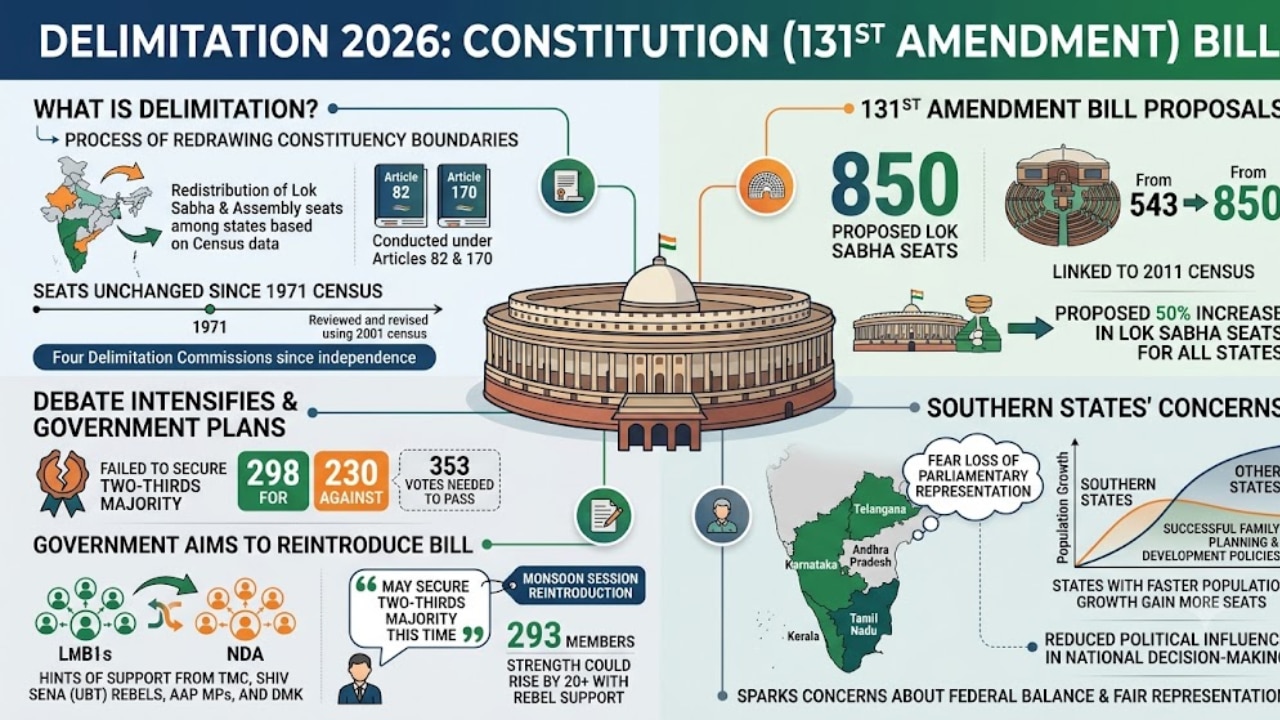
In simple words, delimitation is the process of redrawing Lok Sabha and Assembly constituency boundaries. Under delimitation, seats are redistributed among states based on Census data. The process is conducted under Articles 82 and 170 of the Indian Constitution.
Notably, the number of Lok Sabha seats remained unchanged since 1971 cesus. However, the constituency boundaries were later reviewed and revised using the 2001 census. The Delimitation Commissions have been constituted a total of four times since independence that too under different Delimitation acts.
131st Amendment Bill Proposes 850 Lok Sabha Seats, 2011 Census-Based Delimitation
Notably, the central government introduced the Constitution (131st Amendment) Bill, 2026 in April this year during the special session of the Parliament. It proposed expanding the Lok Sabha strength from 543 to 850 seats linking it to the 2011 census. The bill also proposed a 50 percent increase in Lok Sabha seats for all states.
However, the bill failed to secure the needed two-thirds majority mark. Out of 528 members, 298 supported the bill, while 230 opposed it. Notably, 353 votes of the members were needed to pass the bill in the lower house.
Delimitation Debate Set To Intensify As Government Plans To Reintroduce Bill
With the central government hinting that it is going to introduce the legislation again, the debate over it has intensified. The issue is politically sensitive in the southern states as the discussion is aimed at representation and women’s reservation.
Union Minister Ramdas Athawale has dropped a fresh hint that if some TMC and six Shiv Sena (UBT) MPs support the Bill and join NDA, boosting the ruling alliance’s numbers in the Lower House and paving the way for the saffron party to reintroduce the Bill in the Lok Sabha.
Athawale also claimed that several AAP MPs could also join the NDA. The recent breakup of the decade-long alliance of Dravida Munnetra Kazhagam (DMK) and the grand old party will also work in NDA’s favour.
“Six out of nine MPs have come with Eknath Shinde. This has increased the strength of our NDA and the Mahayuti in Maharashtra,” Athawale told news agency ANI on Wednesday.
“A very good thing has happened now: the DMK has broken its alliance with the Congress Party. Several MPs from Mamata Banerjee’s party have also joined us, and Lok Sabha members of the Aam Aadmi Party may also join us… The Modi government is going to pass the Delimitation Bill related to women’s reservation (Nari Shakti Vandan Adhiniyam). It will be passed, and I believe we can have a two-thirds majority this time,” he added.
As per several media reports, the central government is planning to reintroduce the delimitation bill in the upcoming Monsoon Session. Currently, the NDA has 293 members in the Lower House. It’s strength would rise by 20 with the support of TMC’s rebel MPs. The numbers could rise if another split happens in Shiv Sena (UBT).
The DMK, which has 22 members in the lower house, recently ended its alliance with the Congress and could also support the bill in Lok Sabha.
Southern States Fear Loss of Parliamentary Representation Under Fresh Delimitation Exercise
- Southern states fear that they could lose Lok Sabha seats after delimitation freeze ends in 2026.
- Southern states such as Tamil Nadu, Kerala, Karnataka, Andhra Pradesh and Telangana have recorded lower population as compared to other northeastern states. The reason is successful family planning and development policies.
- States with faster population growth could gain more seats under a population-based delimitation exercise.
- Southern states raised concerns that this could reduce their political influence in national decision-making.
The ongoing debate over the bill has also sparked concerns about maintaining the country’s federal balance and ensuring fair representation for all regions.