




Great Lakes Institute of Management, Gurgaon, through its Center of Excellence for Sustainable Development, hosted the Data, Governance & the SDGs: A Sustainability Symposium at India Habitat Centre, New Delhi, bringing together senior government leaders, industry executives, global institutions, researchers and policymakers to explore how data and artificial intelligence can accelerate India’s sustainable development agendaThe symposium marked the launch of three major knowledge initiatives the book Data Science for Sustainable Development Goals: Indian Case Studies, an ESG whitepaper developed with Development Alternatives and Pierag Consulting, and an open-source Sustainability Index developed by the institute’s Data Lab using satellite nightlight data, GHG emissions data and soil moisture data to map economic activity and regional development.
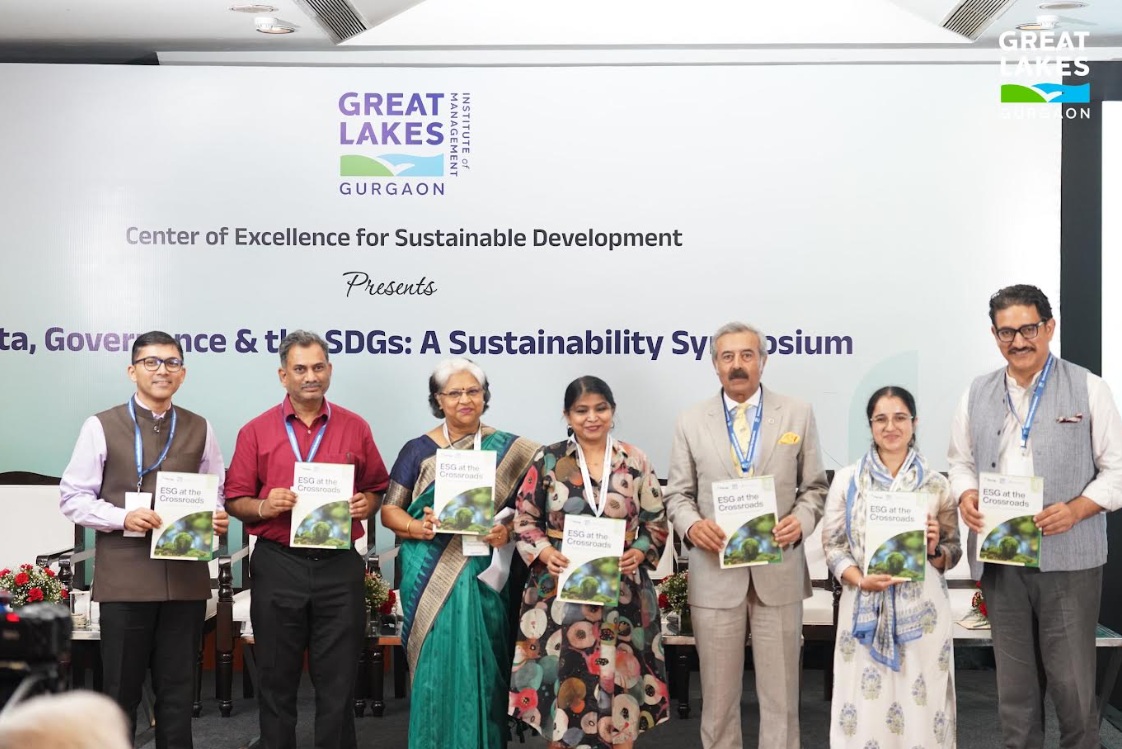 |
Great Lakes Institute of Management, Gurgaon hosts the Data, Governance & the SDGs: A Sustainability Symposium in New Delhi
The symposium was inaugurated by DrSaurabh Garg, Secretary, Ministry of Statistics and Programme Implementation, Government of India; MsEunsong Kim, Programme Specialist and Chief of Sector for Social and Human Sciences, UNESCO; and MsAnna Roy, Senior Advisor & Head, Women Entrepreneurship Programme, NITI Aayog.
Opening the symposium, DrSaurabh Garg emphasised the importance of making data more timely, granular and interoperable for effective policymaking“If data is too dated, no one wants to use itIt’s fresh data that everyone wants to use,” he said, adding that better data systems would be critical to making development decisions more targeted and effective as India works towards Viksit Bharat 2047.
MsEunsong Kim emphasised the need to ensure that technological progress contributes to inclusive and sustainable development“The question before us is not simply how much AI we can develop, but whether and how AI can accelerate progress towards the SDGs without reproducing and deepening existing inequalities,” she said.
The symposium also marked the launch of Data Science for Sustainable Development Goals: Indian Case Studies, edited by DrBappaditya Mukhopadhyay, Professor, Analytics, Great Lakes Gurgaon, and DrAvik Sarkar, Visiting Faculty & Senior Researcher, ISBThe book brings together Indian case studies demonstrating how data science can be applied to address development challenges and support evidence-based decision-making.
The event featured a session on data-driven governance, with experts from government, academia, philanthropy and civil society examining how data can improve public policy and service deliveryMsAnna Roy highlighted the need to make public data more accessible and usable, saying, “Data is a whole ecosystemWe get enamoured by the platforms and the nice tools, but we forget the tragedy of data collection and the drudgery of maintaining quality.”
The newly launched ESG whitepaper is based on a closed-door CXO roundtable held on May 22, 2026, on International Biodiversity Day, in collaboration with Development Alternatives and knowledge partner Pierag ConsultingThe subsequent ESG fireside chat, moderated by DrSanghamitra Bhattacharyya, Great Lakes Gurgaon, brought together Kunwar Himmat Singh, Director – Corporate Affairs, ESG & CSR, Nestle India, and ENagachandran, Deputy Director, Ministry of Corporate AffairsThe discussion examined the evolution of ESG beyond compliance and disclosure, with a focus on business resilience, responsible governance, sector-specific approaches and long-term value creation.
Kunwar Himmat Singh highlighted the growing business relevance of ESG, saying, “ESG is no longer a gesture of complianceIt is a business resilience agenda, it is about the very survival of an organization.” ENagachandran emphasised the need for a calibrated regulatory approach, noting, “You cannot have the same set of guidelines governing a company that manufactures plastic and one that mines coal.”
DrSanghamitra Bhattacharyya, Great Lakes Gurgaon, said: “The discussion reinforces the need for multiple actors to work in partnership national and civil society organisations, ministries and corporates so that we can work together in synergy to achieve these outcomes.”
The Sustainability Index, developed by the Great Lakes Gurgaon Data Lab, uses satellite data to map three indicators – nightlight, GHG emissions and soil moisture – with economic activity and regional development across IndiaThe underlying datasets and code have been made publicly available, enabling researchers and users to analyse other environmental indicators and contribute to the repository.
The symposium concluded with a panel on “Importance of Data in Driving Sustainability,” bringing together experts from academia, industry, government affairs and the energy and climate sector to discuss how reliable data can strengthen sustainability measurement and decision-making.
Through the symposium and its research initiatives, Great Lakes Gurgaon continues to build collaboration between academia, government and industry to apply data and technology to real-world sustainability and development challenges.
About Great Lakes Institute of Management, Gurgaon
Established in 2010, Great Lakes Institute of Management, Gurgaon is a premier business school dedicated to shaping business-ready leaders for the dynamic corporate landscapeIn 2019, Great Lakes Gurgaon received the AMBA UK accreditation and in 2026 it received the AACSB US accreditation – making it the youngest B-school in India to receive this ‘double crown’ of global accreditationsThe institute has swiftly risen to prominence by being the first in India to introduce full-time specializations in Analytics, AI, and Machine Learning, preparing professionals to lead effectively in today’s evolving global business environment
Learn more at www.greatlakes.edu.in./gurgaon.