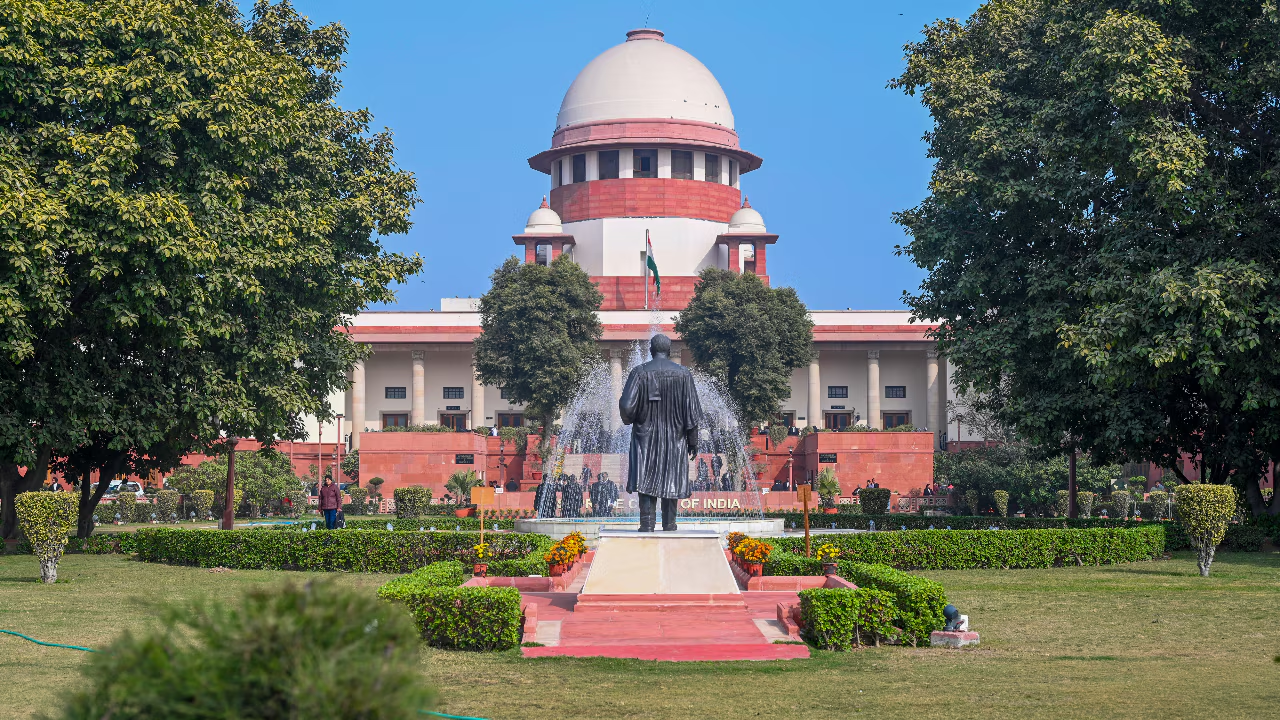
The Supreme Court has ruled that a married daughter cannot be denied consideration for ‘compassionate appointment’ simply because the state government’s policy restricts such appointments to only divorced daughters or those abandoned by their husbands.
Published: July 31, 2026, 7:05 PM IST
Share Article
https://www.india.com/news/india/big-ruling-by-supreme-court-married-daughters-cannot-be-excluded-from-compassionate-appointment-divorced-daughters-article-14-patna-high-court-bihar-8489501/
(File)
New Delhi: The Supreme Court has ruled that a married daughter cannot be denied consideration for ‘compassionate appointment’ simply because the state government’s policy restricts such appointments to only divorced daughters or those abandoned by their husbands. The Court stated that such a classification is unconstitutional and violates Article 14 of the Constitution.
Appeal against Patna High Court order
A bench comprising Justice MM Sundresh and Justice Prasanna B. Varale allowed the appeal filed by Saira Khatoon and her daughter. They had appealed against a Patna High Court order that upheld the rejection of the daughter’s claim for ‘compassionate appointment’ following her father’s death.
The appellants had challenged the Bihar government’s policy dated December 10, 2014, under which only a divorced daughter or one abandoned by her husband is considered eligible for ‘compassionate appointment’.
The state government had also rejected the claim on the grounds that the deceased employee’s brother had objected to the appointment.
What did the Supreme Court say?
However, the Supreme Court noted that the brother had already issued a ‘No-Objection Certificate’ and stated that “that ground for rejection no longer exists.”
Regarding the policy limiting ‘compassionate appointment’ to only divorced daughters or those abandoned by their husbands, the bench led by Justice Sundresh observed that any discrimination between sons and daughters in such matters is constitutionally impermissible.
The Supreme Court stated that it has repeatedly held that any classification distinguishing between a daughter and a son is inherently unconstitutional.
The Court further remarked that a classification limiting eligibility solely to divorced daughters or those abandoned by their husbands cannot stand the test of law. Rejecting the premise underlying the Bihar government’s policy, the Supreme Court stated that the law cannot presume that a daughter severs ties with her maternal home after marriage and resides solely with her husband at her matrimonial home.
The order noted that the appellant had specifically stated that, although her divorce had not received formal legal recognition, she was living with her maternal family and receiving support from her mother and brother.
The Bench observed that adopting an overly technical approach cannot be grounds for refusing to consider a claim for compassionate appointment.
Setting aside the Patna High Court’s order and the decision to reject the claim for compassionate appointment, the Supreme Court directed the Bihar authorities to reconsider the appellant’s case on its merits.
The Court directed the respondent (Bihar government) to consider the appellant’s case for compassionate appointment on its merits within eight weeks from the date of receipt of the order.
(With IANS inputs)