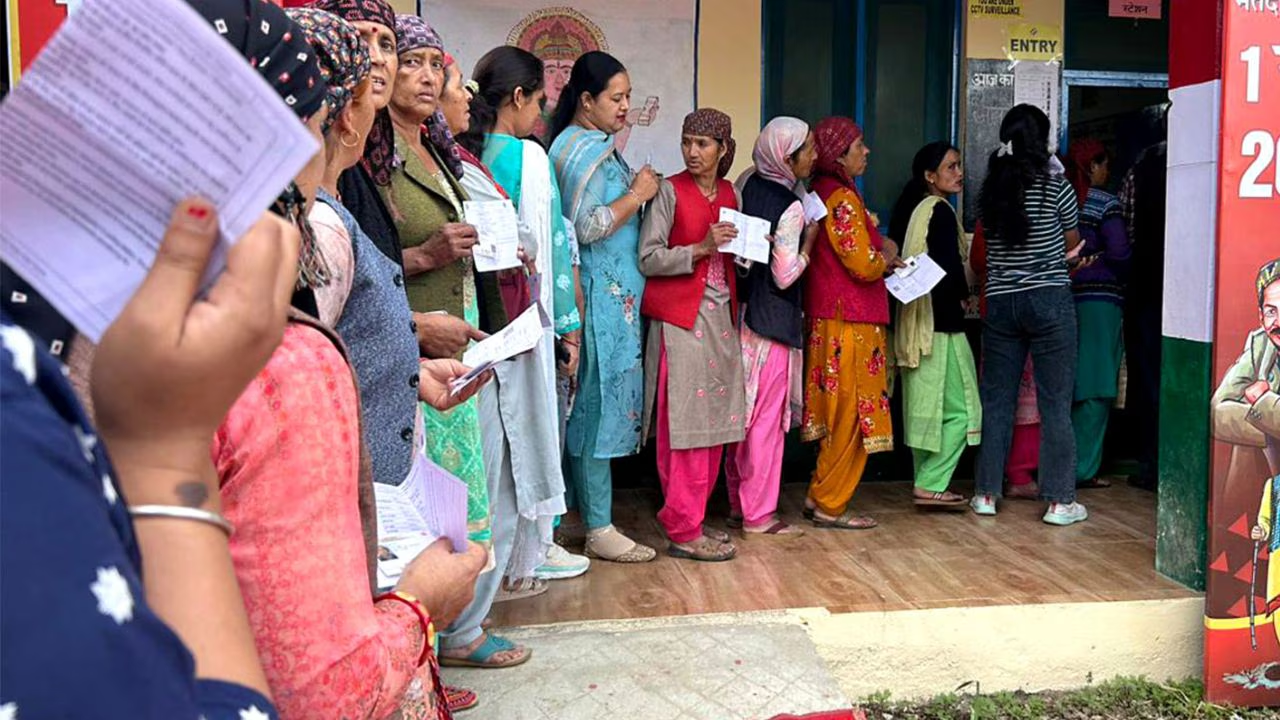
SIR is a participative exercise involving all stakeholders including electors, political parties and election officials.
Updated: June 13, 2026, 3:34 PM IST
Share Article
https://www.india.com/news/india/sir-in-focus-what-is-special-intensive-revision-manpower-states-covered-and-full-timeline-explained-8445140/
SIR in Focus: What Is Special Intensive Revision? Manpower, States covered and full timeline explained(Representational Image)
India, often regarded as the world’s largest democracy, is famous for its diverse culture, vibrant political system, and constitutional values that uphold freedom, equality, and justice. Recently, general elections were held in Assam, Kerala, Puducherry, Tamil Nadu, and West Bengal. Amid the election season, the word ‘ Special Intensive Revision (SIR)’ trended across social media platforms and news headlines. Several questions lingered in a common man’s mind regarding the Special Intensive Revision. In this article, we have provided you with the necessary details related to Special Intensive Revision.
What do you mean by Special Intensive Revision?
SIR is a participative exercise involving all stakeholders including electors, political parties and election officials. ECI requests all political parties to appoint BLAs for each Polling Booth, in order to ensure full participation of political parties so that SIR is conducted with complete transparency and full participation of political parties.
Read more:
Major relief for Khan Sir, Patna Civil Court stays his arrest, asks police for case diary
On May 14, 2026, the Election Commission of India(ECI), in exercise of its powers under Article 324 of the Constitution of India, Section 21 along with other applicable provisions of the Representation of the People Act, 1950, has ordered Special Intensive Revision (SIR) in 16 States and 3 Union Territories (UTs).
“No eligible citizen is left out while no ineligible person is included in the Electoral Roll,” is the key objective of the Special Intensive Revision. Every person who is a citizen of India and who is not less than eighteen years of age on the qualifying date and is not otherwise disqualified under any law shall be entitled to be registered in the electoral roll.
According to the press release published on May 15, during SIR, BLOs will conduct house-to-house enumeration. Every existing elector, whose name exists in the electoral roll, will be made available an Enumeration Form (in duplicate) through BLOs. The elector has to fill the enumeration form, filling his/her required details and has to return one copy to the BLO. Provision will also be given to electors to fill Enumeration Form online during the SIR period.
Enumeration Phase has started for the states of Odisha, Mizoram, Sikkim, and Manipur on 30.05.2026. All eligible electors whose Enumeration Forms are received by the Electoral Registration Officer (ERO) on or before June 28, 2026, will be included in the Draft Electoral Rolls. Electors who are unable to submit their Enumeration Forms by June 28, 2026, may apply through Form 6 along with the prescribed Declaration Form during the claims and objections period.
Both tables given below have been taken from the press release from the Press Information Bulletin(PIB) of the Election Commission.
| States/UTs
|
Qualifying date of SIR | Preparation, Training & Printing | House to House visits by
BLOs |
Rationalization of Polling Stations | Publication of draft Electoral roll | Period for filing claims & objections | Notice Phase/ disposal of Claims &
objection |
Publication of Final Electoral Roll |
|
01.07.2026 |
20.05.2026 to
29.05.2026 |
30.05.2026
to 28.06.2026 |
By 28.06.2026 |
05.07.2026 |
05.07.2026 to
04.08.2026 |
05.07.2026 to
02.09.2026 |
06.09.2026 |
|
5. DNH & DD |
01.07.2026 |
25.05.2026 to
03.06.2026 |
04.06.2026
to 03.07.2026 |
By 03.07.2026 |
10.07.2026 |
10.07.2026 to
09.08.2026 |
10.07.2026 to
07.09.2026 |
11.09.2026 |
|
6. Uttarakhand |
01.07.2026 |
29.05.2026 to
07.06.2026 |
08.06.2026
to 07.07.2026 |
By 07.07.2026 |
14.07.2026 |
14.07.2026 to
13.08.2026 |
10.07.2026 to
11.09.2026 |
15.09.2026 |
|
01.07.2026 |
05.06.2026 to
14.06.2026 |
15.06.2026
to 14.07.2026 |
By 14.07.2026 |
21.07.2026 |
21.07.2026 to
20.08.2026 |
21.07.2026 to
18.09.2026 |
22.09.2026 |
|
01.10.2026 |
15.06.2026 to
24.06.2026 |
25.06.2026
to 24.07.2026 |
By 24.07.2026 |
31.07.2026 |
31.07.2026 to
30.08.2026 |
31.07.2026 to
28.09.2026 |
01.10.2026 |
|
01.10.2026 |
20.06.2026 to 29.06.2026 |
30.06.2026
to 29.07.2026 |
By 29.07.2026 |
05.08.2026 |
05.08.2026 to 04.09.2026 |
05.08.2026 to 03.10.2026 |
07.10.2026 |
|
18. Nagaland |
01.10.2026 |
05.08.2026 to
14.08.2026 |
16.08.2026
to 14.09.2026 |
By 14.09.2026 |
20.09.2026 |
20.09.2026 to
20.10.2026 |
20.09.2026 to
18.11.2026 |
22.11.2026 |
|
19. Tripura |
01.10.2026 |
05.09.2026 to
14.09.2026 |
15.09.2026
to 14.10.2026 |
By 14.10.2026 |
21.10.2026 |
21.10.2026 to
20.10.2026 |
21.10.2026 to
19.12.2026 |
23.12.2026 |
Annexure-II
| Name of the State/UT | Number of
BLOs |
Number of BLAs | Electors (as on 12.05.2026) |
| Andhra Pradesh | 46,397 | 68,868 | 4,16,16,061 |
| Arunachal Pradesh | 2288 | 3131 | 8,87,607 |
| Chandigarh | 614 | 1143 | 5,18,663 |
| DNH & DD | 488 | 466 | 4,27,849 |
| Haryana | 20629 | 12917 | 2,06,63,155 |
| Jharkhand | 29571 | 21644 | 2,64,89,777 |
| Karnataka | 59050 | 25,284 | 5,55,74,064 |
| Maharashtra | 97924 | 96949 | 9,86,64,413 |
| Manipur | 2996 | 5003 | 20,91,999 |
| Meghalaya | 3551 | 0 | 23,43,252 |
| Mizoram | 1353 | 3430 | 8,75,004 |
| Nagaland | 2432 | 2623 | 13,56,858 |
| NCT of Delhi | 13026 | 28881 | 1,48,23,234 |
| Odisha | 38123 | 8391 | 3,34,33,659 |
| Punjab | 24453 | 8547 | 2,14,56,297 |
| Sikkim | 572 | 681 | 4,71,094 |
| Tripura | 3356 | 6757 | 28,97,674 |
| Telangana | 35985 | 25886 | 3,39,20,705 |
| Uttarakhand | 11733 | 21808 | 79,76,466 |
| Total | 3,94,541 | 3,42,409 | 36,73,87,831 |
In the first two phases of the SIR in 13 States/UTs covering nearly 59 crore electors as on the date of order of SIR in the respective States/UTs, over 6.3 lakh BLOs and 9.2 lakh BLAs appointed by political parties were involved in various stages of the SIR process.