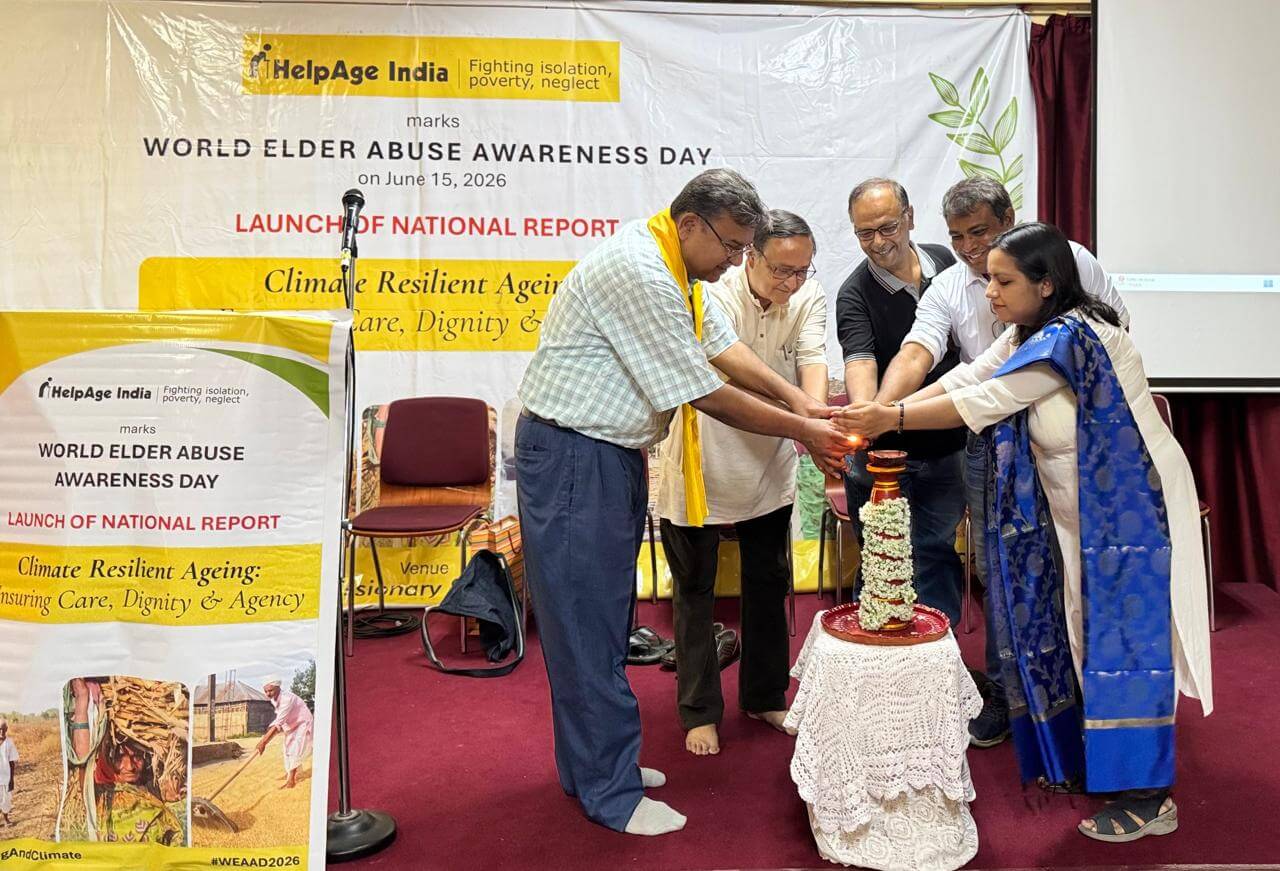
Marking ‘World Elder Abuse Awareness Day’ today, HelpAge India launched its firstof-its-kind landmark study – ‘Climate Resilient Ageing – Ensuring Care, Dignity & Agency’ at the India International Centre. The report was formally launched at an event with participation of key stakeholders including government, community, academia, and media, in the presence of Governing Body members, Mr. Kiran Karnik, Chairperson, Ms. Rumjhum Chatterjee, Vice Chairperson and Mr. Amarjeet Sinha also Former Secretary, Ministry of Rural Development, Government of India, as the Keynote Speaker. They were joined by special guest & distinguished artist Ms. Sharmila Tagore, HelpAge India’s Honorary Brand Ambassador.The national study covering 2,224 older persons across 20 districts in 10 states such as Andhra Pradesh, Bihar, Gujarat, Karnataka, Kerala, Madhya Pradesh, Maharashtra, Odisha, Tamil Nadu, and Uttarakhand, reveals the profound impact of climate change on India’s rural ageing population and how disadvantaged older persons are facing significant multiple high-risk challenges. Following the Intersectional Place Perspective (IPP) framework,it highlights that climate vulnerability among older persons is shaped not by age alone, but by an intersection of multiple factors, including gender, impairment & mobility, poverty, living arrangements and geographic location.A significant 78% of respondents experienced at least one climate-related hazard in the last three years -Heatwaves (45%), floods (27%) and droughts (20%) were the most commonly reported hazards. More than one-third of those exposed, reported moderate to severe impacts on their lives. Older persons living alone(13%), widows (33%), those aged 80 and above (28%), and older persons with cognitive, communication or mental health difficulties (12%) face disproportionately greater challenges and risks.”Older persons are among those most at risk from rising climate shocks, particularly those living alone or withimpairments, and yet they remain largely invisible in climate response efforts. Climate impacts extend far beyond physical hazards, affecting health, income, housing, care and social wellbeing. While most older persons are doing their best to cope, age-related challenges whether physical, financial or social, often limit their ability to prepare for, withstand or recover from such climate episodes, weakening their agency and resilience. While government schemes provide a critical safety net, a more multi-pronged approach is needed with targeted interventions at household, community and institutional levels, alongside improving access to welfare schemes. Integrating ageing into climate adaptation, climate financing, elder-centric disaster risk reduction and social protection policies is essential,” says Rohit Prasad, CEO, HelpAge India.Heat stress poses major challenges for older persons, especially those in kutcha or poorly ventilated houses, with 60% reporting their homes not fully safe. While most affected by heatwaves stay indoors (90%) and increase water intake (81%), illness still rises (74%), existing conditions worsen (44%), and healthcare access becomes difficult (33%). Vulnerabilities are compounded for older age 80+, widows, and those with cognitive or mobility difficulties, face overlapping economic, social, health, and environmental disadvantages. Household coping strategies include reducing water use (73%), storing water (58%), shifting livelihood activities (42%), and buying water externally (32%). On the health front, nearly half live with long-term impairments, mainly mobility (32%) and vision (24%). Yet many struggle to access essential healthcare, with more than half (52%) unable to afford medicines.Government facilities remain the backbone of healthcare provision, with Primary Health Centres (51%) and government hospitals (49%) being the most commonly accessed services.Family remains the cornerstone of support for most older persons in India, with 73% living with children or relatives, and 94% who need care receive it from family members. Sons (31%), spouses (30%), and daughters-in-law (17%) provide the majority of caregiving, though patterns differ by gender: nearly half of older men are cared for by their spouse, while widowed women rely primarily on children
This dependence increases with age but is strained by migration, as 18% of households report a family member moving away for work. Sons account for the majority of these migrants (76%), potentially reducing the availability of family-based care and support for older persons. For respondents living alone, care arrangements are particularly fragile: 38% depend on neighbours, 20% on distant family, and 16% receive no care at all, leaving them more vulnerable to loneliness, poor healthcare access, and reduced resilience during climate shocks.“This report highlights the intersection of ageing and climate change. Repeated climate hazards disproportionately impact older persons – especially women, widows, those living alone, the impaired, and the oldest old. A large segment, already disadvantaged by low education, savings, and poor health, relies heavily on welfare and family support. Older women shoulder multiple burdens, from caregiving to securing water and income. In such contexts, accessible essential services are not just critical – they are vital for survival,” says Anupama Datta, Head – Policy Research & Advocacy, HelpAge India.Community support & networks on the other hand, though much desired, is limited. Only 33% report that community support is always available when needed, while 25% say support is rarely or never available. Economic security is fragile: 55% have no agricultural land, pensions are the main income for nearly half (49%), yet many continue working in self-cultivation (25%), agricultural labour (13%) or non-agricultural labour (12%).Alarmingly, 16% have neither work nor income and as age increases, active participation in farming and wage labour declines, while the proportion with no work and no income rises from 11% among those aged 60–69 to 21% among those aged 80+, increasing economic risk in later life. Awareness of government welfare schemes is high, particularly PDS (93%), pensions (71%), subsidised healthcare (67%) and housing support (62%), with 65% finding access easy and most of them receiving benefits regularly. Pensions, PDS and Ayushman Bharat–PMJAY together strengthen financial, food and healthcare support. Access is particularly challenging for older persons with poor health (30%), those severely affected by climate-related shocks (30%), with no formal education (22%), and from lower socio-economic groups (22%). Additional challenges include, long waiting times and delays (25%), digital access difficulties (15%), and lack of support during the application process (10%), highlighting the need for more age-friendly service delivery.Drawing on his on-ground experience as HelpAge’s Mission Head – Livelihoods & Resilience, Girish Mishra says,”Climate change is increasingly affecting the health, livelihoods, care and dignity of older persons in rural India.While our field experience shows that older persons are grappling with these challenges, it also highlights their role as part of the solution and their untapped potential to contribute more. They support communities to respond through their knowledge, traditional wisdom, experience, and collective action. Elder-Self-Help-Groups (ESHGs) and other community institutions, play a vital role in helping older persons access support and participate in local solutions. Building climate resilience is not just about protecting older persons from risks, it is about recognising their strengths and empowering them to continue contributing to stronger and more resilient communities.”Call to Action: As we collectively face the intersecting realities of climate change and population ageing, the study highlights that resilience cannot be built through climate action alone. It calls for strengthening the capacities and agency of older persons, ensuring their voices are included in climate adaptation and disaster risk reduction efforts, and prioritising support for those facing the greatest disadvantage. Equally important is investing in the family, community and institutional systems that older persons rely on, while strengthening health services, care networks and social protection. Together, these measures will be critical to ensuring that older persons can age with dignity, security and resilience in an ever-changing climate.About HelpAge IndiaHelpAge India is a leading non-profit organization working with and for older people in India for the past 48 years. It runs healthcare, age care, livelihood, disaster response and digital empowerment programs throughout the country & strongly advocates for the older persons, working collaboratively with stakeholders. It became the first and only Indian organization to be honored with the ‘UN Population Award 2020’ for its exemplary work in the field of ageing and population issues, and earlier in 2014, has been the recipient of ‘Vayoshreshtha Samman’ by Government of India as an institution working for senior citizens.Elder ‘Voices from the Ground’ (film link) I For more details visit HelpAge India
This dependence increases with age but is strained by migration, as 18% of households report a family member
moving away for work. Sons account for the majority of these migrants (76%), potentially reducing the
availability of family-based care and support for older persons. For respondents living alone, care arrangements
are particularly fragile: 38% depend on neighbours, 20% on distant family, and 16% receive no care at all, leaving
them more vulnerable to loneliness, poor healthcare access, and reduced resilience during climate shocks.
“This report highlights the intersection of ageing and climate change. Repeated climate hazards
disproportionately impact older persons – especially women, widows, those living alone, the impaired, and the
oldest old. A large segment, already disadvantaged by low education, savings, and poor health, relies heavily on
welfare and family support. Older women shoulder multiple burdens, from caregiving to securing water and
income. In such contexts, accessible essential services are not just critical – they are vital for survival,” says
Anupama Datta, Head – Policy Research & Advocacy, HelpAge India.
Community support & networks on the other hand, though much desired, is limited. Only 33% report that
community support is always available when needed, while 25% say support is rarely or never available.
Economic security is fragile: 55% have no agricultural land, pensions are the main income for nearly half (49%),
yet many continue working in self-cultivation (25%), agricultural labour (13%) or non-agricultural labour (12%).
Alarmingly, 16% have neither work nor income and as age increases, active participation in farming and wage
labour declines, while the proportion with no work and no income rises from 11% among those aged 60–69 to
21% among those aged 80+, increasing economic risk in later life.
Awareness of government welfare schemes is high, particularly PDS (93%), pensions (71%), subsidised
healthcare (67%) and housing support (62%), with 65% finding access easy and most of them receiving benefits
regularly. Pensions, PDS and Ayushman Bharat–PMJAY together strengthen financial, food and healthcare
support. Access is particularly challenging for older persons with poor health (30%), those severely affected by
climate-related shocks (30%), with no formal education (22%), and from lower socio-economic groups (22%).
Additional challenges include, long waiting times and delays (25%), digital access difficulties (15%), and lack of
support during the application process (10%), highlighting the need for more age-friendly service delivery.
Drawing on his on-ground experience as HelpAge’s Mission Head – Livelihoods & Resilience, Girish Mishra says,
“Climate change is increasingly affecting the health, livelihoods, care and dignity of older persons in rural India.
While our field experience shows that older persons are grappling with these challenges, it also highlights their
role as part of the solution and their untapped potential to contribute more. They support communities to
respond through their knowledge, traditional wisdom, experience, and collective action. Elder-Self-Help-Groups
(ESHGs) and other community institutions, play a vital role in helping older persons access support and
participate in local solutions. Building climate resilience is not just about protecting older persons from risks, it is
about recognising their strengths and empowering them to continue contributing to stronger and more resilient
communities.”
Call to Action: As we collectively face the intersecting realities of climate change and population ageing, the
study highlights that resilience cannot be built through climate action alone. It calls for strengthening the
capacities and agency of older persons, ensuring their voices are included in climate adaptation and disaster risk
reduction efforts, and prioritising support for those facing the greatest disadvantage. Equally important is
investing in the family, community and institutional systems that older persons rely on, while strengthening
health services, care networks and social protection. Together, these measures will be critical to ensuring that
older persons can age with dignity, security and resilience in an ever-changing climate.
About HelpAge India
HelpAge India is a leading non-profit organization working with and for older people in India for the past 48 years. It runs
healthcare, age care, livelihood, disaster response and digital empowerment programs throughout the country & strongly
advocates for the older persons, working collaboratively with stakeholders. It became the first and only Indian organization
to be honored with the ‘UN Population Award 2020’ for its exemplary work in the field of ageing and population issues, and
earlier in 2014, has been the recipient of ‘Vayoshreshtha Samman’ by Government of India as an institution working for
senior citizens.
Elder ‘Voices from the Ground’ (film link) I For more details visit HelpAge India